


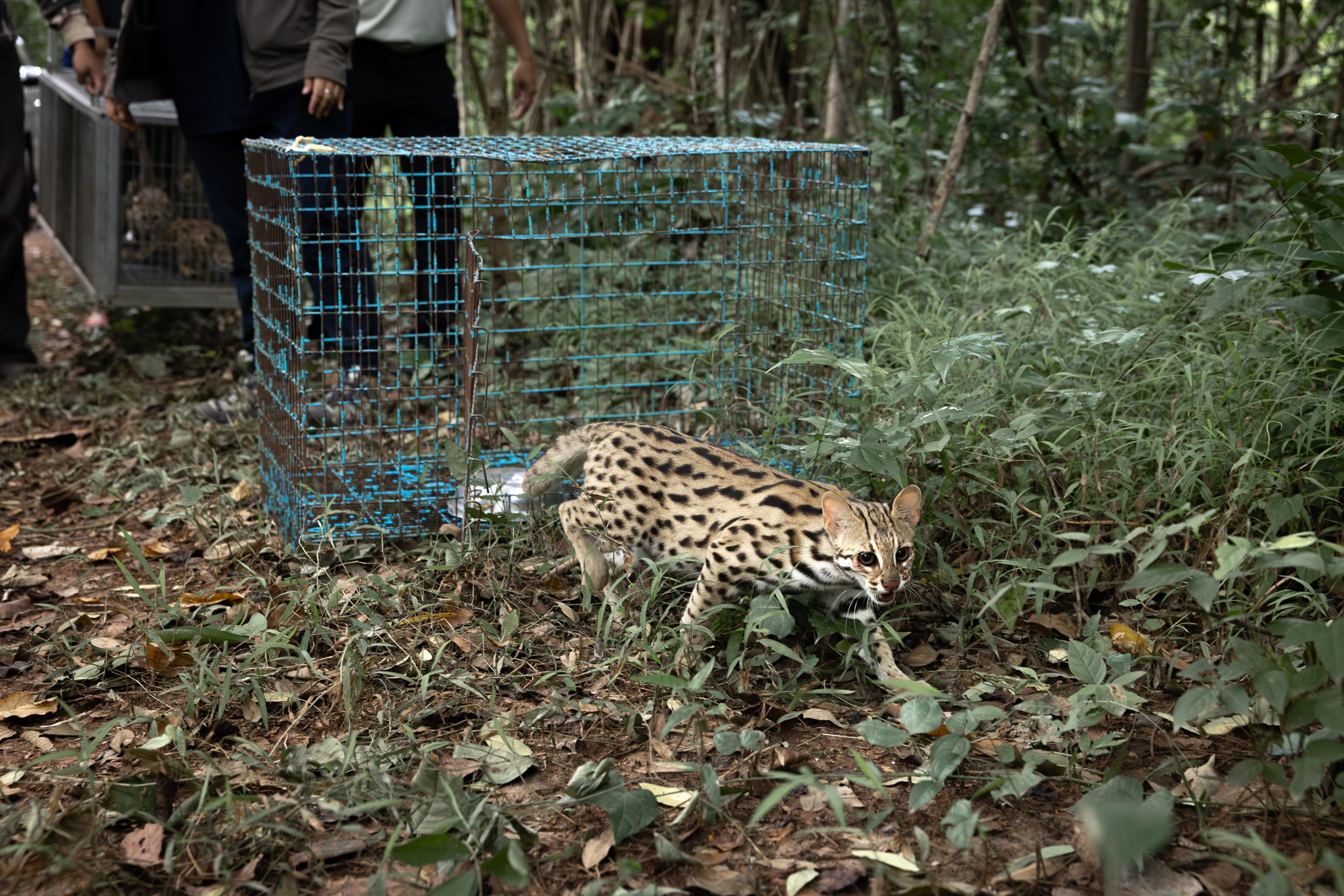
- A government-run wildlife rescue center in northeastern Thailand rehabilitates and releases dozens of leopard cat cubs every year.
- Rescue numbers have risen sharply since 2023, a trend staff at the center attribute to a combination of worsening habitat fragmentation, fire activity and increased use of a government hotline.
- Although the center can monitor camera traps for footage of released cats, they currently have no way to be certain how many of the cats survive after release.
KHON KAEN, Thailand – A wildlife officer holds a leopard cat cub in one hand, its entire body small enough for her fingers to wrap around its torso. With the other hand, she feeds it formula milk from a syringe. This is the latest rescue at the Department of National Parks and Wildlife’s rescue center in Khon Kaen, northeastern Thailand, which rehabilitates and ultimately releases dozens of lost and injured leopard cat cubs every year.
Behind the officer, 15 larger leopard cats (Prionailurus bengalensis), rescued as young cubs months earlier, pace around inside their cages. They look a lot like domestic cats, only slightly more slender and with sharply defined markings on their fur; unlike domestic cats, they bare their teeth and growl whenever a human walks past.
Nine of the cats, between 8 and 9 months old, will be released in the forest that afternoon. The other six, a younger cohort, will take their place in the center’s specialized behavioral rehabilitation pens, where they will spend two months practicing their climbing and hunting skills in preparation for life in the wild.
Leopard cats are small wild felines common across much of Asia. The IUCN classes them as least concern, though experts believe populations are increasingly vulnerable to hunting and habitat loss.
Highly adaptable to changing landscapes, leopard cats often live close to farms and villages. In northeastern Thailand, females are frequently found raising their litters in sugarcane fields. The tall leaves offer shelter from the sun, but proximity to humans exposes the cats to threats ranging from capture for the illegal trade to fires caused by agricultural burning — a traditional method used by farmers to clear fields and control pests.
Since 2023, the center says it has admitted between 40 and 65 leopard cats each year, up from an annual average of around 10 before that. Staff attribute the increase to a combination of worsening habitat fragmentation, rising fire activity and greater public use of the government’s wildlife hotline.
It is not unusual for farmers to find sick or lost leopard cat cubs in and around their fields, particularly during the burning season, which spans from January to April. Following recent government regulations on agricultural burning, fire rates on agricultural land in the northeast appeared to decline slightly this year. Yet overall fire activity increased this burning season, driven largely by forest fires. Between January and August 2026, the center admitted more than 60 leopard cat cubs from all over the region. According to the team, over half were found in charred fields, often with burn injuries.
From rescue to rehabilitation
When cubs arrive at the center, the team focuses on stabilizing their health, treating injuries, infections and nutritional deficiencies. Twenty of the 60 cubs admitted this year did not survive, either because their injuries were too severe or because they arrived at the center too late. According to the center, this is a lower mortality rate than in previous years — around 33% compared to 60%.
“Many of the cubs that didn’t survive were brought by people who tried to take care of them at home,” says researcher and veterinarian Warisara Thomas. Not only is this illegal, says Warisara, but it also rarely turns out well for the cubs, which require highly specialized diets and care, and are vulnerable to diseases that can be transmitted by domestic animals.
Because most rescues are very young on arrival, they need to be hand-fed formula milk several times a day, before gradually transitioning to solid food. Once the cubs have weaned, they are transferred to cages or small enclosures until they can begin behavioral rehabilitation. Owing to the large number of rescues and limited space, some cats spend several months waiting for a place in the rehabilitation pens. Before entering, the leopard cats undergo a full health check and are tagged with microchips. This is their final health check before release.

At the center, Warisara opens a cage and reaches inside, gently grabbing a limp leopard cat by the scruff. Just minutes before, the same cat was threatening to bite her. Now, the sedative injected by the veterinary team has taken effect.
One after the other, veterinarians measure the six cats’ weight and length, draw their blood and swab their noses to test for diseases, including for feline immunodeficiency virus, parvovirus and canine distemper virus.
“We are being very careful as we really want to avoid introducing new diseases into the wild population,” Warisara says.
To keep track of the cats’ identities, the vets then photograph each cat from different angles and use a large needle to implant a microchip in the back of its neck. After a shot of vitamins, they are returned to their individual cages before the sedatives wear off, ready to be transported to the rehabilitation pens. Each pen measures around 24 square meters (258 square feet) and houses two cats. The enclosures are designed to mimic natural habitat, with plenty of vegetation, tree trunks for the cats to practice climbing and dark nooks where they can hide and rest.
After months confined to smaller enclosures, the cats’ muscles are weak. As most were separated from their mothers at a young age, they never learned essential survival skills such as finding their own food. To stimulate the cats’ hunting instincts, staff let live chicks and mice into the pens.
“At the beginning, some are really good at hunting, but there’s a few that are afraid of the chicks,” says Warisara, with a chuckle. Over time, the more timid cats learn by copying their pen-mates. In the meantime, their diet is supplemented with meat.
Hunting is only one aspect of becoming wild — it’s also important to teach them to distrust humans, says Warisara, so they do not return to the center and avoid the risks associated with approaching people. During the rehabilitation phase, the cats have little direct contact with staff except when they are being trapped for their health check or for transportation. “They learn to associate humans with negative experiences,” she says.


Ready for release
Staff watch the cats remotely, using cameras installed inside the pens. They look for cats that are actively hunting, climbing and behaving normally before deciding they are ready for release. The group released today will be the third release of 2026.
Wherever possible, staff try to release the cats close to their area of origin. However, for practical purposes most are released into a nearby forest in Phu Pha Man National Park, a protected area just a few minutes’ drive from the rescue center.
“Leopard cats are really adaptable, but we look for protected forests and make sure that the elevation is not too high,” Warisara says.
There must also be enough food waiting for them. “We’ve analysed the scat of wild leopard cats inside the park, and found traces of rodents, amphibians and birds such as jungle fowl,” she adds. Before every release, the staff use live traps to survey the abundance and condition of these prey species, then release them back into the forest.
“This area can hold just a few more releases,” says Nuntita Ruksachat, head veterinarian at the center. “We are studying the suitability of other areas.”

While the team uses camera traps to monitor the activity of released leopard cats and microchips to identify them if they end up back at the clinic, they currently lack the technology to track the movements of individual animals through the forest.
“We can see footage of leopard cats carrying prey and looking healthy,” Warisara says. “But it’s difficult to keep track of individuals because they are nocturnal and the footage is often not sharp enough to identify them by their markings.”
This means the center does not know how many leopard cats survive after release. Next year, if they have enough funds, the team plans to fit the cats with GPS collars to track their individual movements through the forest.
“We are still looking for the right kind of collar,” Warisara says. It needs to remain securely attached to the necks of these small animals while maintaining a reliable signal. When the team previously released collared jackals into the same area, for example, the signal disappeared as the animals ventured deep into the forest.
Speaking about survival rates in small cat releases, Jim Sanderson, founder and director of the Small Wild Cat Conservation Foundation and member of the IUCN Species Survival Commission Cat Specialist Group, says a soft release, “where the cats know where to find food but are otherwise free to hunt on their own,” is “absolutely vital” to help them avoid starving. Without it, he says, “their chances of survival are slim.”
The cats that already live in the forest present another threat. Females have a better chance of survival, Sanderson says, whereas new males may be driven away or killed by the resident males. “That’s the way nature and real life is,” he says. “Nasty, brutish, and sometimes very short.”

Warisara describes the rehabilitation pens as a form of soft release — a gradual step between captivity and the forest, where leopard cats learn how to hunt live prey. “Ideally, these pens would be inside the forest, but this is what we have available,” she says. In her ideal setup, the pens would be left open for a few weeks so the cats could come and go. The center is aware of the limits of what it can do, she says, but works with limited resources and capacity.
At the release site, the team unloads nine cages from the pickup truck and lines them up in a straight line. Inside are the nine cats from the oldest cohort. The veterinary staff have raised them since they were small cubs, and the cats have spent the past two months in the behavioral rehabilitation pens.
Standing behind the cages, officers open the doors and wait. One by one, the cats cautiously approach the edge of their cages, sniffing the air and the soil before stepping out. Some need a little encouragement, so the officers gently shake their cages. Once outside, they move quickly, slithering to the side of the path and disappearing into the thicket. Soon all nine cages are empty. The center staff share brief congratulatory glances before resuming their work. They load the cages back onto the vehicle and return to the center, where the recently rescued newborn cub needs to be fed again.
“The cycle never stops,” Warisara says.
Banner image: A leopard cat steps out of its cage and into the forest in Phu Pha Man National Park, northeastern Thailand, after several months in the care of the Khon Kaen wildlife rescue center. Image by Ana Norman Bermúdez for Mongabay.
In Thailand, burned sugarcane plantations become traps for leopard cat cubs
Rescue networks built by fire: Saving animals from Australia’s bushfires
Cite this article
Ana Norman Bermúdez (2026). ‘A few are afraid of the chicks’: Preparing Thailand’s rescued leopard cats for life in the wild. Mongabay Conservation news. DOI: https://doi.org/10.66709/news-331841

