



A crypto ETF can arrive with substantial assets before public trading reveals much about outside investor demand. That makes a rising launch benchmark important for ETF sponsors and easy to misread as a market verdict.
Bloomberg ETF analyst Eric Balchunas said on Sept. 15 that average day-one ETF assets had roughly doubled over five years. He also said he was hearing from white-label issuers that $100 million had become the new bar, an observation he attributed to Athanasios Psarofagis.
The cited post shows the benchmark is circulating among ETF professionals, but it doesn’t include the underlying comparison.
A fund’s opening assets can include sponsor or affiliate seed arranged before listing, and authorized participants can later create or redeem blocks of shares in the primary market. Investors can trade existing shares in the secondary market without changing the fund’s share count, and the value of the crypto portfolio can move AUM even when capital activity is flat.
The Investment Company Institute’s description of ETF mechanics draws those boundaries directly. They turn “day-one size” into a mixture of sponsor preparation, primary-market activity and asset prices, depending on the fund and the chosen cutoff.
The crypto ETF launch number contains different kinds of capital
Four recent crypto products illustrate the accounting differences. The entries use different dates and filing measures, and TKNZ’s operational seed was prospective when disclosed.
| Fund | Affiliate or prelisting seed | Later filing measure | Observation date and status |
|---|---|---|---|
| T. Rowe Price Active Crypto ETF (TKNZ) | $20,000 of completed initial seed plus $14.98 million of expected operational seed, for an expected $15 million total | The prospectus still described the operational seed as expected | Prospectus dated June 18; trading began July 16, 2026 |
| Fidelity Solana Fund (FSOL) | 200,000 shares at $25 each, or $5 million, purchased Sept. 24, 2025 | 7.775 million shares and $120.038 million of paid-in capital | $113.949 million of net assets at Dec. 31, 2025 |
| Franklin Solana ETF (SOEZ) | Cash seed transaction used to buy 17,000 SOL worth $2,323,133.80 on Nov. 25, 2025 | $9,776,591 of filing-reported share contributions | $9,365,055 of net assets at March 31, 2026 |
| Bitwise Dogecoin ETF (BWOW) | $2.5 million affiliate purchase before trading began in November 2025 | No creations in the first half of 2026; an aggregate 20,000 shares redeemed | $473,547 of net assets at June 30; closure announced Sept. 10 |
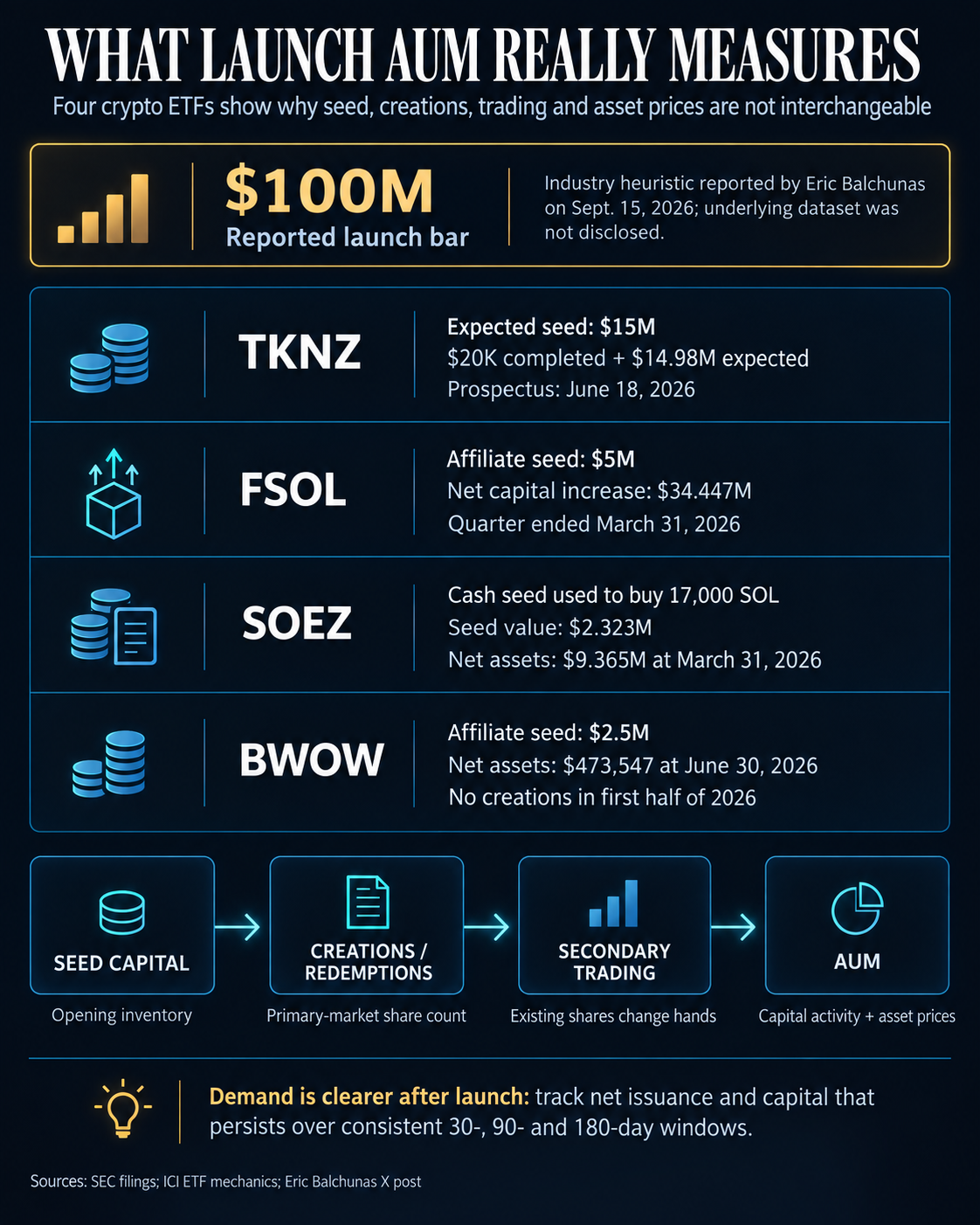
T. Rowe Price’s TKNZ prospectus provides the cleanest example of launch preparation. The sponsor and an affiliated administrator had purchased $20,000 of initial seed. They were expected to add $14.98 million of operational seed for an expected $15 million total, with the proceeds intended to acquire eligible assets at or before listing.
That capital could make the fund appear larger at launch without demonstrating outside demand. The filing also described seed-investor activity separately from the authorized-participant function.
Fidelity’s filings then show the signal that can emerge after seed. Sponsor affiliate FMR Capital bought FSOL’s seed basket on Sept. 24, 2025, paying $25 each for 200,000 shares. By Dec. 31, the fund reported 7.775 million shares outstanding, $120.038 million of paid-in capital, and $113.949 million of net assets in its annual filing.
The first quarter of 2026 separated capital activity from portfolio value even more sharply. FSOL issued $48.548 million of shares, redeemed $13.416 million and made $685,000 of shareholder distributions.
Those entries resulted in a $34.447 million net capital increase, and net assets still fell to $97.449 million as SOL declined.
Franklin Templeton’s Solana product took a different path. An affiliate completed a cash seed transaction whose proceeds funded the purchase of 17,000 SOL worth $2,323,133.80 before the fund began trading.
Through March 31, 2026, SOEZ recorded $9,776,591 of share contributions and ended with $9,365,055 of net assets, according to the Franklin filing. Investment performance brought the ending asset figure below the capital contributed over the period.
BWOW supplies the weakest post-launch capital record in this group. A Bitwise affiliate funded a $2.5 million initial basket before trading began in November 2025. By June 30, 2026, BWOW’s quarterly report showed $473,547 of net assets and 40,000 shares outstanding. The fund recorded no creations during the first half of 2026, while an aggregate of 20,000 shares were redeemed.
Dogecoin depreciation also reduced the portfolio’s value, so the AUM decline reflects both investor activity and market performance. The absence of creations provides clearer evidence of weak follow-through.
Bitwise Investment Advisers decided on Sept. 10 to close, delist, and liquidate BWOW. Trading is scheduled to stop before the market opens on Oct. 15.
Measure demand after the opening capital
ICI identifies net issuance, meaning shares created less shares redeemed, as one way to track ETF demand.
Conversions and reinvestment can affect issuance, while secondary trading can prompt authorized participants to create or redeem shares. Fees, distribution reach, product overlap, and the underlying asset’s performance shape what happens after listing.
A useful comparison would set the same observation windows for every launch. It would identify sponsor and affiliate seed at listing, exclude converted legacy assets where the question is new demand, measure creations and redemptions after trading begins, and separate capital activity from changes in the underlying portfolio’s value.
Persistence could then mean the shares and outside capital remaining after a disclosed interval, such as 30, 90, or 180 days.
That framework would also prevent trading volume from standing in for flows. Heavy secondary-market turnover can show liquidity and attention even as the same shares change hands. Primary-market share creation changes the fund’s capital base.
The four products here make the ambiguity visible without resolving the broad industry benchmark.
TKNZ disclosed a planned launch balance largely built from affiliated seed, FSOL’s later share count and paid-in capital showed substantial post-seed issuance, SOEZ recorded additional contributions at a smaller scale, and BWOW showed no new creations in the first half of 2026 before its sponsor chose to close it.
The products differ by asset, sponsor, distribution, and age, and their filings cover different windows.
For crypto sponsors, a $100 million launch bar may function as a balance-sheet and distribution hurdle: enough committed capital to support liquidity, visibility and operating runway. For investors, launch AUM remains an opening condition.
The stronger verdict arrives over time, through creations, redemptions, and capital that persists after the seed has entered the market.
