


Tiny particles from space are passing through Earth all the time, even though we cannot see, hear, feel, taste, or smell them.
Many of these particles are linked to cosmic rays, extremely energetic particles that can come from exploding stars and other violent events far beyond our solar system. When cosmic rays strike atoms high in Earth’s atmosphere, they create showers of secondary particles. Among them are muons, which can travel through the atmosphere and even penetrate underground.
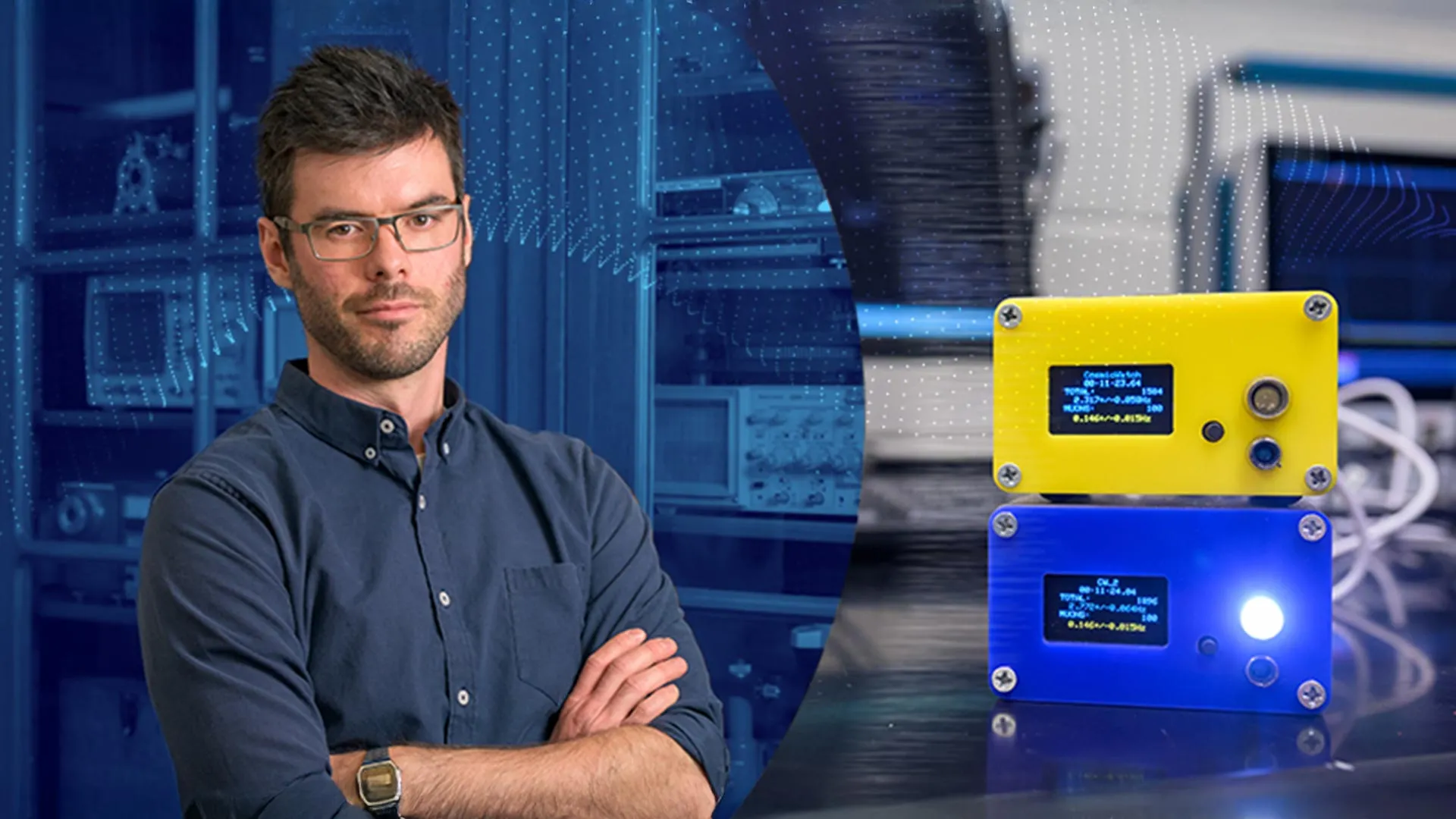
University of Delaware physics professor Spencer Axani has developed a device called CosmicWatch that makes it much easier to detect these otherwise invisible particles. The technology is now being used by everyone from high school students to professional researchers.
A $100 Detector for Invisible Cosmic Particles
CosmicWatch is roughly the size of a box of animal crackers. Built from electronic components costing around $100, the detector flashes and records a count whenever a muon passes through it. The information is stored so users can later download and analyze the data.
The device was initially created as an inexpensive way to introduce students to particle physics. Since then, however, CosmicWatch has found a role in international astrophysics research as well.
“CosmicWatch detectors allow us to do far more physics at a dramatically lower cost, in a compact and portable form, opening the door to many new kinds of experiments and outreach opportunities,” Axani said.
What Muons Can Reveal About the Universe
Scientists study muons because they can provide clues about some of the most powerful events in the cosmos, including supernovae, gamma-ray bursts and blazars. By measuring muons, researchers can estimate properties of the original cosmic ray, including its energy, mass and direction.
Muon flux also played an important role in physics history. In the early 1940s, measurements of these particles provided one of the first experimental confirmations of Einstein’s theory of special relativity.
Muons are useful for studying objects on Earth as well. The particles can travel through solid materials such as walls, rock, or humans without causing damage. Because they leave behind a detectable energy trail, scientists can use them to image structures hidden behind large amounts of matter. In 2016, muon technology uncovered an unknown corridor in the Great Pyramid of Giza.
The challenge is that conventional muon detectors are often bulky and expensive. That limits both the experiments researchers can perform and the number of schools that can give students hands-on access to the technology.
“A typical undergraduate physics lab course uses a rack of electronics about the size of a small bookshelf to measure muons,” Axani said.
How CosmicWatch Began
Axani first created CosmicWatch in 2017 while he was a graduate student at MIT. His original goal was to build a compact, energy-efficient muon detector for use at the IceCube observatory in Antarctica.
IceCube is a massive detector buried beneath the ice that searches for neutrinos, another type of subatomic particle. A muon detector is useful because it helps researchers distinguish muons from the neutrinos they are trying to identify.
As the project developed, Axani realized the same technology could be made portable and inexpensive enough for educational use. CosmicWatch then evolved into an outreach tool for teaching particle physics.
After joining the UD faculty in 2022, Axani continued refining the design. He recently released the third version of CosmicWatch. Improvements described in an article in the Journal of Instrumentation in October allow the new detector to monitor its surroundings, tolerate high radiation levels, and gather data more quickly.
“Even though I had studied cosmic rays, I didn’t fully appreciate the rich physics behind the working of these detectors to actually ‘see’ the world and atmospheric particle production,” said Masooma Sarfraz, a doctoral student in Axani’s lab and primary author on the journal article. “For a student like me who has been working on theoretical ideas, this was a perfect opportunity to dive into the experimental side. It also connects beautifully to my current broader research work with particle physics.”
From Dark Matter Research to Spaceflight
The latest CosmicWatch design is well suited for calibrating large-scale detectors. It is currently being used in the NuDot experiment at UD and at the Coherent CAPTAIN-Mills (CCM) dark matter detector in Los Alamos, New Mexico.
Researchers are also developing another version that could measure primary cosmic rays aboard rockets and spacecraft.
Despite its expanding research role, education remains an important part of CosmicWatch. At UD, Axani uses the detector to teach particle, nuclear, and astrophysics. Students assemble the devices themselves, gaining experience with high-speed electronics before using their finished detectors in experiments they design.
Musarate Shams, a doctoral student in the quantum science and engineering program, modified his own CosmicWatch by adding temperature and pressure sensors. His goal was to study cosmic rays in Earth’s upper atmosphere.
In May, the detector traveled aboard a high-altitude balloon to 100,000 feet, near the edge of space. After examining the measurements, Shams was able to show how the flow of cosmic rays from space changes as altitude increases.
“It’s a very cool thing to build something in the lab in a couple of days that’s able to detect these cool particles from hundreds of light-years away,” he said.
Giving Students a Taste of Real Particle Physics
CosmicWatch is also being used outside the University of Delaware. Natasha Holmes, the Ann S. Bowers Associate Professor of Physics at Cornell University, has students in her introductory physics courses build the detectors and conduct experiments with them.
She said that working directly with the technology gives students an experience that feels much closer to professional experimental physics.
“The students seem really excited about doing this thing that is more like what particle physicists and experimental physicists actually do,” she said. “They get to learn some coding with it, and sometimes they break the devices, and then we have to talk to them about being careful with your equipment. It’s very different from a typical physics lab. We’ve had students say they’re doing ‘real science’ after using it.”
A Possible Global Network of Cosmic Ray Detectors
Axani estimates that thousands of CosmicWatch detectors have been built since the first version appeared eight years ago. He hopes that number could eventually grow much larger through a worldwide “citizen science” effort.
Under that idea, people in different parts of the world could measure local muon rates and send their observations to a central location online. Together, those measurements could create a much broader picture of particle activity around the planet.
Axani is also developing a related detector system that could help groups of satellites respond more intelligently to changes in their environment. The technology could allow satellites to communicate with one another about conditions in space. If a solar flare were detected, for example, the system could alert nearby satellites so they could power down when necessary.
What began as an inexpensive educational project has now spread into several areas of advanced physics, something Axani did not originally expect.
“Although it started as an educational program, it’s found a use in a lot of different areas of physics,” Axani said. “It’s pretty cool.”
