


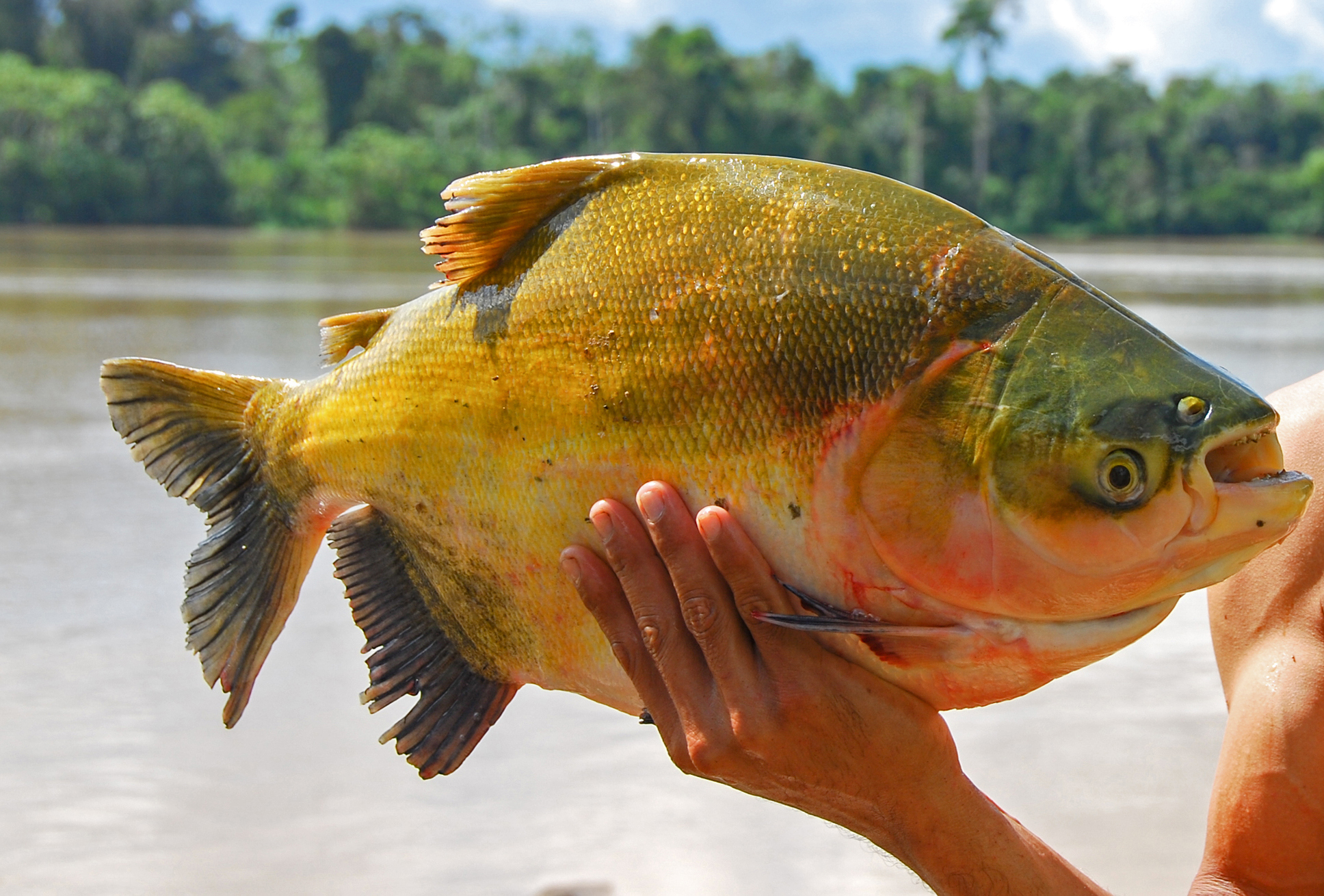
- One of the most cooked fish in the Brazilian Amazon, the tambaqui was included in the official national list of threatened species, triggering fear of losses from Amazon small-scale fishers who depend on the species for their livelihood.
- The tambaqui was classified as vulnerable due to projections of a 43.4% overall population decline over three generations as it’s targeted by intense fishing.
- Starting at the end of October, its fishing could be prohibited in Brazil if a recovery plan isn’t implemented, according to the Ministry of Environment and Climate Change.
- The gray triggerfish was also included in the list of 490 fish and invertebrate threatened fauna, triggering reactions from artisanal fishers and the fishing industry.
An Amazon fisher for 38 years, Josué de Castro said he was very surprised when he learned that tambaqui, a fish that accounts for 20% of his income, is now a threatened species in Brazil, and he might not be allowed to fish it anymore.
“It will ultimately have a big impact on the lives of the fishers and riverside communities who depend on fishing,” Castro, who lives in the São Raimundo do Jarauá community in northern Amazonas state, told Mongabay by phone. “In our area, I don’t think it’s actually facing extinction yet; there are still plenty of them around.”
One of the most consumed fish in the Brazilian Amazon, the tambaqui (Colossoma macropomum) was included in the official national list of threatened fish and aquatic invertebrate fauna species published by the Ministry of Environment and Climate Change (MMA) in April. Starting at the end of October, its fishing could be prohibited in the entire country if a recovery plan isn’t implemented by then, said Braulio Dias, MMA’s director of conservation and sustainable use of biodiversity.
“Inclusion on the list does not mean a fishing ban, provided that a population recovery plan — proposed by experts under MMA coordination — is approved,” Dias told Mongabay in a text message, adding that Ordinance Nº 1,666, published on the same day of the April 27 list, set a 180-day deadline for this to happen, which would be Oct. 25.
Target of intense fishing pressure in its natural habitat in recent decades, the tambaqui was categorized as vulnerable due to projections of a 43.4% overall population decline over three generations, according to the Biodiversity Extinction Risk Assessment System (SALVE), run by ICMBio, the Brazilian agency in charge of conservation units.
Widely distributed across the Amazon River floodplains and the vast majority of its major tributaries, tambaqui occurs naturally in the northern states of Acre, Rondônia, Amazonas, and Pará, and is being spread throughout South America via fish farming, ICMBio said. Over the past 20 years, overall population losses have been partially offset by large-scale supply of farmed tambaqui, it added, even though it is not possible to precisely quantify the impact of fish farming on reducing pressure on wild stocks.
Aware of the potential losses, family-scale fishers partnered with researchers and requested the Ministry of Fisheries and Aquaculture (MPA)’s help to reverse the inclusion of the tambaqui in the endangered list — or at least make it more flexible for certain situations, said Igor Hister Lourenço, a research and development analyst at Mamirauá Institute for Sustainable Development, a social organization fostered and supervised by the Ministry of Science, Technology and Innovation, focused on research, natural resource management, and social development, primarily in the Middle Solimões region of Amazonas state.


“It’s complex to do this for the entire basin,” Lourenço, who lives in Amazonas state and closely follows the fishing situation in the area, told Mongabay by phone. “This area is still rich in tambaqui. It’s plentiful here — whereas in some regions, like the Madeira [River], they’ve already disappeared and have been showing up more in recent years. There was a long stretch without them, but they’re reappearing now. So doing that [a general restriction] is, to say the least, questionable.”
Lourenço said fishers weren’t consulted, which is a mistake, not only because of the lack of information about the Amazon basin and the distinct realities throughout this area with continental proportions, but also because of poor information related to small-scale fishing dynamics.
“I do agree that tambaqui populations are extremely low in some regions, but there are technical issues concerning fishing: The smaller the stock, the harder it is to make a catch. So, these populations won’t necessarily go extinct,” Loureço said. “When it becomes too costly to go after a species with low stocks, what happens is that you diversify production — and that has been happening a lot over the years.”

Lack of data from traditional communities
In its risk assessment, ICMBio noted that the only available data for fishery landings pertain to unprotected areas, which account for 61% of the extent of occurrence of natural tambaqui populations, with no formal data from conservation units and Indigenous territories, which account together for 39% and would be at low risk of extinction.
The São Raimundo do Jarauá community is located in the Mamirauá Sustainable Development Reserve, a conservation unit that allows sustainable management of natural resources by traditional communities. Castro, also vice-president at the Alvarães Fishers’ Colony Z-23, said he’s afraid of the unbalanced effects of a ban, given strong competition with tambaqui farming in the region.
“We work with lake fish, we don’t have fish farms. So, the people who have fish farms will have the right to harvest tambaqui, while we won’t?,” he questioned. “The government needs to look at this aspect, and we need to discuss these situations, because it’s not fair if the burden falls only on us, while the people who own fish farms — business owners with large operations producing lots of tambaqui — retain the right to harvest theirs.”
Finalizing a recovery plan for the tambaqui by October is a priority, said Roberto R. Gallucci, general coordinator of MMA’s department of shared management of fishery resources. “MMA has established a timeline and defined the steps necessary to finalize the PR [recovery plan] by October,” he wrote in a text message.
According to him, the plan is being led in cooperation with MPA and includes representatives from the fishing community, environmental and fisheries management organizations and researchers. A “crucial” draft plan was presented by MPA on June 12, he added.
In an emailed statement, MPA said it is compiling and submitting technical inputs to MMA for the tambaqui recovery plan. It didn’t respond to Mongabay’s request for a copy of the draft.

More endangered species
The bony marine fish gray triggerfish (Balistes capriscus) was also included in the list as endangered species, triggering reactions from artisanal fishers and the fishing industry. Known in Brazil as peroá, it’s very popular in southeastern Espírito Santo state, where fishers from the city of Guarapari mobilized against a possible ban.
“Punishing artisanal fishers from Guarapari for the inclusion of the species on a national list is a disproportionate measure,” Adrian Christian, president of Guarapari Fishers’ Association (Aspeg), told news portal Folhaonline.es. “Unlike other regions, where industrial fleets can compromise fish stocks, fishers affiliated with Aspeg use low-impact methods, preserving local biodiversity.”
A recovery plan for peroá is also being prioritized, according to MMA.
However, these plans are not always effective, said Cadu Villaça, head of the National Fisheries and Aquaculture Collective, pointing to the situation of the red snapper (Lutjanus purpureus), whose status worsened from vulnerable to endangered, despite a recovery plan.

“On one side stands MMA and on the other MPA, vying for prominence, while the red snapper suffers the consequences,” Villaça wrote in a text message, urging a deep reflection on how to manage fishery resources. “We need to reach people; we need to influence the hands that unhook the fish and the minds that decide to stay in areas where large numbers of a specific species or size are being caught. We fail to recognize this effort, and that is regrettable.”
In total, 490 species are now part of the list of fish and invertebrate threatened fauna. White sea catfish (Genidens barbus) and whitemouth croaker (Micropogonias furnieri) were previously included in the list, but their situation is under review following MPA’s appeal.
Banner image: Tambaqui (Colossoma macropomum), Amazon, Brazil. Image by w_endo via iNaturalist (Public domain).
Karla Mendes is a staff investigative and feature reporter for Mongabay in Brazil and the first Brazilian to win the John B. Oakes Award for Distinguished Environmental Journalism. A member of the Pulitzer Center’s Rainforest Investigations Network, she is also the first Brazilian and Latin American ever elected to the board of the Society of Environmental Journalists (SEJ); she was also nominated Diversity, Equity and Inclusion (DEI) chair. Read her stories published on Mongabay here. Find her on LinkedIn, Instagram, Threads, Bluesky and 𝕏.
Amazon fishers help scientists map dam harms to Madeira River stocks
FEEDBACK: Use this form to send a message to the author of this post. If you want to post a public comment, you can do that at the bottom of the page.
