


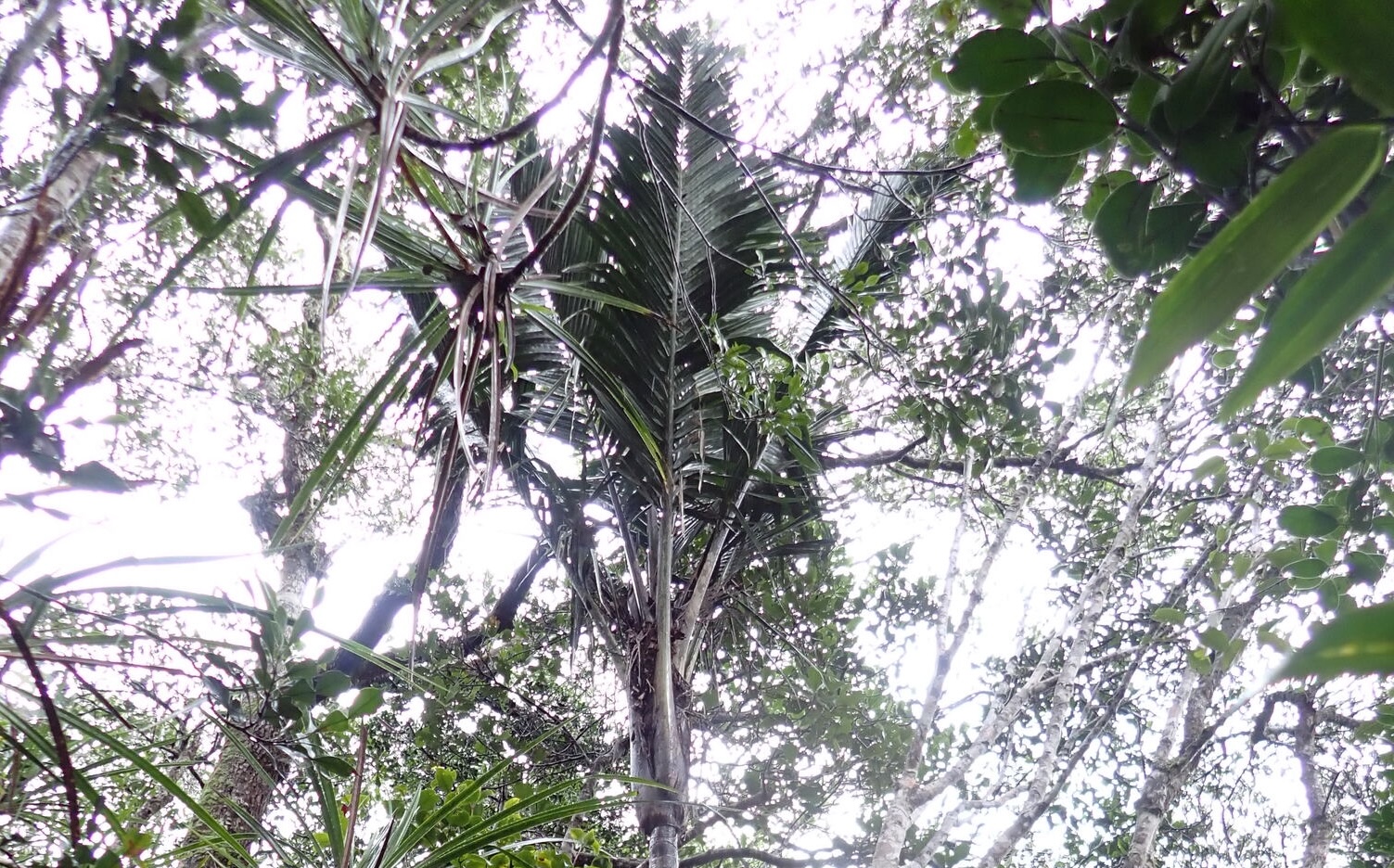
Researchers have tracked down 28 individuals of a palm tree species last recorded in Madagascar nearly 100 years ago.
Nearly every tree of the species, Ravenea latisecta, was found within four protected areas in the Andasibe-Mantadia region of Madagascar, according to a recent study.
“Andasibe–Mantadia is one of Madagascar’s best-explored botanical regions, and Ravenea latisecta is not an inconspicuous plant, it is a palm several metres tall,” Louis Aureglia, study lead author with Aix-Marseille University in France, told Mongabay by email. “Yet confirmed populations remained undocumented for almost a century. This is a good reminder that botanical exploration is far from complete.”
There are around 20 known species of palm trees in the genus Ravenea. All are only found in Madagascar and the Comoros, and nearly all are endangered or critically endangered.
For the study, Aureglia and his colleagues launched a survey in Andasibe–Mantadia in 2024 to document Ravenea palm trees in the wild. They also examined historical specimens kept in herbariums.
Palm trees are usually large and difficult to miss, yet some Ravenea species can be tricky to tell apart with confidence if they’re not flowering, Aureglia said.
The “real turning point” in their fieldwork, he added, was when they found “fertile” plants: male or female trees containing inflorescences, or branched structures with clusters of flowers.
“Ravenea latisecta is dioecious, meaning that male and female flowers are produced on separate plants,” Aureglia said. “Once we found both male and female individuals, with inflorescences matching the original description, we could confirm the identification confidently.”
Eventually, they found 28 individuals of R. latisecta, mostly at four sites: Vohimana Reserve, Analamazoatra National Park, Mantadia National Park, and Vakona Forest private reserve.
These records come nearly a century after R. latisecta was first described from a specimen collected in 1927 in eastern Madagascar. Four herbarium specimens collected in 1992 were also previously labeled as R. latisecta, but three are other Ravenea species and one can’t be confirmed, Aurgelia said.
With fewer than 50 mature individuals known to exist, R. latisecta is listed as critically endangered on the IUCN Red List.
The researchers don’t yet know whether the palm tree is naturally rare or if certain threats have reduced the population to just a few dozen individuals. The protected areas where they’ve been found are under pressure from slash-and-burn agriculture and forest loss at the edges, Aureglia said.
But the team “found no evidence that R. latisecta itself is specifically harvested or used by local communities,” he said, adding more monitoring is needed to understand its population trends and threats.
Aureglia said his team doesn’t know if any verified individuals of R. latisecta are being cultivated in botanical gardens. “We also found no fruiting individuals during our surveys, which means that we have not yet been able to collect seeds for propagation or other ex situ conservation measures,” he added.
Banner image of Ravenea latisecta courtesy of Louis Aureglia.

