


The International Criminal Court and the rule of law it undergirds are in trouble. Former ICC prosecutor Fatou Bensouda has warned of a “deep erosion of international justice” taking place. Many ICC judges and other senior officials have been sanctioned by Russia and the United States. After an unduly prolonged investigation, the court’s chief prosecutor has been removed over sexual misconduct allegations.
The ICC has long been criticized for doing too little too slowly, picking on the weak and giving a pass to the powerful. More generally, efforts to secure accountability for crimes in Gaza and Ukraine have confronted pushback. Many atrocities—including those in Syria during the Assad years, China’s crimes against the Uyghurs, and mass killings and rape in Sudan—have gone largely or entirely unpunished.
But this does not mean the struggle for international justice is a lost cause. Washington, long an essential, if deeply flawed, champion, has disqualified itself for now. But many countries remain committed to the rule of law, and many people around the world want the powerful held to account for their crimes. Increasingly, these efforts will by necessity take place outside of the ICC. Yet as the upcoming trial of the former leader of the Philippines, Rodrigo Duterte, shows, even a weakened ICC still has a role to play.
The push for accountability now lies in the hands of the same coalition of middle powers that brought the ICC into being a quarter century ago. Continuing to defend the ICC is essential, but more is needed. Universal jurisdiction—the principle that heinous offenses against all humankind can be judged by any state—must become even more universal. Governments outside Europe must invest in the capacity of national prosecutorial units and judges to pursue complex investigations and conduct protracted trials. And when the older Hague-based court, the International Court of Justice (ICJ), which addresses state rather than individual responsibility, issues provisional measures and final judgments, middle powers must push to implement those rulings. Finally, these governments should support the expansion of regional jurisdictions to deal with atrocious situations—such as in Sudan—that China, Russia and the United States refuse to address.
Ever since the trials of accused German and Japanese war criminals at Nuremberg and in Tokyo following World War II, advocates of rights have struggled to bring to justice officials, like Duterte, who commit grave crimes against civilians while they hold power. A notable success took place in Argentina in the 1980s. After seven years of brutal military rule, a newly elected civilian government documented 8,960 “disappearances” conducted by the armed forces. They convicted and imprisoned several military commanders, including two former presidents. The Argentine example inspired similar efforts elsewhere in Latin America and in a few countries in Africa and Asia. Even in situations where it was difficult or impossible to bring officials to trial, as in South Africa, the push for accountability involved detailed documentation of crimes by the outgoing regime.
In 1993, the United Nations Security Council established a tribunal along the lines of Nuremberg to investigate crimes committed during the breakup of Yugoslavia. In response to genocide in Rwanda the following year, the Security Council created a similar tribunal for that country. Over time, the two tribunals became great successes, apprehending those they indicted, conducting good trials, and imprisoning most of the high officials they tried.
This performance was crucial in the effort to establish a global court. In 1998, 148 governments met in Rome to establish the International Criminal Court. The treaty they drafted was supported by 120 of those governments; 21 abstained, and seven—Iraq, Libya, Qatar, Yemen, China, Israel, and the United States—ultimately opposed it. The Clinton administration wanted the Security Council to authorize prosecutions, enabling the five permanent members to veto any prosecution. This would have nullified the value of the Court. Though Clinton eventually signed the treaty, the United States never ratified it. Today, the 125 members of the court also do not include China, India, or Russia.
Like its predecessors, the ICC seeks accountability: “to put an end to impunity for the perpetrators of” the most serious crimes. Accountability means official acknowledgment of culpability for abuses. This is of immense importance to victims, and their families and communities. Acknowledgement through legal processes is often the most important way of making amends for the suffering that has been caused. It identifies those who caused abuses and thereby stigmatizes them. It makes clear that abuses are crimes and that punishment may be warranted. It helps prevent the rewriting of history. And there is a possibility that it will help deter further abuses.
Those core aims face enormous challenges today. Disinformation and polarization undermine the concept of truth; political leaders are increasingly contemptuous of any constraints; repeated vetoes by permanent members of the Security Council block referrals to the ICC or the creation of new ad hoc courts; and most tribunals remain distant from survivors, witnesses, and affected communities.
Nonetheless, if one looks beyond the ICC, the movement for international justice has made significant progress in recent years. Governments have increasingly turned to the International Court of Justice to address international crimes. In 2019, Gambia charged Myanmar with genocide against the Rohingya. In June 2023, Canada and the Netherlands sued the Assad regime in Syria for violations of the U.N. Convention Against Torture. And that December, South Africa brought a suit against Israel for alleged genocide in Gaza. Each of those cases is pending, though the Myanmar judgment may come down later this year. The ICJ has already expanded the opportunity for more litigation along these lines, invoking the principle of erga omnes partes to hold that any state party to the Genocide Convention may institute court proceedings against another state party.
In response to Security Council blockage, the U.N. General Assembly has created investigative mechanisms to probe and collect evidence related to crimes in Iraq, Myanmar, and Syria. These bodies have served as central repositories of testimony, documents, and digital data, and supported the building of case files for prosecution at such times and places as that becomes possible.
Perhaps of even greater significance, authorities at the domestic level, primarily in Europe, are expanding efforts to prosecute and try perpetrators of international crimes. Courts in Austria, France, Germany, the Netherlands, and Sweden have charged and/or convicted Assad regime and allied perpetrators of crimes in Syria of torture, crimes against humanity, and sexual violence. Following earlier convictions in France and the United States, the Lafarge cement company (now part of the Swiss conglomerate Holcim), is under investigation in France for alleged complicity in crimes against humanity in Syria’s conflict. And on July 15, Syrian authorities arrested a former Assad-era colonel for allegedly overseeing the manufacture and storage of chemical weapons used against civilians in 2013 and 2017.
In 2024, a Swiss court convicted former Gambian Interior Minister Ousman Sonko for crimes against humanity committed over 16 years during the brutal reign of Yahya Jammeh, who was forced from power in 2017. Also in 2024, the Brussels Court of Appeal ruled that the Belgian government must pay financial compensation for the colonial-era policy of systematically removing from their families children born in the Belgian Congo to a black mother and a white father. This March, another Belgian court ordered a former diplomat to stand trial for his alleged role in acts leading to the assassination in 1961 of Patrice Lumumba, the Congo’s first prime minister.
In Sweden, a criminal trial of the former CEO and chairman of Lundin Oil (now Orron Energy) for complicity in war crimes committed by Sudan’s regime is coming to an end, with the prosecution seeking prison sentences of up to 10 years. And in June 2025, Ukraine and the Council of Europe agreed to establish a special tribunal with the mandate, grounded in the territorial jurisdiction of Ukraine, to prosecute senior figures for the crime of aggression against Ukraine. As of now, 36 governments and the European Union have pledged to join an Enlarged Partial Agreement to oversee the tribunal. On July 3, the Netherlands agreed to act as host.
Beyond Europe, Argentina, Indonesia, and Timor-Leste are among those probing crimes in Myanmar against the Rohingya. In February 2025, a federal judge in Brazil opened a war crimes investigation into a visiting Israeli soldier for his alleged participation in the demolition of civilian homes in Gaza, forcing him to flee the country to avoid possible arrest. In the United States, in October 2025, a New York jury found the French bank BNP Paribas liable for damages for enabling mass atrocities in Sudan.
Even the beleaguered ICC has made important headway, issuing charges against Russian President Vladimir Putin, and against Israel’s leaders (along with principals of Hamas, before they were killed) for alleged war crimes and crimes against humanity in Gaza. In October 2025, an ICC Trial Chamber convicted a senior member of the Janjaweed of numerous crimes in Darfur, Sudan, including, in an important jurisprudential landmark, two counts of crimes against humanity of “gender persecution.”
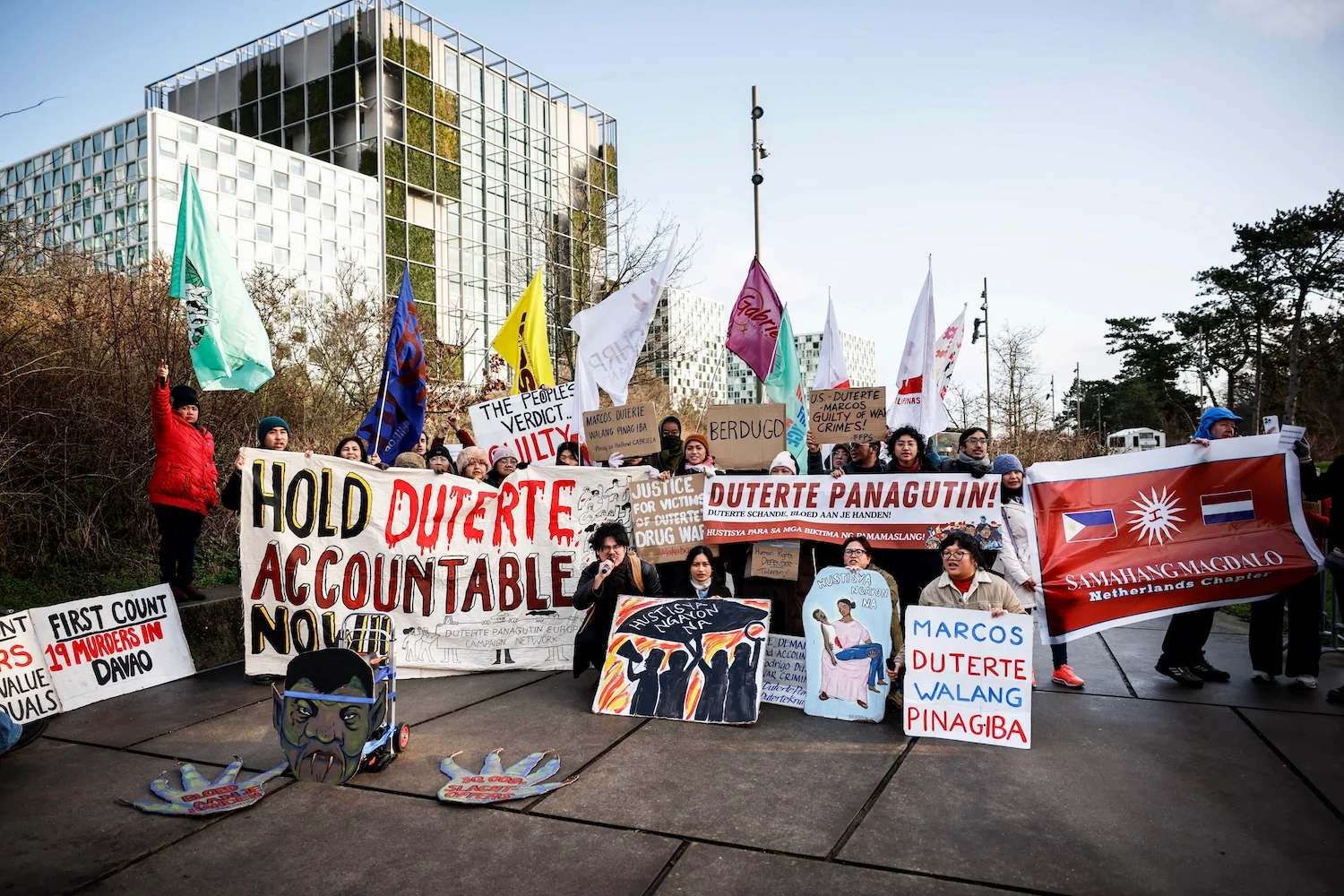
In November, the ICC will commence perhaps its most consequential trial, that of Duterte, the former Philippine president. Duterte, who ruled with an iron fist from 2016 to 2022, is charged with crimes against humanity for allegedly overseeing the mass murder of civilians in his own country as part of a draconian “war on drugs.” Ever since Duterte was sent to The Hague in March 2025, the prosecution, the defense, and many victims have been preparing for the very kind of contest this institution was designed to carry out.
Some will argue that none of this matters, that charges against figures as powerful as Putin and Israeli leader Benjamin Netanyahu are empty gestures that won’t have real impact. Maybe. But history suggests that, even if arrest is not imminent, justice is a long game. Radovan Karadzic and Ratko Mladic were arrested 13 and 16 years, respectively, after they were first charged by the International Criminal Tribunal for the Former Yugoslavia. They are serving life sentences. Moreover, even now, the travel of any ICC indictee remains restricted.
To be sure, even the most successful prosecutions won’t end today’s democratic backsliding. But the impact of seeing a political potentate in the dock should not be underestimated. Just ask survivors of atrocities who have pushed successfully for judicial process against former leaders from Argentina to Guatemala, Chad to Liberia.
Or ask people in Manila, as we did last week. According to a Catholic Church worker close to victims and their families, the charges against Duterte are “the fulfillment of a dream—that accountability is possible.” The sibling of a man killed in Duterte’s drug war sees the ICC process as “a lesson for everyone that even a president can be punished for his crimes.” For another victims’ advocate, the trial in The Hague is “surreal” in that it shows, after years of impunity, “what real justice looks like.”
At this authoritarian moment, when placing limits on those in power often appears harder than ever, the ICC trial of Duterte offers a cause for hope. It is a reminder that, even as the world’s largest states prefer to turn a blind eye to international crimes, there are still paths forward for governments and individuals demanding justice.
