

Close Menu
NCIJ Network NCIJ Network
    What's Hot

    DHS Official Resigns, Citing ‘War on Immigrants’

    July 27, 2026

    Confused Deputy Flaws Persist in Google Cloud, Microsoft Azure

    July 27, 2026

    Lawsuit claims BitMEX used server freezes and internal trading to seize 622 Bitcoin ahead of its September closure

    July 27, 2026
    Facebook X (Twitter) Instagram
    Trending
    • DHS Official Resigns, Citing ‘War on Immigrants’
    • Confused Deputy Flaws Persist in Google Cloud, Microsoft Azure
    • Lawsuit claims BitMEX used server freezes and internal trading to seize 622 Bitcoin ahead of its September closure
    • Wildfires ‘stark reminder’ of extreme climate challenge – William
    • How Andy Burnham can make his devolution agenda work | Devolution
    • Do images of Trump show White House edited Getty photo? We investigated
    • Trump says Iran war talks taking place during lull in strikes
    • Burnham to tell schools in England to adapt teaching to local business needs | Education policy
    • About
      • Our Team
      • Editorial Policy
      • Editorial Independence
      • International Support
    • Trust & Standards
      • AI Usage Policy
      • Conflict of Interest Policy
      • Corrections Policy
      • Ethics Policy
      • Fact-Checking Policy
      • Source Protection
    • Get Involved
      • Guide for Sources
      • Support Independent Journalism
    • Legal
      • Cookie Policy
      • Privacy Policy
      • Terms of Use
    Facebook X (Twitter) Instagram
    NCIJ Network NCIJ Network
    Monday, July 27
    • Home
    • World
    • Ai
    • Business
    • Politics
    • Health
    • Crypto
    • Science
    • Technology
    • Cybersecurity
    • Defense & Security
    • Economy
    • Energy
    • Europe
    • More
      • Fact Check
      • Investigations
      • Opinion & Analysis
      • Environment
    NCIJ Network NCIJ Network
    Home»Science

    Why Jupiter has several giant moons but Saturn has only Titan

    NCIJ NETWNCIJ NETWORKBy NCIJ NETWNCIJ NETWORKJuly 27, 2026 Science No Comments3 Mins Read
    Share
    Facebook Twitter LinkedIn Pinterest Email

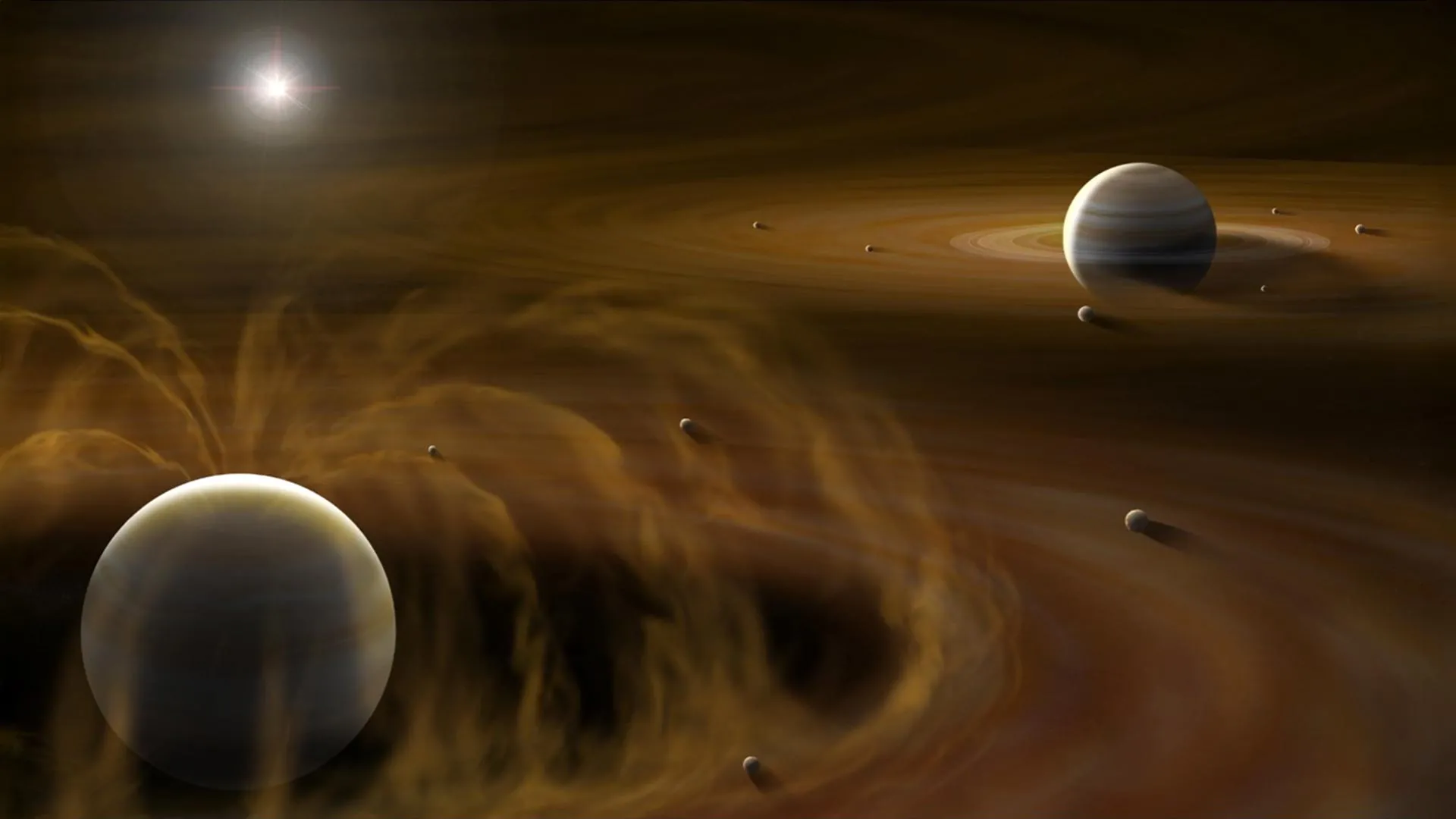
    Jupiter and Saturn are the two largest planets in the Solar System, and both are surrounded by enormous families of moons. Jupiter currently has more than 100 reported moons, while Saturn, which is also encircled by an extensive ring system, has more than 280.

    The makeup of those moon systems is very different. Jupiter has four especially large moons, including Ganymede, the biggest moon in the Solar System. Saturn, by comparison, is dominated by Titan, the Solar System’s second largest moon.

    A Longstanding Moon Formation Mystery

    Because Jupiter and Saturn are both gas giants, astronomers have struggled to explain why their major moons developed so differently. Existing theories of satellite formation offer several possible answers, but recent research into stellar magnetic fields suggests that some of those ideas may need to be reconsidered.

    One unresolved question involves magnetic accretion and the formation of satellites. Researchers have debated whether Jupiter’s circumplanetary disk could have developed an empty inner region. A circumplanetary disk is the rotating collection of material around a young planet from which moons can form.

    A single physically consistent theory capable of explaining both Jupiter’s and Saturn’s moon systems could also help scientists understand planets and moons outside the Solar System. That possibility led researchers from institutions in Japan and China, including Kyoto University, to create a new model.

    “Testing planet formation theory is somewhat difficult because we have only our Solar System for reference, but there are multiple satellite systems close to us whose detailed characteristics we can observe,” says first author Yuri I. Fujii.

    Simulating Young Jupiter and Saturn

    The researchers used numerical simulations to examine the internal structures and thermal evolution of Jupiter and Saturn when the planets were young. This allowed them to estimate how the planets’ magnetic fields may have changed over time.

    They also modeled the circumplanetary disks surrounding both worlds. In addition, the team ran N-body simulations to track the formation of moons and the gradual movement of their orbits. The calculations were carried out using the PC cluster at the Center for Computational Astrophysics, National Astronomical Observatory of Japan.

    Jupiter’s Magnetic Field Created a Safe Zone

    The simulations indicate that the contrasting moon systems of Jupiter and Saturn may have emerged from differences in the structures of their circumplanetary disks. Those differences, in turn, appear to have been controlled by the strength of each planet’s magnetic field.

    Young Jupiter had a powerful magnetic field that created a magnetospheric cavity inside its circumplanetary disk. This inner gap likely helped capture and preserve Io, Europa, and Ganymede as they moved through the disk.

    Young Saturn’s magnetic field was not strong enough to create a similar cavity. Without that protected region, migrating moons could not survive inside Saturn’s disk.

    Predicting Moon Systems Beyond the Solar System

    The findings may help guide future observations of exomoons and the disks surrounding young gas giants. According to the model, planets as large as Jupiter or larger should tend to develop compact systems containing several moons.

    Gas planets closer to Saturn’s size, however, may typically end up with only one or two moons.

    The researchers now plan to apply their theory to additional moons and to possible exomoon systems around distant planets.

    giant Jupiter moons Saturn Titan
    NCIJ NETWNCIJ NETWORK
    • Website

    Keep Reading

    Wildfires ‘stark reminder’ of extreme climate challenge – William

    500,000-year-old elephant bone hammer shows ancient humans were master toolmakers

    Scientists reveal what sparkling water really does to your teeth

    Your dreams aren’t random. Your brain is rewriting reality

    NASA’s Swift Sees ‘Wandering’ Mega Black Hole Shredding Star

    NASA to Cover Three US Spacewalks, Host Preview News Conference

    Add A Comment
    Leave A Reply Cancel Reply

    Editors Picks

    DHS Official Resigns, Citing ‘War on Immigrants’

    July 27, 2026

    Confused Deputy Flaws Persist in Google Cloud, Microsoft Azure

    July 27, 2026

    Lawsuit claims BitMEX used server freezes and internal trading to seize 622 Bitcoin ahead of its September closure

    July 27, 2026

    Wildfires ‘stark reminder’ of extreme climate challenge – William

    July 27, 2026
    Latest Posts

    The Western Myth of Russian Greatness – Foreign Policy

    July 21, 2026

    Defence stocks rally as John Healey appointed chancellor; UK borrows less than expected in June – business live | Business

    July 21, 2026

    You Pay for Internet Service in Empty Buildings on Alaska’s Adak Island — ProPublica

    July 21, 2026

    Subscribe to News

    Get the latest sports news from NewsSite about world, sports and politics.

    NCIJ Network is an independent digital news platform delivering trusted investigative journalism, European and global news, in-depth analysis, and fact-based reporting with accuracy, transparency, and integrity.

    Facebook X (Twitter) Instagram Pinterest YouTube

    DHS Official Resigns, Citing ‘War on Immigrants’

    July 27, 2026

    Confused Deputy Flaws Persist in Google Cloud, Microsoft Azure

    July 27, 2026

    Lawsuit claims BitMEX used server freezes and internal trading to seize 622 Bitcoin ahead of its September closure

    July 27, 2026

    Subscribe to Updates

    Get the latest creative news from FooBar about art, design and business.

    Type above and press Enter to search. Press Esc to cancel.