


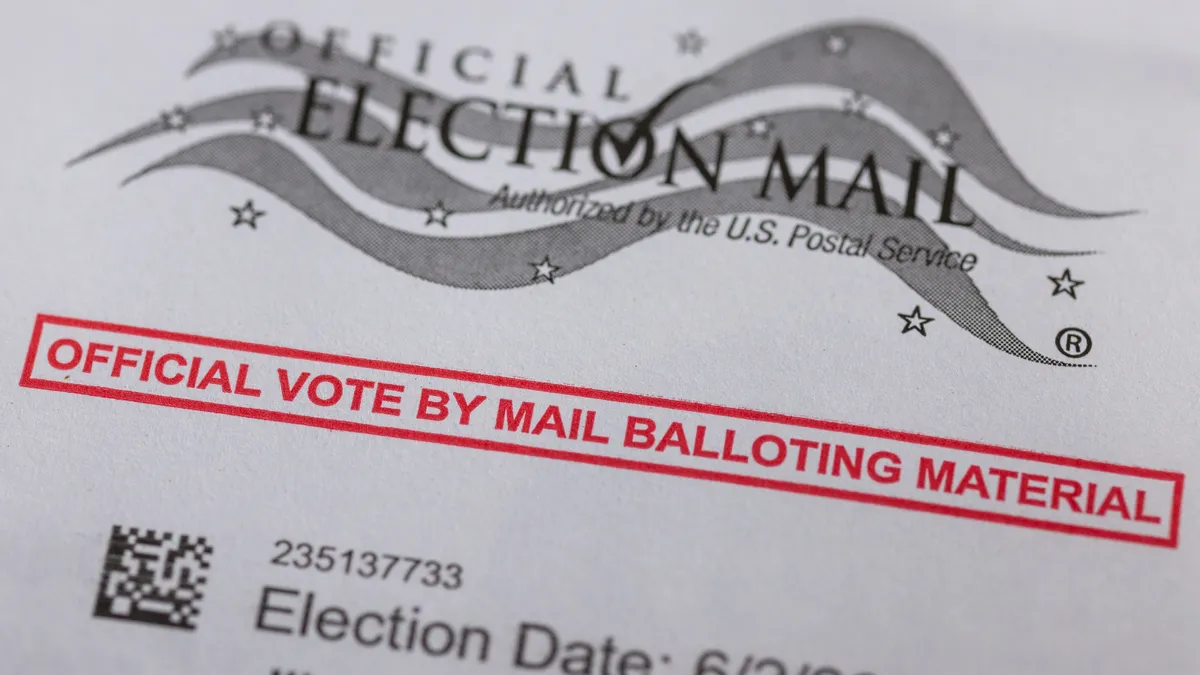
In June 2026, the U.S. Postal Service proposed a rule in which it would stop delivering mail ballots for states that do not give the federal government voter lists.
So far, the USPS has only proposed the rule to have itself stop delivering mail ballots for states that do not give the federal government voter lists. It has not been finalized and made active as of this writing, and it faces legal challenges that could change, delay or stop the rule’s final implementation. Some posts claim that a judge ruled “ALL 50 states MUST send in their voter rolls to confirm citizenship,” but those claims are based on a single decision to stay an injunction, meaning it is a temporary go-ahead while the lawsuit plays out, and ignores other ongoing lawsuits halting the USPS from going forward anyway.
Snopes originally fact-checked a version of this claim in June 2026. We’re revisiting it because of renewed interest and new variations of the claim as the proposal’s legal situation continues to evolve.
In summer 2026, social media users circulated the claim that the U.S. Postal Service under President Donald Trump was planning not to deliver mail ballots to states that don’t hand over their voter lists to the federal government.
For example, a July 18 Facebook post (archived) read:
🚨BREAKING: The Postmaster General has announced that the USPS will not deliver mail-in ballots for the 2026 midterm elections to states that refuse to comply with President Trump’s election integrity executive order.
States that do not provide voter rolls or cooperate with federal efforts to verify citizenship and eligibility will not receive USPS services for mailing ballots.
This is a major step to enforce clean voter rolls and ensure only eligible American citizens can vote.

(Facebook user David J Harris Jr.)
The rumor appeared on Reddit (archived), in Facebook (archived) posts (archived) and on X (archived).
Snopes readers also searched our site and sent emails asking about various versions of the claim.
In short, the USPS did propose a rule change that would require a state to give the federal government lists of mail-in and absentee voters in exchange for the USPS delivering mail ballots to voters in the state. Therefore, we have rated this claim
The proposed rule is based on a March 31, 2026, executive order, but it differs in some details, leading to some confusion over the content of the prospective policy.
It should be noted that the rule has not been finalized. The rule and the executive order are facing multiple legal challenges. As of July 23, 2026, a judge has blocked implementation of the order and proposed rule in about two dozen states that challenged it. Legal challenges regarding the rule’s continued implementation everywhere else remain in flux.
Below, we break down exactly what the proposed rule says and its legal status as of this writing:
USPS’ proposed rule
On June 2, the USPS proposed a rule change to amend how it handles mail ballots. A proposed rule is open for public comment for 30 days after publishing. Afterward, the proposing agency reads over the comments and publishes a finalized rule that addresses the comments. The rule can still be challenged in the courts even after it is finalized.
First, the rule would standardize mail ballot envelopes to include the official election mail logo, a unique barcode and automation compatibility.
The rule would then cover the “Mail-In and Absentee Participation List.” The proposal says states would give the USPS a list of people they are sending mail ballots to, along with the unique barcode for those people. The states could then “add to or modify the list of enrollees until the last day that ballots may be mailed out to individuals under state law.”
The proposal says “states would retain full control over who would (or would not) be able to vote by mail in federal elections within each state, as states would control enrollment with the Postal Service for inclusion on the state’s Mail-In and Absentee Participation List.” States would accomplish this, according to the proposal, by providing the USPS with the list of mail voters through a “Federal Ballot Mail Portal.” The USPS would not verify whether individuals should or should not be included on that list.
However, the proposal also says the USPS would implement a “verification procedure for compliance with the proposed standards” that would include confirming the state submitted a list consistent with the proposed rule.
As stated above, this potential rule change is only a proposal as of July 2026. The rule will have to be finalized and survive legal challenges before it can be implemented.
Trump’s prior executive order
Trump’s March 31 executive order directed the USPS to propose this rule, albeit with slightly different wording.
The White House directed the USPS to “provide each State with a list of individuals (Mail-In and Absentee Participation List) who are enrolled with the USPS,” as opposed to ordering that states provide the lists to the USPS.
The executive order did, however, direct the Department of Homeland Security to create a “State Citizenship List.”
The order also said the Secretary of Homeland Security and the head of the USPS would coordinate “in effectuating all relevant aspects of the implementation of this order,” although what exactly that would look like is not yet clear.
The proposed rule does not mention coordination with other federal agencies in creating, sharing or utilizing the voter lists. However, it makes a few mentions of “law enforcement,” who could “compare the total number of mailed ballots to the total number of received ballots to detect potential issues meriting further investigation” using the USPS’ data.
Legal challenges
Finalization of the rule and its implementation remain in flux due to ongoing legal challenges against both the proposed rule and the original executive order.
On June 3, two law firms, working on behalf of the NAACP civil rights organization, filed a court motion “to enforce a settlement agreement in which the U.S. Postal Service (USPS) committed to prioritizing the timely delivery of election mail, including mail-in ballots.” The groups said the proposed rule would violate this agreement by giving the USPS a “new gatekeeping function.”
The NAACP requested an injunction blocking the USPS from proceeding with finalizing and implementing the proposed rule — which it said is likely to disenfranchise voters in the upcoming midterm elections — while the lawsuit plays out in the courts. While an injunction was initially granted,
This appeals court decision is the one that people claiming all 50 states must comply with the decision are referring to.
However, a judge in Massachusetts said a group of organizations, led by the League of Women Voters, fighting against the executive order in a separate lawsuit could request an injunction if the appeals court in D.C. lifted the injunction granted to the NAACP in the other lawsuit. The groups submitted that request on July 20. As of July 23, n
Finally, in April, 23 state attorneys general and one governor sued the federal government over the March executive order. The lawsuit argues that the executive order violates the separation of powers because the Constitution grants states the power to run elections, rather than the federal government or the president. On June 25, a request for an injunction, blocking the parts of the executive order pertaining to the lists and the USPS’ rule while the lawsuit was ongoing, was granted by a Massachusetts judge — the same judge ruling on the League of Women Voters’ injunction request.
That injunction remains in place, meaning the USPS would still need to deliver mail ballots if it does not receive an absentee voter list in the states that sued.
