


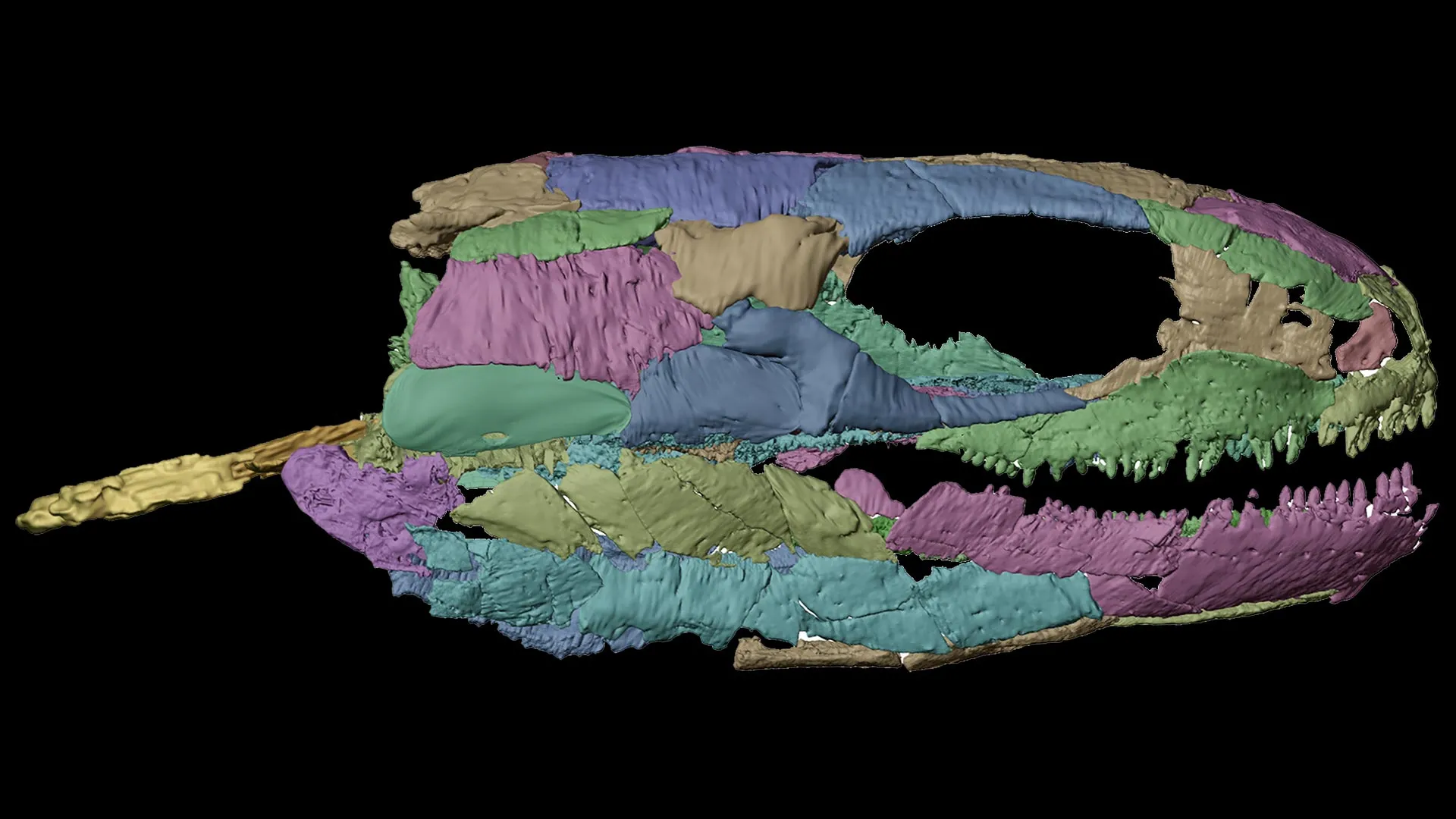
A small fossil discovered in Scotland and regarded for nearly three decades as one of the earliest known reptiles has turned out to be a very different kind of prehistoric animal. New research published in Nature is challenging its long-established place in evolutionary history. The study was led by scientists at the American Museum of Natural History and the University of Oxford, working in collaboration with the European Synchrotron Radiation Facility.
The 345-million-year-old fossil, discovered in 1984, belongs to a species called Westlothiana lizziae. Nicknamed “Lizzie” because of its resemblance to a lizard, the specimen consists of a nearly complete skeleton preserved in two crushed slabs of rock. Early descriptions relied largely on anatomical features visible at the surface, including four limbs with fingers and toes that appeared to have claw-like tips. These characteristics distinguished Westlothiana from many other animals living at the time, whose limbs more closely resembled fins.
Although the fossil’s distorted condition made its anatomy difficult to interpret, researchers widely regarded it as the earliest known amniote adapted to life on land. Amniotes are a major group of vertebrates that includes reptiles, birds, and mammals. Following its scientific description in 1990, Westlothiana became an important reference point for researchers investigating when and how these animals first evolved.
“Lizzie has been an icon for the early evolution of amniotes for decades,” said Xavier Jenkins, a postdoctoral fellow in the Museum’s Division of Paleontology and co-lead author of the study. “But when we were finally able to see inside the fossil, we found an animal that looked very different from what we expected.”
Advanced X-Ray Scans Reveal Lizzie’s True Identity
Using powerful X-ray imaging technology at the European Synchrotron Radiation Facility in Grenoble, France, the scientists peered beneath the surface of the rock and reconstructed previously inaccessible parts of the animal’s anatomy.
What they discovered was strikingly different from the anatomy expected in an early reptile. Lizzie possessed a primitive skull, internal gills containing bone, and a mouth resembling that of a fish, complete with thousands of tiny teeth. Together, these features rule out its previously proposed position within the evolutionary lineage leading to reptiles. Instead of living primarily on land, Westlothiana appears to have been an aquatic or amphibious animal.
“The surprisingly primitive features of the skull show us that Lizzie was not only not a reptile but belonged to a much more ancient lineage. It turns out looks can be deceiving, and Lizzie lived a completely different lifestyle than we previously thought,” said Ben Igielman, co-lead author of the study, who started this research during his graduate work at the University of Oxford.
Reptile-Like Features Evolved in Aquatic Ancestors
The discovery also changes how scientists understand the origins of several anatomical features traditionally associated with vertebrates adapted to terrestrial environments.
Researchers now believe that characteristics such as claws and the arrangement of five digits on each hand and foot, a pattern familiar in reptiles and mammals, had already emerged in earlier animals that were still closely associated with water. These creatures belonged to the evolutionary lineage leading to tetrapods, the broader group of four-limbed vertebrates that encompasses both amphibians and amniotes.
“This is a big surprise,” said study co-author Roger Benson, the Museum’s Macaulay Curator of Paleontology. “It shows that, although we think of amphibians as being more ‘primitive’ than reptiles today, some of the traits of reptiles were already there in the ancestor of both amphibians and reptiles.”
Ancient Footprints May Tell a Different Story
The findings could also have important implications for the interpretation of prehistoric fossil tracks. Recently discovered trackways have been used as evidence that amniotes first appeared during the Devonian Period, more than 359 million years ago.
These ancient impressions record the movements of a four-limbed animal with apparently clawed digits. However, if distant relatives of tetrapods such as Westlothiana also possessed claws, such footprints are no longer sufficient on their own to identify the animals that left them as amniotes.
Some trackways previously attributed to early amniotes may instead have been left by more ancient, amphibious creatures belonging to the evolutionary lineage of tetrapods.
“The broader lesson is that terrestrial-looking traits, such as a reptile-like foot, a weight-bearing forelimb, and claw-like phalanges were not unique features of tetrapods, but rather accumulated piecemeal in their close relatives, in animals that were still living in and out of the water,” Jenkins said.
Additional contributors to the study include Jason Head from the University of Cambridge, Vincent Fernandez from the European Synchrotron Radiation Facility, Lucy Roberts from the Natural History Museum, London, and Timothy Smithson from the University Museum of Zoology Cambridge.
The research received funding from the National Science Foundation (grant number EAR-PF 2518154), the National Environment Research Council (grant numbers NE/S000739/1, NE/W007576/1, and NE/L002507/1), and the Biotechnology and Biological Sciences Research Council (grant number BB/X014819/1).
