


- The International Commission for the Conservation of Atlantic Tunas (ICCAT), a multilateral body that governs much of the fishing that takes place in the Atlantic Ocean and adjacent seas, held its annual meeting Nov. 16-23 in Vilamoura, Portugal.
- The parties adopted a measure aimed at strengthening a long-standing ban on shark finning that’s routinely flouted. The EU called it a “landmark” agreement, but it wasn’t the fins-naturally-attached policy many parties and NGO observers had long sought to institute.
- Despite intense negotiations, the parties couldn’t agree on a new catch limit or allocation system for yellowfin tuna, which was fished above the current limit in 13 out of the last 15 years, and also failed to reach an agreement on management objectives for blue sharks.
- The parties agreed to increase the catch of bigeye tuna and reduce catches of southern albacore following assessments of both stocks.
VILAMOURA, Portugal — Shark finning entails slashing fins off sharks and dumping the bodies into the sea, often while they’re still alive. In the Atlantic Ocean, the practice has been banned on paper since 2004, yet some Japanese and Chinese vessels still do it. The fins end up in shark fin soup, a delicacy in parts of Asia, and the bodies sink to the bottom of the sea.
The most effective rule to enforce finning bans, called “fins naturally attached,” prohibits vessels from landing fins unattached from bodies. At the International Commission for the Conservation of Atlantic Tunas (ICCAT), a multilateral body that governs much of the fishing in the Atlantic and adjacent seas, it’s been proposed 18 years in a row, including in 2026. It’s never passed due largely to resistance from Japan.
However, at ICCAT’s recent annual meeting, held Nov. 16-23 in Vilamoura, Portugal, delegates reached a compromise.
ICCAT parties, which include 56 countries and the EU, adopted a measure that could establish a fins-naturally-attached rule by 2029 or 2030, under certain conditions, but for the time being allows alternatives for sharks landed frozen, which many are. The deal drew mixed reactions from parties and NGO observers who had backed a straightforward, no-alternatives policy as the best way to end finning, a practice many people regard as cruel and wasteful.
“Until we see a no-exceptions rule, we’re not going to be opening the champagne bottle,” Nicolas Blanc, executive co-director of the Portugal-based NGO Sciaena, told Mongabay.
The shark finning agreement was, however, one of the few deals reached on the meeting’s most contested issues. Despite intense negotiations, the parties couldn’t agree on a new catch limit for yellowfin tuna (Thunnus albacares) or how to divide the catch among the parties. Nor did they reach an agreement on management objectives for blue sharks (Prionace glauca), failing to take a key step toward a long-term, science-based approach for the near threatened species.
Shark week
ICCAT is one of the world’s five tuna RFMOs, or regional fisheries management organizations. It also adopts rules for sharks, which vessels both target and catch incidentally. Sharks are predators key to marine ecosystems and have been severely impacted by overfishing globally.
The new measure, introduced by Japan, requires sharks landed fresh — those that are chilled rather than frozen on board — to have their fins naturally attached. For sharks landed frozen, vessels can use one of two alternatives: The first is to tie fins directly to the corresponding body with rope or wire; the second is to keep the fins and body separate, marked with “identical and uniquely numbered tags,” and stored in the same hold. These alternatives are the same as those adopted by the Indian Ocean Tuna Commission, another tuna RFMO, in 2025.
The alternative options have conditional sunset clauses. They would expire on Jan. 1, 2029, if only one party or fewer elects to use them in the preceding two years — and a straightforward fins-naturally-attached policy would take their place. They’d expire on Jan. 1, 2030, if only two parties or fewer used them in the 2027-2029 period.
If these conditions aren’t met — and NGO observers suspect they won’t be, given how many ICCAT parties could opt to use one of these alternatives in their fleets — then discussion of a fins-naturally-attached rule will resume at the 2029 annual meeting.
The European Commission, the EU’s executive branch and a longtime backer of fins naturally attached, trumpeted the deal, calling it a “landmark” and a “breakthrough agreement.” Its oceans and fisheries commissioner called it “major step forward.”
Other parties and NGO observers expressed mixed feelings about the agreement, with some calling it a necessary compromise because it was all Japan would agree to. ICCAT generally operates on consensus, meaning one party can block a measure.
“There’s the glass half full sort perspective on it, and there’s the glass half empty perspective,” Mark Waddell, Canada’s head of delegation at the meeting, told Mongabay, acknowledging that it was a struggle to decide whether to support the deal.
“The definition of insanity is repeating the same thing over and over again, expecting a different outcome,” he said. “And we’re 17 years on here trying to advocate for fins naturally attached.”
“We are tenacious and unified on this,” he added, speaking of the attitude of Canada and other parties that support fins naturally attached. “Having said that, we are optimistically accepting the proposal by Japan with a view to seeing a trajectory that would take us to, be it 2029 or 2030, a full fins-naturally-attached [rule].”
Several conservationists who focus on sharks expressed dissatisfaction with the agreement, saying it wouldn’t do enough to protect sharks.
“We are concerned that the compromise on finning ban enforcement is exceedingly complicated and risk-prone with a lengthy timeframe for potential benefits and alternatives that have no scientific basis,” Sonja Fordham, president of the U.S.-based NGO Shark Advocates International, said in a joint statement with other NGOs. “Opening the door for entire fleets to start employing problematic techniques involving wires, ropes, and tags to sort detached fins needlessly risks an increase in marine debris and threatens long-fought progress toward the only fool-proof method for finning ban enforcement: ending at-sea removal of shark fins.”
Iris Ziegler, the head of fisheries policy at the German Ocean Foundation, told Mongabay she was concerned that neither the term “sharks” nor “frozen” was well defined in the measure and fleets could exploit these ambiguities. She said her general takeaway was that ICCAT was “preserving the status quo and standing still instead of making progress,” with “industry interests prevailing and shark conservation sacrificed on the altar of profit maximization.”


Other shark matters were also on the ICCAT agenda. The EU put forward a proposal that would have set management objectives for blue sharks, which are heavily targeted for their meat and fins. The proposal also set the commission on track to adopt a harvest strategy for the species by 2029 at the latest. However, the EU and the U.S. couldn’t agree on how to set the management objectives, according to NGO observers, and the proposal failed. Harvest strategies, which involve largely automated, science-based catch decisions, are considered a best practice in fisheries management. ICCAT’s blue shark harvest strategy has been in the works for a few years and was on pace to be among the first shark harvest strategies at any RFMO. An unnamed spokesperson at the European Commission told Mongabay in an email that scientific work will continue and adopting a harvest strategy by 2029 is still possible if management objectives are agreed to in 2027.
Blue shark discussions are often intertwined with those about shortfin mako sharks (Isurus oxyrinchus), which are incidentally caught in the blue shark fishery and are endangered globally. ICCAT parties, seeking to help shortfin makos recover, adopted a rule in 2022 prohibiting their retention in the North Atlantic, dead or alive, if more than 250 metric tons of the species were killed the previous year. Every year, mortality has been well above that threshold — in 2025, it was about 779 metric tons — so this rule amounts to a retention ban and all shortfin makos must be returned to sea.
In 2026, one assessment found that shortfin makos’ age of maturity may be younger than previously thought, which would improve the species’ prospects for recovery, a decades-long process. On the back of this finding, the U.S. came to the meeting with a proposal to change the shortfin mako threshold to allow vessels to keep some of the catch — a move opposed by many NGOs and some parties. The U.S. withdrew the proposal toward the end of the annual meeting.
The U.S. and Japanese delegations didn’t respond to questions from Mongabay.

Wicked tuna
By far the most time-consuming debate at the annual meeting, as well as the preparatory meetings immediately preceding it, was over the yellowfin tuna catch. The debates got so divisive that “bad blood” arose between the parties, Sciaena’s Blanc said.
On paper, ICCAT already has an agreed-upon total allowable catch for the species: 110,000 metric tons annually. Yet for 13 of the past 15 years, the parties have collectively exceeded that figure, generally landing about 140,000 metric tons. That’s because there’s no agreement on how to allocate the catch among fishing nations, creating a “free for all,” as Blanc put it.
In the course of the meeting, the parties considered raising the total allowable catch. Most proposals were between 120,000 and 130,000 metric tons. The European Commission spokesperson said the EU didn’t agree to proposals at or above 128,500 metric tons. Canada’s Waddell said his calls for a precautionary approach “garnered modest uptake, perhaps little uptake” from other parties. Ultimately the parties couldn’t agree, leaving the current limit in place, and they came away with no allocation system.
“It is a huge amount of biomass that we’re taking out of the ocean,” Blanc said of the yellowfin catch, which he noted didn’t even account for unreported catches. “And of course those animals matter in the normal functioning of the ecosystem.”


Blanc said the most concerning part required a closer look at the data: More than 90% of yellowfin individuals caught in the ICCAT area in recent years were juveniles, according to the science committee. He called it “very, very worrying.”
Fishing methods contribute to the large juvenile take. Much of the tuna fishing in ICCAT’s area is undertaken by purse seining vessels that trap schools in a massive net and cinch it closed at the bottom, like a purse. They often set their nets around fish aggregating devices (FADs), floating structures that attract fish, especially juveniles. Vessels deploy them by the hundreds and they routinely escape service, contributing to marine debris and entangling marine life.
The ICCAT purse seiner fleet is largely European, and in recent years the EU has successfully advocated for loosening FAD rules. Previously, ICCAT had a 72-day FAD closure for conservation reasons, but it’s since been reduced to 45 days. At this meeting, the EU and a coalition of Central American countries that also use FADs pushed to reduce it further. The EU initially aimed to eliminate it entirely before offering 30 days as a compromise. The European Commission spokesperson said there would be no strong scientific basis for the current FAD closure if a total allowable catch and allocation system were in place for yellowfin and bigeye tuna (Thunnus obesus). To the relief of conservationists, the parties didn’t agree to change the FAD rule and the closure will remain at 45 days for 2027.
The parties did agree on a 16.4% increase in total allowable catch for bigeye tuna after the science committee found its population health to be improving. Local news reports in places like the Basque Country, an administrative region in Spain, and Portugal’s Atlantic archipelagos celebrated the move as a win for fishers.
ICCAT parties also agreed to lower the total allowable catch for southern albacore (Thunnus alalunga) by 13.1% following a stock decline, and they advanced on a framework to test a harvest strategy in preparation for adopting it at the 2027 annual meeting. The moves were praised by conservationists, who credited South Africa and Brazil with taking leadership roles.
ICCAT also adopted a new rule that requires parties to disclose the beneficial owners of chartered vessels — a push toward accountability in a sector where ownership information is hard to find.
Two other proposals supported by NGO observers failed to pass. One would have established an ecosystem approach to fisheries management in a binding resolution, a move other RFMOs have recently made. Another, proposed by Canada, would have established a joint high seas boarding and inspection system to strengthen rules enforcement in waters beyond any nation’s jurisdiction.
Shannon Arnold, an associate director at Ecology Action Centre, a Canada-based NGO, said attending ICCAT meetings can make her “cynical” but that’s no reason to give up. She said it was “so hard to move stronger fisheries management forward at RFMOs … because the measures are actually legally binding and have teeth,” leading to “incredible push back from some industry and countries that want to exploit without limits.”
“More than ever, we need countries to come together on shared global governance,” she said.
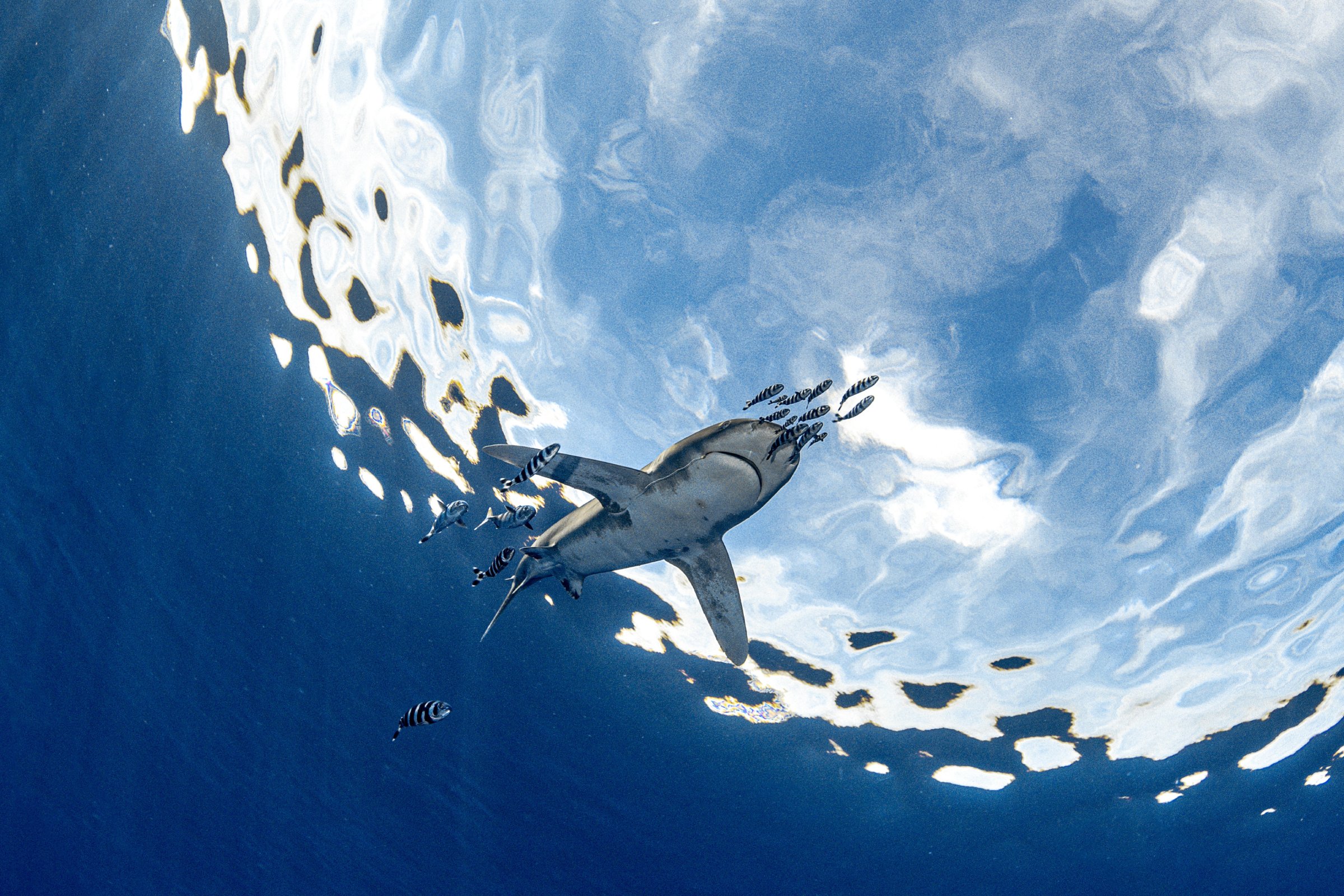
Banner image: An oceanic whitetip shark (Carcharhinus longimanous). Image by Renata Romeo/Ocean Image Bank.
Feedback: Use this form to send a message to the author of this post. If you want to post a public comment, you can do that at the bottom of the page.
Cite this article
Edward Carver (2026). Nations hail new shark finning rules in the Atlantic. Conservationists say Japan blocked better ones. Mongabay Conservation news. DOI: https://doi.org/10.66709/news-337021

