


Ryon McDermott set out seven years ago to create a new scale measuring masculinity. McDermott, along with other researchers studying male psyches, was tired of the field’s long-standing assertion that the manlier the man, the worse his outcomes. It was high time to measure masculinity in a positive light.
For almost half a century, the many social science scales that measure gender or masculinity have consistently shown that rigid fealty to Western masculine norms — such as prioritizing work, power-seeking and status — link with poor mental and physical health. Endorsement of such norms also correlates with misogynistic beliefs and violent behaviors, including sexual violence, studies have shown.
But giving men a talking-to about their many defects rarely lands well. Nor does that negative focus help men thrive. But what approach would help? “We don’t really have a definition of men’s health. If we don’t know what we are going towards, how can we even do this [research]?” says Matt Englar-Carlson, a counseling expert at California State University, Fullerton.
What traits, the researchers wondered, define a healthy man? And could a healthy reframing of manhood improve men’s outcomes, such as by getting them to the doctor or lowering their high rates of social isolation, depression and even death by suicide?
Those questions would cleave the field, though as fights go, this one has been downright nice. McDermott, a psychologist of masculinity at the University of South Alabama in Mobile, would ultimately question positive masculinity’s very existence. Meanwhile, his friends and collaborators at Movember — a nonprofit research organization based in Richmond, Australia that encourages mustache-growing in November to spark conversations around men’s health issues — are poised for a 2027 launch of the Healthy Manhood Index. That scale uses a positive framing and is designed to gauge men’s strengths, while illuminating areas for improvement.
Masculinity is treated as a barrier to health
The first gender measurement scale emerged almost a century ago. It positioned femininity and masculinity at opposite poles, with researchers assuming that the most gender-conforming men and women were the healthiest.
That thinking has since unraveled. As women began smashing gender barriers, by doing everything from donning pants to entering the workforce, penalties for women acting more masculine largely disappeared.
geogphotos/Alamy
Inspired by the feminist movement, researchers began studying the masculine psyche. Yet they largely framed masculinity as a barrier to health. The Male Role Norms Inventory, one of the most popular masculinity scales in use today, exemplifies that focus. Individuals rank statements like: “A man must stand on his own two feet and never depend on other people to help him do things.”
The higher the score on that and more than 60 similar statements appearing in popular masculinity scales used over the past 50 or so years, the worse men’s outcomes, McDermott and his colleagues at Movember reported in July in Men and Masculinities. “Manlier” men often struggle with depression and substance use and engage in sexual aggression. They also tend to avoid asking for help or taking precautionary health measures, such as wearing a mask during the COVID-19 pandemic.
But almost 80 percent of the statements used frame masculinity as a problem to be solved, the team found. That deficit lens biases the findings, argues coauthor and social psychologist Peter Fisher of the Movember Institute of Men’s Health, the organization’s research arm. “If the only tools you have available to you are looking for deficits, you will find deficits,” says Fisher, who is based in Santa Monica, Calif.
Researchers pivot to studying positive masculinity
That negative framing has also seeped into public discourse, so much so that some people now intuitively link “masculinity” with the word “toxic.”
Yet those most macho of men are the outliers, the small percentage who score highest on masculinity scales, Englar-Carlson says. He suspects that what really matters for health is flexibility around when to behave in certain ways. Stoicism, a typically masculine-coded trait, can be calming in emergencies but scary when a man experiences a mental health crisis and refuses help.
Englar-Carlson and psychologist Mark Kiselica, of Penn State University, Harrisburg, developed the Positive Psychology Positive Masculinity, or PPPM, paradigm in 2010. Public health experts, therapists and others should focus on men’s strengths not deficits, they argued.
The ideas in PPPM are what McDermott began trying to turn into a masculinity scale a few years later. But his efforts sent him into a tailspin.
He and his colleagues began by identifying positive traits that people linked more with men than women. The team generated a list of 79 possible positive male attributes based on findings from focus groups and studies of positive masculinity and positive psychology, such as “having a good sense of humor,” “serving country or community” and “having passion for one’s work.” More than 1,000 individuals then rated those attributes on a scale from 1 for “strongly disagree” to 7 for “strongly agree” along three dimensions: positive, typically expected of men and typically expected of women.
Roughly 40 percent of the attributes, particularly those pertaining to protective behaviors and assertiveness, were seen as both positive and expected more of men than of women, McDermott and his colleagues reported in 2019 in Psychology of Men & Masculinities.
But the study also showed that both men and women scored above the midpoint on almost all the allegedly male attributes. That could mean the supposedly gendered attributes had little to do with gender. And for many measures, such as patience and having good hygiene, women scored higher than men. Could that mean that the study’s list was rebranding attributes from feminism as masculine? The idea didn’t sit well with McDermott.
Then, the team’s research took a dark turn. The researchers had respondents fill out both their new masculinity survey and a scale measuring sexist beliefs. That revealed that the more strongly respondents endorsed masculine ideals, the more likely they were to endorse sexist beliefs, the team’s unpublished work shows. Think about a statement like, “A good man should be strong,” McDermott says. For many people, that translates to “a good woman should be weak.”
“I’ve looked at this across three different samples [of people], and I find the same results each time,” McDermott says. “Whenever you define masculinity, you are inherently defining it against femininity.”
Most attributes are neither male nor female, but human, McDermott has come to believe. And gendering those universal traits merely reinforces sexist stereotypes. The work has left him gutted. “I really thought that there was such thing as positive masculinity,” he says. “But now I believe that it can never truly be positive.”
Focus on changing behaviors not beliefs
Fisher is well aware of McDermott’s journey. “He’s been trying to create a positive masculinity scale, or isolate the positive characteristics of masculinity, for a while,” Fisher says. “And he’s been struggling.”
Perhaps McDermott has set too high a bar, Fisher says. Rather than trying to identify and measure masculinity through beliefs, he says, why not focus on men’s actions?
So for the past several years, Fisher and colleagues have been doing just that. They have organized numerous focus groups and tested survey statements with some 12,000 individuals across six countries. Besides addressing the lack of age and cultural diversity used to create most masculinity scales currently in use, Fisher and his team hope that their scale will provide men with a blueprint for what constitutes healthy behavior.
Here’s what a healthy masculinity index might measure
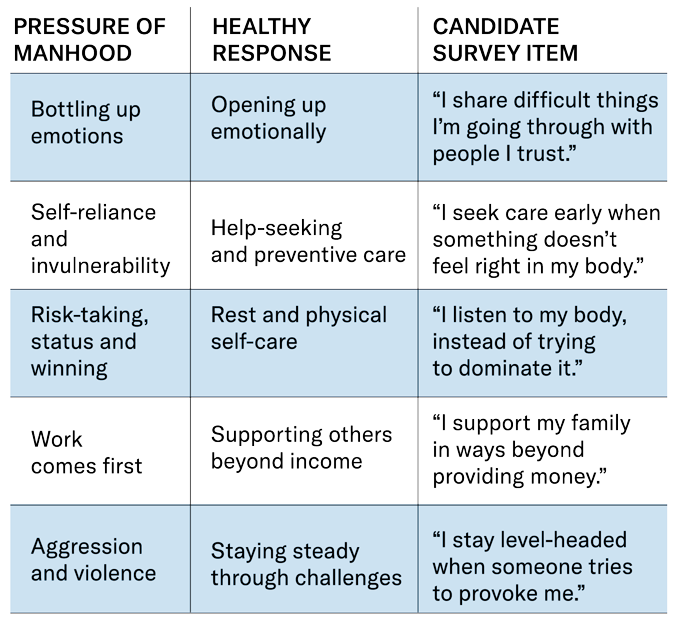
Below are qualities Movember Institute of Men’s Health researchers are evaluating to develop a new masculinity scale. The items are preliminary and may not appear in the final version. The rows show counterproductive behaviors that result from pressures facing men, healthy responses and possible wording for survey statements the men would then rate.
Movember Institute of Men’s Health
All the statements in the Healthy Manhood Index start with “I” plus a verb, such as “I do,” “I talk” or “I check in,” Fisher says. For instance, men often feel pressure to restrict their emotions, so the healthy response would be for men to open up emotionally. The index might have men rate a statement like: “I share difficult things I’m going through with people I trust.” Crucially, the higher the score on the index, the healthier the man.
Fisher’s goal is to move men toward healthy behaviors without alienating them. “We just want to meet men where they are,” he says.
Should researchers keep or toss masculinity?
A debate that could easily become acrimonious has remained almost cloyingly friendly. McDermott refers to Fisher as “brilliant.” Fisher credits McDermott for “letting the data change his mind.”
Researchers in the field recognize that they share the same goals, says psychological researcher Michael Addis of Clark University in Worcester, Mass. They want men to be healthier and to treat others, including women and seemingly less masculine men, with respect. “The question is how do we do that? We either sell them on a new masculinity, or we say ‘…. masculinity is always going to be in some ways a box,’” he says.
Though discussions around how to frame masculinity can feel wonky, the stakes are real, Addis and psychiatrist and behavioral scientist Ethan Hoffmann of Stanford University wrote in 2024 in Psychology of Men & Masculinities.
Consider suicide. Men who strongly endorsed masculine norms were less likely than others to seek help for depression and more likely to die by suicide, researchers reported in 2025 in Psychiatry International.
Theoretically, public health campaigns aimed at men can help. But what form should they take? A positive masculinity campaign may recast a statement like, “real men never ask for help” to “real men know when it’s time to ask for help,” Addis and Hoffman write. But a campaign that rejects gender labels may roll out statements like: “Real men aren’t real: It’s a fiction that could cost you your life.”
Such postgender messaging may feel too abstract for the average guy, Fisher says. Convincing a 65-year-old man to stay on top of his prostate cancer appointments is hard enough without trying to shift his worldview.
McDermott counters that positive masculinity “makes the sex role stuff continue,” enshrining the idea that gender roles and hierarchies constitute a necessary organizing principle for societies.
Reconciliation may be possible, Addis says. Policy makers and public health experts could first rope men in with a more positive masculine approach. Then over time, they could help men question and relinquish gender norms. “I call it dancing with the devil,” or temporarily adopting the gendered approach as a means to a desired end, he says.
However the debate unfurls, researchers are writing their own script on how to fight like real men — or real people. “There’s a lot of men in the psychology of men [field] who have worked really hard to not let our egos get in the way of good work,” Addis says. “It’s sort of like practice what you preach.”
If you or someone you care about may be at risk of suicide, the 988 Suicide and Crisis Lifeline offers free, 24/7 support, information and local resources from trained counselors. Call or text 988 or chat at 988lifeline.org.
