


Challenger Deep is the deepest valley in the deepest trench in the ocean, plunging to roughly 11,000 meters below sea level.
Now, scientists have a new clue about how it got to be so … well, deep.
Challenger Deep is found within the Mariana Trench, a crescent-shaped gouge in the seafloor east of the Philippines in the Pacific Ocean. The trench is the scene of a slo-mo tectonic collision called a subduction zone: The Pacific plate is diving beneath the Mariana plate, bending downward as it sinks into the mantle, forming a steep trench on the ocean floor.
All subduction zones are deep, but “it’s interesting why this is the deepest spot in the Earth’s ocean,” says geoscientist Robert Stern, an emeritus professor at the University of Texas at Dallas and a visiting researcher at the University of California, Los Angeles.
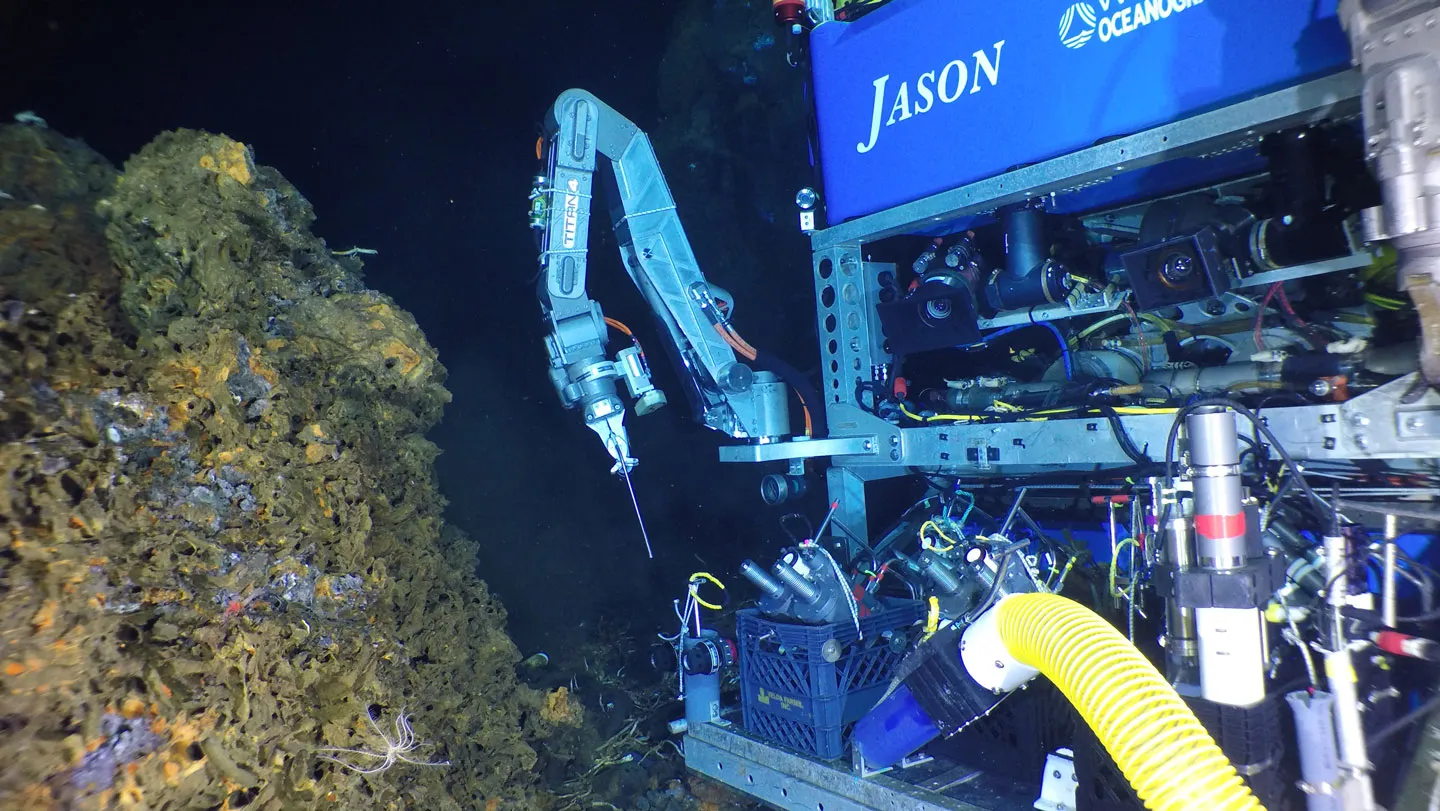
He and colleagues employed a remotely operated robot called ROV Jason/Medea to descend to more than 6,000 meters and explore the Mariana Trench seafloor around the edges of Challenger Deep. The rocks turned out to contain pyroclastic deposits, evidence of an erstwhile explosive volcanic eruption. Those deposits included platelike blocks that could indicate eruption pulses, and lobe-shaped rocks where the volcanic flows ended and quickly cooled.
Robert Stern/UT Dallas
These are the deepest pyroclastic deposits found on Earth, the scientists report November 23 in Frontiers in Earth Science.
How explosive an eruption is at Earth’s surface depends on the chemical makeup of the magma. When the molten rock contains a high proportion of volatile gases, including water vapor, those gases suddenly expand when the magma reaches the surface, producing a violent explosion.
Such explosive volcanism shouldn’t be possible in the deep sea; the pressure is too high for any escaping gases to expand, Stern says. Along with that mystery, the volcanic deposits were found unusually close to the trench, compared with what would be expected for a subduction zone.
Stern and his colleagues developed a hypothesis that incorporates these disparate pieces of evidence: The extreme depth of Challenger Deep, they say, may be at least partially due to an especially sharp bend in the Pacific Plate as it sinks into the mantle.
That tighter bend would explain why volcanism is happening closer to the subduction zone than usual. The classic subduction zone scenario is that the sinking plate heats up and melts partially as it descends; the magma rises through the overhanging plate and erupts, forming volcanic island arcs several hundred kilometers from the collision zone. Here, the volcanic deposits were just a hundred kilometers or so from the trench — which makes sense if the plate is dipping more steeply.
As for the pyroclastics, “we can’t answer if the eruptions were really explosive,” Stern says. But at those pressures, any gases such as water vapor contained in the magma wouldn’t be able to explosively expand as they would at the surface.
Instead, the pyroclastic rocks might have formed through a new version of deep-sea eruption, one in which water emerging from the magma is initially in a supercritical fluid state. That would minimize any explosive expansion during the eruption and could also produce fragmented, dense deposits like those seen by Jason/Medea.
The discovery of deep-sea pyroclastics is “surprising and unprecedented,” says William Chadwick, a geologist at Oregon State University in Newport. Challenger Deep may be the only place on Earth “with the ingredients to produce explosive volcanism in the super-deep ocean,” he says. “Imagining this happening is … pretty mind-boggling.”
A lot more work remains to be done to evaluate all of these new ideas, Stern says. “But a lot of things are now coming together.”
