


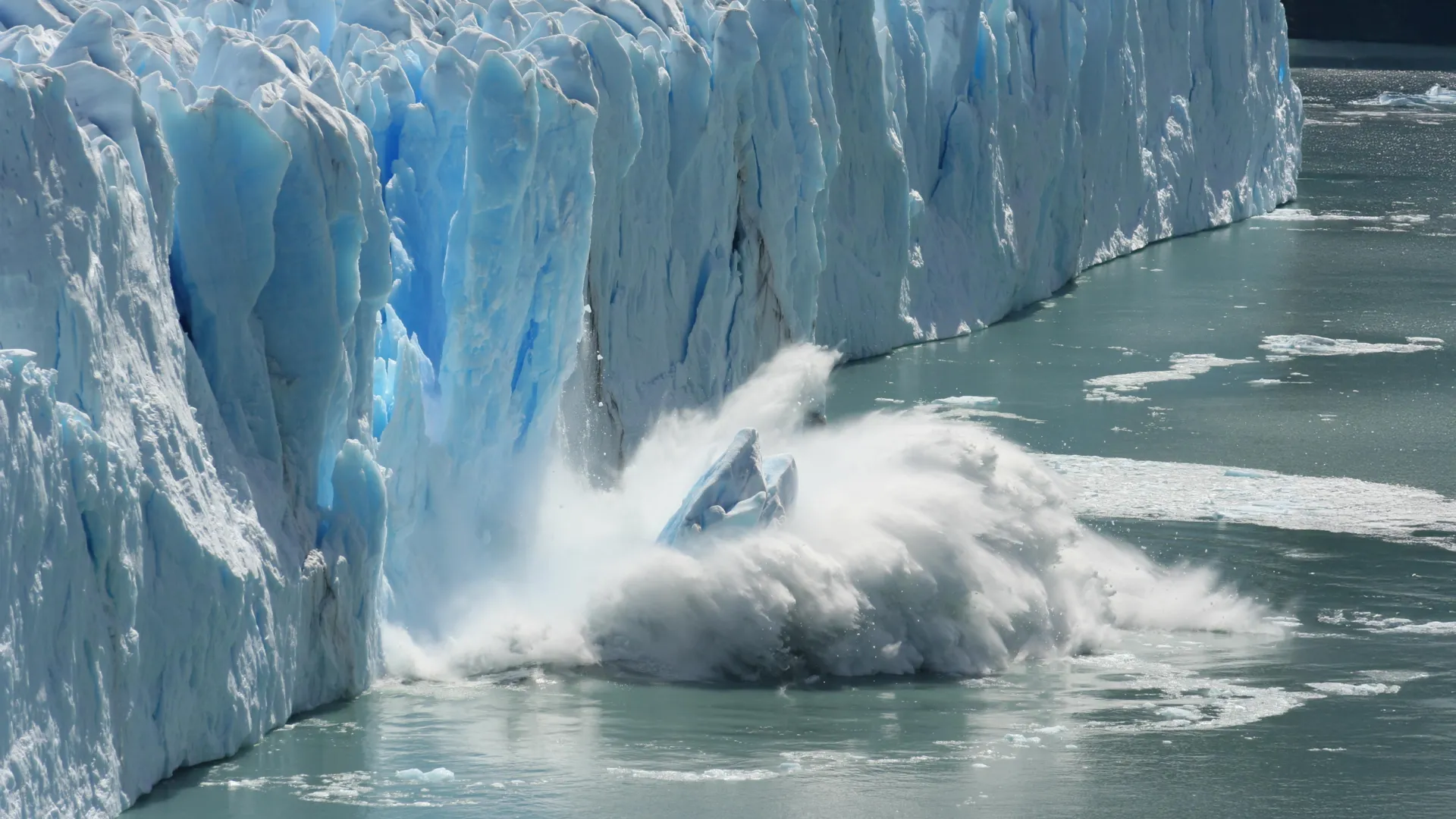
As temperatures rise, the floating ice shelves that help hold Antarctica’s massive ice sheet in place are melting and breaking apart at record rates. As these protective barriers disappear, they expose towering walls of solid ice. Whether these cliffs remain standing or collapse could play a major role in Antarctica’s future ice loss and its contribution to rising sea levels worldwide.
For years, scientists have believed that ice cliffs become unstable once they exceed 100 meters in height, roughly as tall as the Statue of Liberty. According to this theory, a cliff that grows too tall will collapse under its own weight, exposing an even taller wall of ice farther inland. That new cliff would then collapse, potentially setting off a chain reaction that causes the ice sheet to retreat rapidly.
But new research from MIT and the Woods Hole Oceanographic Institution (WHOI) challenges this long-standing assumption. The findings suggest that the fate of an Antarctic ice cliff depends on much more than its height, and that even dramatic collapses do not necessarily lead to an unstoppable retreat.
Published in the journal Science, the study examined satellite observations of more than 15,000 Antarctic ice cliffs collected over four years. Researchers discovered a surprising pattern: When the cliffs collapsed, they sometimes retreated much faster than existing models predicted. Yet rather than continuing to disintegrate, the affected glaciers soon stabilized.
“We found that when the cliffs were retreating, they were doing so faster than what has been modeled, which would mean more ice loss and higher contributions of sea level rise,” says study author Caroline Needell, a graduate student in the MIT-WHOI Joint Program. “But because we found that the retreat was short-lived, and all the glaciers eventually stabilized, that would suggest that things won’t be so bad. We don’t see this runaway effect.”
The study’s co-authors are Catherine Walker, an assistant scientist at WHOI, and Jeremy Bassis, an associate professor at the University of Michigan.
Why Scientists Expected Antarctica’s Ice Cliffs to Collapse
The possibility of runaway ice cliff collapse is described by a theory called marine ice cliff instability (MICI). It proposes that when an exposed ice wall reaches a critical height, its own weight makes it structurally unstable. If the cliff falls and reveals an even taller wall behind it, the process could repeat, progressively eating away at the Antarctic ice sheet.
Earlier research investigated this possibility primarily through computer models. Scientists used the physical properties of ice to estimate how enormous frozen cliffs should behave, then compared those calculations with a limited number of observations from Antarctica. These studies suggested that cliffs taller than approximately 100 meters were particularly vulnerable to collapse.
“Predictive ice-sheet models that have been used so far to represent ice cliff instability just take into account cliff height,” Needell notes. “That’s the only variable that matters. And once the cliff height reaches the critical threshold, usually 100 meters, it should initiate this runaway effect of ice sheet retreat.”
Needell and her colleagues wanted to test those predictions against a much larger collection of real-world measurements. They sought to determine how tall Antarctica’s ice cliffs actually become and whether their collapse consistently triggers the destructive chain reactions predicted by existing models.
Satellites Reveal Surprising Ice Cliff Stability
To investigate, the researchers turned to NASA’s Ice, Cloud, and Land Elevation Satellite-2 (ICESat-2). This spacecraft repeatedly travels over Earth’s polar regions, using a laser-based instrument called an altimeter to measure elevations with great precision. Its observations track the heights of glaciers, ice sheets, and sea ice, as well as ocean levels in and around Antarctica.
The team analyzed measurements gathered between 2019 and 2023, examining more than 15,000 ice cliffs at three-month intervals. Most were far shorter than the height considered dangerous by earlier models. The average cliff stood approximately 30 meters tall, although a small number exceeded the proposed 100-meter instability threshold.
The researchers also searched for characteristics that might explain why some cliffs remained stable while others retreated.
One important clue came from the broken ice accumulating in front of the cliffs. Known as mélange, this material consists of a slushy mixture of sea ice and fragments of icebergs. Cliffs that remained relatively stationary tended to have thicker accumulations of mélange, suggesting that the debris could help support the towering ice walls.
“We measured mélange height and found taller cliffs have thicker mélange, which could be a built-in stabilizing effect,” Needell explains.
Surrounding seawater provided another possible source of stability. The observations indicated that deeper water can exert greater supporting pressure against an ice cliff, helping counteract the forces that might otherwise cause it to collapse.
Together, these findings suggest that the stability of Antarctica’s ice cliffs cannot be predicted by height alone. Conditions in the water surrounding the ice may also determine whether a cliff remains standing.
Antarctica’s Tallest Ice Cliffs Collapse, Then Stabilize
“After we did that global analysis, we thought, ok, let’s zoom in on the tallest cliffs and see how they’re behaving,” Needell says.
The researchers selected four locations around Antarctica where satellites had recorded some of the tallest ice cliffs. Each stood approximately 100 meters high, with the tallest reaching 127 meters. The team then reconstructed how these cliffs changed at three-month intervals throughout the four-year study.
The results initially appeared to support the idea that extremely tall cliffs are unstable. These towering walls did collapse, and the glaciers behind them retreated at speeds substantially greater than those anticipated by existing MICI models.
However, the retreat did not continue indefinitely.
“But that retreat was short-lived,” Needell notes.
Instead of retreating farther inland in a continuous series of collapses, the glaciers stabilized and eventually advanced outward toward the ocean again.
“It’s this rapid retreat, punctuated by periods of stabilization,” Needell says. “That was puzzling to us. Then, we thought: We need to look at all the things that affect cliff height.”
The unexpected pattern suggested that some overlooked physical processes were interrupting the collapse before it could develop into a sustained chain reaction.
Hidden Ridges Beneath the Ice Act as Natural Speed Bumps
To understand what was stopping the retreat, the team examined the shape of the land beneath Antarctica’s ice sheet.
This underlying terrain, known as bed topography, can strongly influence the height and stability of the ice above it. When the ground is relatively flat, the visible slope of the ice more closely reflects the thickness of the ice itself. But when the terrain rises into a ridge or bump, the ice resting on that elevated ground is thinner than its overall surface elevation might suggest.
These buried rises can function like natural speed bumps. By reducing the thickness of the overlying ice, they can make exposed cliffs shorter and less vulnerable to collapse.
When the scientists compared the locations of stabilizing ice cliffs with measurements of Antarctica’s underlying terrain, they found that the cliffs frequently stopped retreating where the ground rose beneath them.
The researchers identified another important process. Taller cliffs tended to “thin out” more rapidly as they collapsed. Rather than remaining towering, unstable walls, they could quickly shrink into shorter cliffs that were better able to withstand further collapse.
These effects help explain why the researchers observed rapid initial ice loss followed by periods of stability, rather than the continuous retreat anticipated by earlier models.
What the Discovery Means for Future Sea Level Rise
The findings could help scientists improve predictions of how Antarctica’s ice sheet will respond to continued warming.
Although the researchers observed some cliffs collapsing faster than expected, the rapid retreat was temporary in the locations they studied. This challenges the assumption that crossing a particular height threshold inevitably leads to runaway collapse.
The results do not mean Antarctica’s ice sheet is safe from further losses. Instead, they reveal that predicting its future requires accounting for several interacting factors, including the shape of the land beneath the ice, the rate at which ice becomes thinner, the depth of surrounding water, and the stabilizing effects of broken ice.
“Now we know what to look for,” Needell says. “We really need to know the bed topography, and we need to know the ice thinning rate, in order to get ice cliff instability right, because this value really matters in the context of projecting sea level rise.”
By incorporating these additional processes into ice sheet models, scientists may be able to produce more reliable estimates of Antarctica’s future contribution to global sea level rise.
The research received partial support from NASA, the U.S. National Science Foundation, and the DOMINOS project, which is part of the International Thwaites Glacier Collaboration.
