


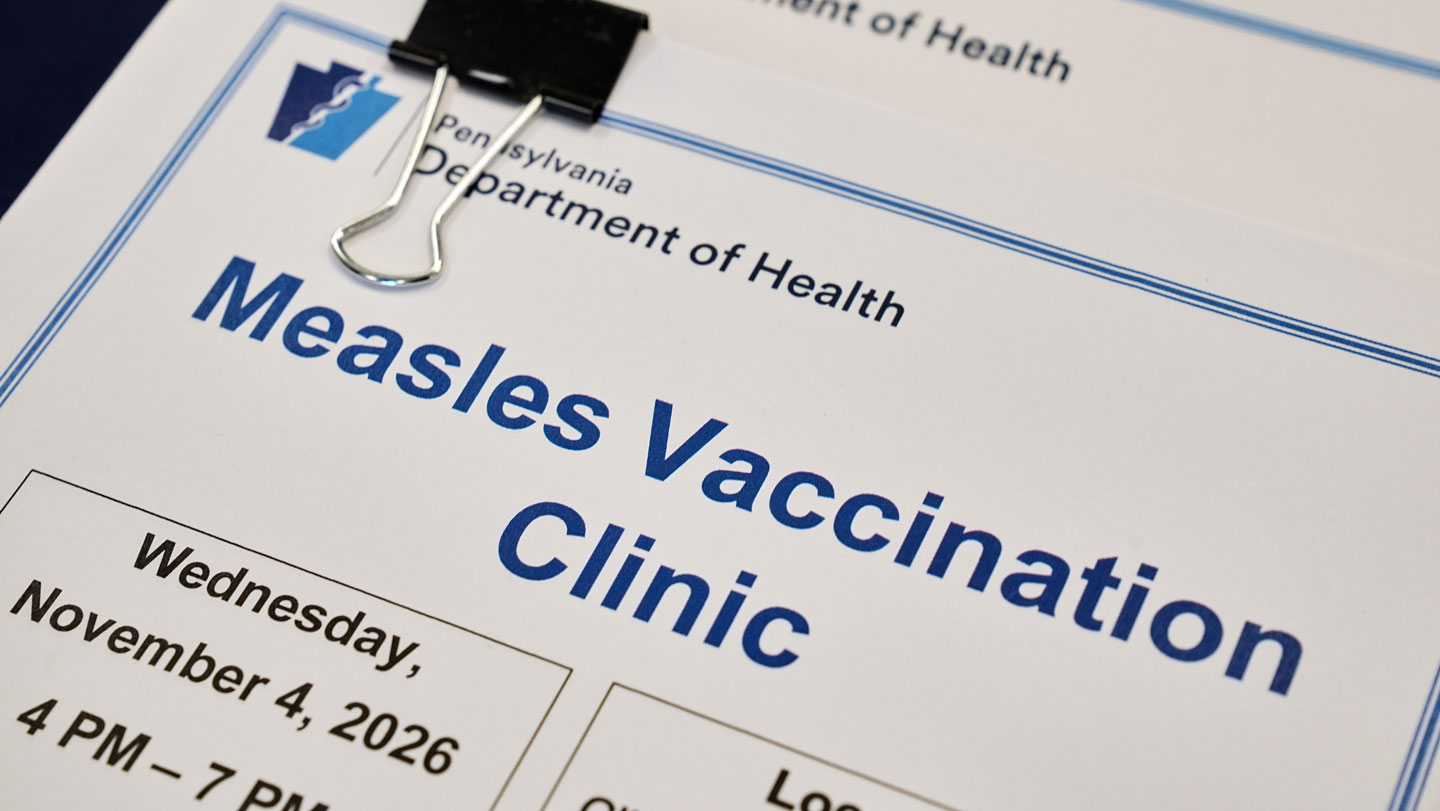
After two years with nearly 100 measles outbreaks, thousands sickened and nearly a dozen deaths, the United States has officially lost its measles elimination status.
The highly contagious disease is now endemic in the United States, the Pan American Health Organization declared November 17. Analyses of cases dated from when the first outbreak began in West Texas through the first half of 2026 revealed the virus has been spreading uninterrupted for more than a year. That benchmark signals measles is no longer under control.
The United States is not alone. Mexico and Bolivia also lost their measles elimination status, PAHO announced; Canada had lost it in 2025. But there is a way to banish measles again, experts say. Vaccinating people across the country, particularly in areas with low vaccination rates, will stifle the virus’s spread. But so far, the U.S. federal public health response has taken a back seat to efforts from state and local health departments to curb ongoing outbreaks.
Measles’s return “is an enormous black eye on the reputation of the United States,” said epidemiologist Jennifer Nuzzo of the Brown University School of Public Health in Providence, R.I., in a Nov. 9 webinar hosted by the university. The Americas led the global campaign to control the virus, and in 2016 the region became the first to eliminate measles transmission from all its countries.
“To lose [elimination status] means we’re going backwards… meaning decades of progress lost,” Nuzzo said. “It’s an indicator of our lack of protection. It is an indicator of our lack of preparedness for disease threats in general.”
Measles made an unwelcome comeback
PAHO’s verdict comes amid a surge of measles not seen in the United States since 1991. Health officials have recorded more than 7,000 cases since the beginning of the West Texas outbreak. That tally includes nearly 2,300 measles cases in 2025 and 5,412 in 2026 as of November 12, according to the U.S. Centers for Disease Control and Prevention. Over 90 percent of cases have been in people who are unvaccinated or whose status is unknown. States report that 13 people have died, although the CDC so far recognizes only nine of those deaths.
While mild measles symptoms include high fever, cough and a rash, roughly 1 in 5 people will be hospitalized with complications such as pneumonia or brain swelling. Children younger than 5 years and adults over 20 are more likely to get sick, as are pregnant women and their infants. At least 13 babies were born infected, called congenital measles, since the beginning of 2025, researchers report November 16 in NEJM Evidence. Those babies are at risk for developing dangerous brain swelling that is almost always fatal later on in life.
The measles, mumps and rubella, or MMR, vaccine helped eliminate measles from the United States in 2000. After that, cases still sometimes popped up. Those cases were mostly in unvaccinated people traveling from parts of the world where the virus still widely circulates. At least 95 percent of people in a community need to be vaccinated to prevent outbreaks.
But widespread misinformation, including a disproven claim that the vaccine causes autism, means fewer children are receiving the MMR shot and more people are questioning its safety. According to the CDC, roughly 92 percent of kindergarteners across the United States had gotten the vaccine in 2025, down from 95 percent in 2019. And in 2025, 83 percent of U.S. adults viewed the MMR vaccine as safe, down from 86 percent in 2024, according to a survey from the University of Pennsylvania’s Annenberg Public Policy Center. Yet decades of evidence show the vaccine is safe and highly effective.
That measles made a comeback is not a surprise, says Nathan Lo, an infectious diseases physician and epidemiologist at Stanford University School of Medicine. Until recently, outbreaks were largely isolated to communities with low vaccination rates and quickly contained. But now, outbreaks seem to be more likely to spill over into neighboring communities, Lo says. “There’s a lot of potential connectedness between the outbreaks.”
What’s more, some infected people aren’t getting tested, making them invisible to officials who are now struggling to trace chains of transmission. An outbreak that hit Arizona and Utah, for instance, was far larger than official numbers suggest, researchers reported July 15 in a preprint at medRxiv.org. The roughly 1,000 confirmed cases may represent just 20 to 30 percent of the outbreak’s true size.
A functional surveillance system is crucial to keeping outbreaks under control, Jonathan Temte, a family medicine physician at the University of Wisconsin School of Medicine and Public Health in Madison, said in the Brown University webinar. Without good surveillance across the entire country, “we can miss pockets out there if people aren’t reporting, if people are hiding cases.”
But surveillance alone won’t stop the virus from “popcorning across the country,” Nuzzo said. “Measles has returned, and it’s going to take vaccination to stop it.”
Efforts to boost vaccine uptake could be targeted toward areas with low vaccination rates. Most places across the United States still have vaccination rates high enough to fend off measles, but not all. “Figuring out which ones are [high risk] can be a little tricky,” Lo says. “But if you do, then intervening in those places can be quite helpful to mitigate spread.”
Homing in on school districts or individual schools could also help. State health departments typically report vaccination rates among school-age children by county. But that broad metric can hide high risk schools with low vaccination rates, epidemiologists Siyu Chen and Ana Bento reported in August in Nature Medicine. Computer simulations relying on data that included 50,000 schools across the United States showed that school-level estimates best revealed where the virus could gain a foothold. That was true even if county-level vaccination rates were close to 95 percent.
Another element that influenced where measles took off was whether communities with cases were near other areas with low vaccination rates, the team found. The outbreak in Texas, for instance, may have ended faster because communities with low vaccination rates were farther away from one another compared with outbreaks in South Carolina and Pennsylvania, says Bento, of Cornell University. Neighboring areas where many are unvaccinated may face longer-burning outbreaks. “Which is what we are now seeing,” Bento says.
The U.S. can eliminate the virus again
Measles elimination status can be regained. The declaration that the virus is endemic is “not a punishment,” Bento says. It’s a sign that something needs to change. That might include vaccine catch-up campaigns, community outreach or getting rid of nonmedical vaccine exemptions.
Local public health officials are “doing every last thing that you can imagine with limited resources,” health psychologist Noel T. Brewer said in a Nov. 12 webinar hosted by the Association of Health Care Journalists. But a cohesive plan at the federal level could bolster defenses before the virus arrives in new states, noted Brewer, of the University of North Carolina Gillings School of Global Public Health in Chapel Hill.
Such efforts could be targeted toward areas with low vaccination rates. Most places across the United States still have vaccination rates high enough to fend off measles. “A subset [with low vaccination rates] are high risk,” Lo says. “Figuring out which ones are which can be a little tricky. But if you do, then intervening in those places can be quite helpful to mitigate spread.”
There’s also wiggle room in the childhood vaccine schedule to provide kids extra protection. Normally children don’t get their first MMR dose until their first birthday. But doctors can give infants an extra MMR dose at 6 months if there is an active outbreak in their area. Pediatricians can also offer the second dose a month after the first one, rather than waiting until around the time children start kindergarten. Adults, particularly those who received only one dose, can also get a booster. It’s unclear whether health officials will officially recommend such actions.
“The problem is that there’s no trusted source for this vaccine decision anymore,” Lo says. Previous vaccine recommendations were up to the CDC’s Advisory Committee on Immunization Practices, which was disbanded in March after lawsuits blocked appointments made by Health and Human Services Secretary Robert F. Kennedy Jr. “Now, there’s a lot of different medical societies and initiatives to try and fill that void,” Lo says. But it’s unclear which would be best positioned to lead.
CDC director Erica Schwartz has said the health agency will not be changing its response to ongoing outbreaks. “We’re going to be doing the same exact thing that we’ve been doing today, which is working with the states” to raise awareness about measles and the MMR vaccine, she told Reuters. The CDC has not responded to Science News requests for an interview.
Eliminating measles again will take dedicated resources and more funding funneled to public health departments across the country, Lo says. “You see increasing measles outbreaks and a lot of time and resources to contain these outbreaks at a time where you’re slashing budgets,” Lo says, “that’s a really bad mismatch.”
Public health responses to measles are expensive. Officials in New Mexico spent an estimated $5.4 million — over $53,000 per case — responding to a 2025 outbreak that was linked to West Texas. As of September, the CDC had provided at least an additional $50 million to states to help fight measles.
Other countries have beaten back measles after an unwelcome return. Extensive vaccination campaigns helped Venezuela and Brazil regain measles elimination status after briefly losing it in 2017 and 2019. The Public Health Agency of Canada also announced that its nearly two-year-long outbreak officially ended in October, though it’s unclear when the country might earn its status back.
“It is not hopeless,” Nuzzo said. “It can be done, and I hope it will be done [in the United States].”
