


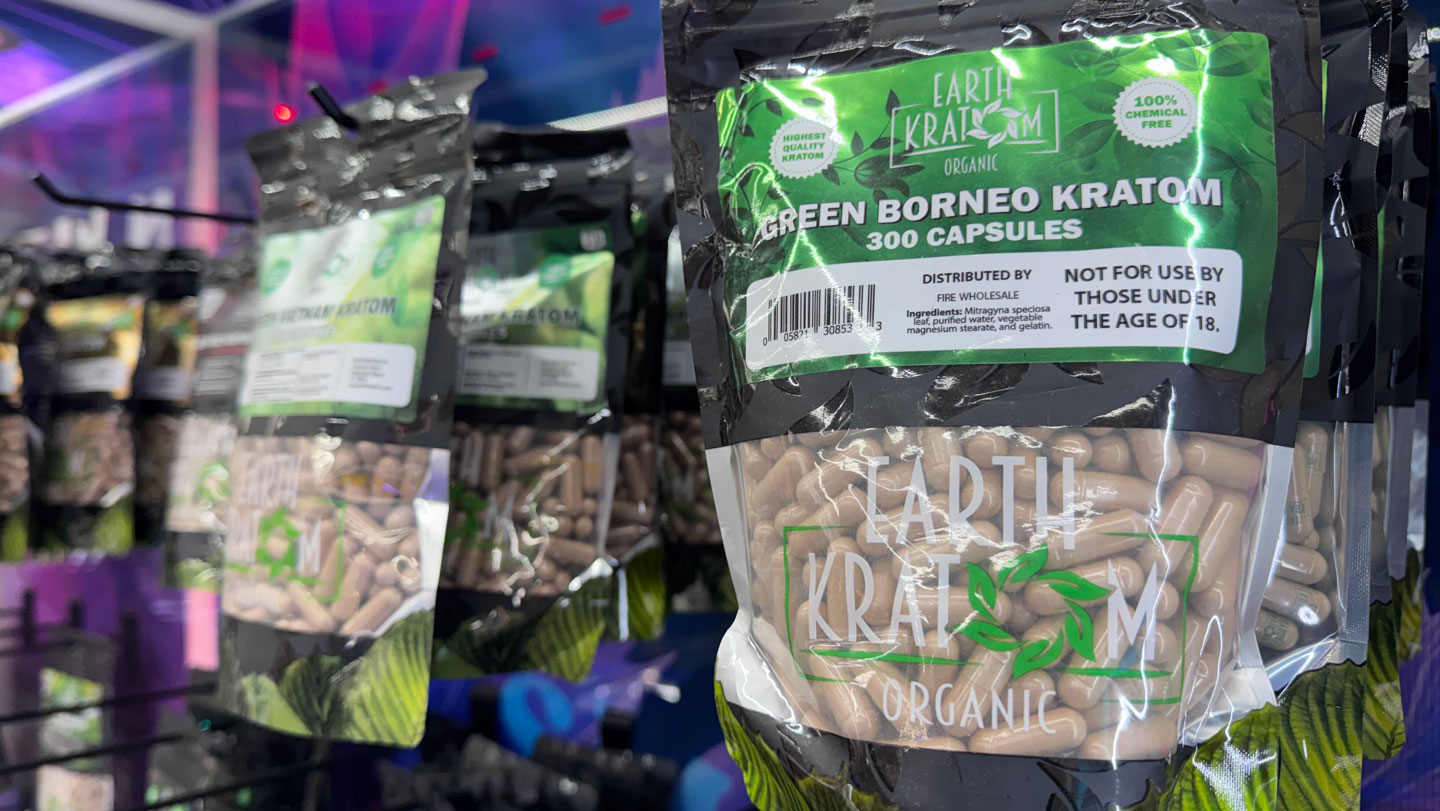
For the past few years, addiction specialist Roopa Sethi has been seeing a new set of patients. They show up at the University of Kansas Health System hospital in Kansas City with what looks like severe opiate withdrawal: nausea, vomiting and muscle aches. They’re extremely anxious and sometimes hallucinating. But they haven’t taken an opioid, like fentanyl or heroin. Instead, they’ve used something labeled as kratom, though it may not contain kratom at all.
Kratom is a plant used for chronic pain relief and to help people stay off opioids. But souped-up new versions with hyperpotent derivatives of the active compound are sold online and in gas stations. The derivatives act strongly on the body’s opioid receptors and are often far more powerful than the opioid drugs they are sometimes intended to replace. Kratom products — sold as pills, liquid shots, edibles and more — are often mislabeled, and state and federal regulations lag far behind.
A 2026 survey estimated that about 5 million Americans have used kratom or similar products, and the increased use has sent kratom-related exposures up 1,200 percent from only 258 exposures in 2015, according to the National Poison Data System.
Now, newer versions of the substance can produce withdrawal symptoms like nausea and vomiting, which are often so severe they bring people to the hospital. Here’s what to know.
How kratom works
Kratom comes from the dried leaves of Mitragyna speciosa, a tree native to Southeast Asia. Dutch scientist Pieter Willem Korthals first described it in 1839. But “without a doubt, it was used likely for centuries prior to that” in countries including Thailand, Indonesia and Myanmar, says Oliver Grundmann, a pharmacologist at the University of Florida in Gainesville. “Wherever there is a stream, these trees are growing there.” People chewed the leaves for a stimulant effect and brewed them into a tea to treat pain,” Grundmann says.
In the United States, kratom is billed pain treatment that is more “natural” than opiates like morphine, Sethi says. “When you take this product at low doses, it is used for waking up … but at higher doses it becomes opiate-like.” Others take it to treat withdrawal or cravings from opioid use.
The leaf form contains more than 40 different naturally occurring chemicals called alkaloids that could have psychoactive effects. The most important is mitragynine, which makes up two-thirds of the plant’s alkaloid content.
Mitragynine acts on the body’s mu opioid receptors. These receptors — found in the brain, spinal cord and gut — usually respond to natural peptide signals in the body such as endorphins, signaling cells to produce pain relief and release chemicals like dopamine. The receptors get their name from the most famous drug that binds to them: opium. Mitragynine is not derived from or related to opium or morphine but it binds partially to the receptor.
“It’s kind of like a dimmer switch versus turning on the lights,” says Mallory Pullman, a clinical toxicologist at the Mississippi Poison Control Center at the University of Mississippi Medical Center in Jackson. “You don’t fully light your room.”
Mitragynine also hits receptors that bind norepinephrine, serotonin and dopamine receptors, says Grundmann. The activity at adrenergic receptors creates a stimulant-like effect. “Now I think when we look at mitragynine, it’s primarily kind of this duality of the adrenergic and the opioid receptor activity,” he says, producing stimulating and depressive results in turn.
Labels may lie
What nature made, chemists and users are happy to tweak.
As the kratom leaf is dried, Grundmann says, tiny amounts of mitragynine metabolize into another alkaloid, 7-hydroxymitragynine, or 7-OH. After someone takes kratom, the body also converts some mitragynine to 7-OH. The small chemical tweak changes the compound from one that binds partially to the mu opioid receptors to one that binds fully — like morphine or opium, Grundmann says. 7-OH binds 10 times more strongly to mu opioid receptors than mitragynine does. The resulting product is far more potent in its effects and addictive potential.
When people use the leaves alone, the amount of 7-OH is extremely limited. But by the mid-2010s, scientists found products with more than 500 percent more 7-OH than in the plant alone, and now, consumers can buy products labeled as pure 7-OH.
While 7-OH can be described as “natural” because it can, in theory, occur in nature, toxicologists like Pullman are also seeing synthetic derivatives that are even stronger, including one molecule named MGM-15. MGM-15 is sold as a “research chemical” and is four times more powerful than 7-OH.
What is in kratom products may not always be what’s on the label, leaving users in the dark about what they are taking. In a 2026 analysis of 44 different kratom products, including tablets, dissolvable films and edibles, Pullman and her colleagues found that 85 percent of the products had contents that did not match the label. Some advertised kratom but contained very high levels of 7-OH. Others had alkaloids that weren’t listed at all.
It’s “very concerning at a consumer level if you can’t trust what’s actually on the label,” Pullman says.
Kratom’s risks and confusing regulation
Sethi started hearing the word kratom about 10 years ago in her work with people seeking treatment for opioid use. “I would have patients intermittently tell me about kratom use,” she says. People were using kratom to stay off opioids, or to treat pain, and didn’t report being addicted to the plant.
Now, it’s a different story, Sethi says.
Patients who started using kratom or 7-OH to get off opioids “now are having really bad withdrawal and cravings and ending up in the hospital,” she says. Some are seeking addiction treatment, not for opioids, but for kratom and 7-OH. In 2025, U.S. poison centers documented 3,434 kratom-related exposure reports, reported both by people who called the center and medical professionals. “I see less fentanyl and more kratom at this point, or more 7-OH,” Sethi says.
In July of 2026, the U.S. Drug Enforcement Administration temporarily classified some kratom derivatives as Schedule I drugs, meaning they have high abuse potential and no medical use. Those derivatives include 7-OH and another related kratom derivative, mitragynine pseudoindoxyl or MGPI, as well as MGM-15 and its powerful sibling MGM-16. The DEA re-upped the temporary scheduling of MGM-15 and 16 and MGPI in October. 7-OH was temporarily placed in Schedule I at any dose higher than that found in the kratom plant. The U.S. Food and Drug Administration has also issued statements warning consumers not to use the products. None of these measures affect the legality of the kratom leaf itself.
Regulations vary at the state level: Twenty-six states don’t regulate kratom at all, while six states and the District of Columbia list kratom’s ingredients as a Schedule I controlled substance, like the current federal scheduling. A further 18 states regulate sale and manufacture in some way.
“I think there’s a lot more concern now, especially that there might be potential opioids out on the market,” Pullman says. Regulations are trying to thread the needle between banning the plant and banning high-potency derivatives, knowing that when one derivative gets smacked down, another will quickly appear in its place. That cycle is a familiar one, mirroring the evolution and development of synthetic opioids.
“There’s risk with everything,” she says. “I think it’s important to distinguish the difference between a synthetic product versus the natural, and that way we can clearly attribute where the risk lies.”
