


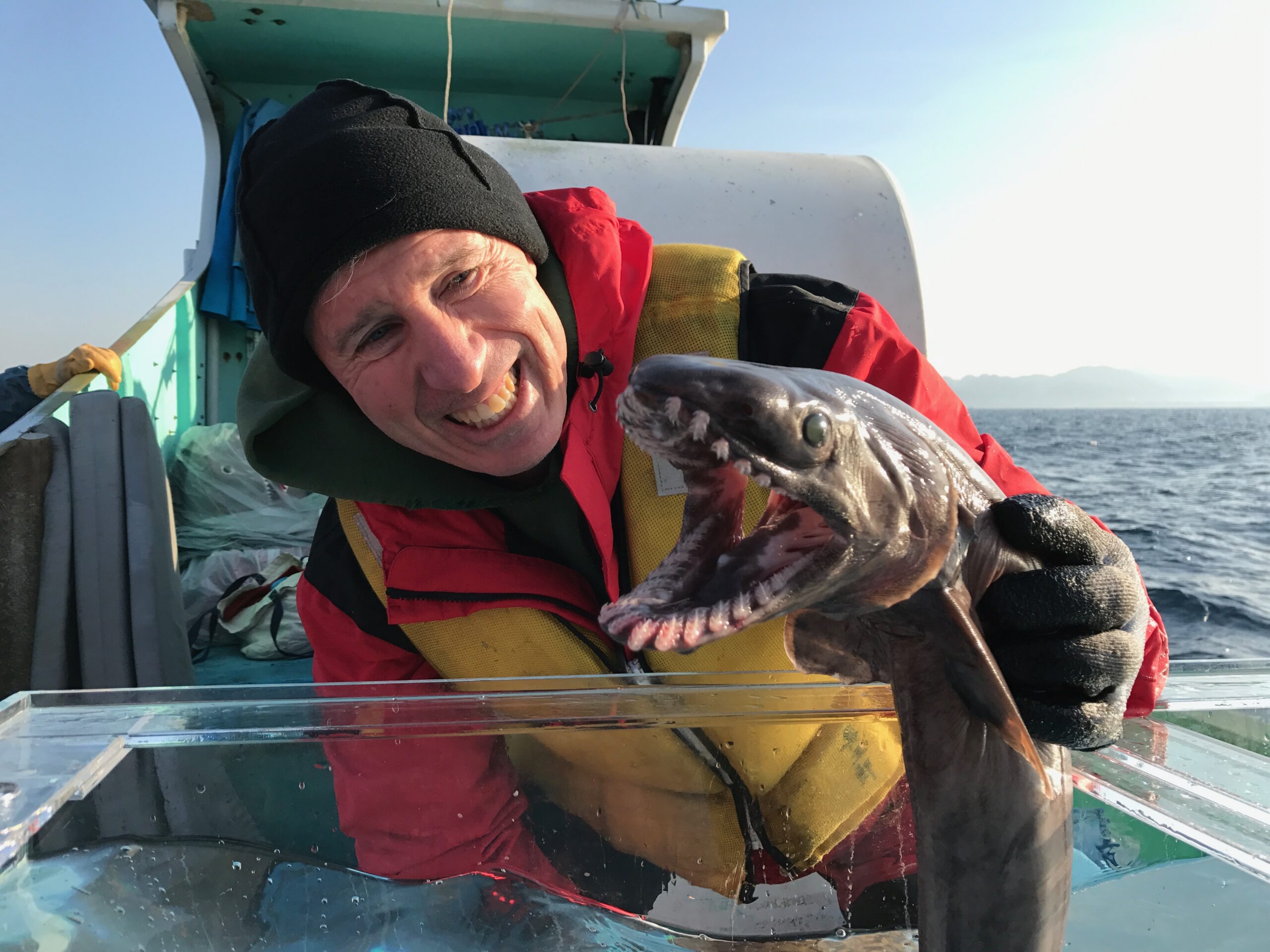
- David Ebert, known as the “Lost Shark Guy,” has spent four decades searching for little-known and rarely seen sharks, rays and chimaeras, describing 56 species new to science.
- Rather than diving in search of elusive species, Ebert works with local researchers and fishers, surveying fish markets and landing sites and training communities to identify and document sharks.
- Ebert says lesser-known sharks are important indicators of marine ecosystem health, yet researchers know little about the biology and conservation status of most species.
- A longtime advocate for overlooked marine life, Ebert also urges scientists to communicate their findings in accessible language and inspire younger researchers to study species that receive little attention.
If there’s an Indiana Jones of the shark world, David Ebert is it.
Known as the “Lost Shark Guy,” the Californian marine biologist has spent his career traveling the globe in search of little- or unknown species of sharks and their cousins, the rays and chimaeras.
It often begins with a photograph or a museum specimen of a shark not seen live in decades. Ebert will hit the road to try to confirm if the animal is still out there. He often ends up at pungent-smelling fish markets or remote landing sites, “up to my elbows in shark guts.”
The creatures he’s found have often been completely new to science. Over the past 40 years, Ebert has described and named 56 species, from the big-nosed lanternshark (Etmopterus bulbosus) and the Arabian black electric ray (Etronarce ramanamurthyi), to Lana’s sawshark (Pristiophorus lanae), named for his niece as a present for her college graduation. He has another half-dozen species in the pipeline.
“There’s nothing cooler than finding some sharks that are rare or a new species,” Ebert tells Mongabay. “You forget everything that stinks or smells around you when you start seeing some really cool sharks and rays like that.”
Ebert is a fierce advocate for lesser-known sharks and rays, of which there are hundreds.
“Everybody wants to go diving with the manta rays and the whale sharks, but there’s all these other sharks out here,” Ebert says. “I tell young people, if you want to make a name for yourself, find something nobody’s working on.”
An old-school taxonomist who came up as part of what he calls the “Jaws generation” of shark scientists, Ebert has charged full steam into the internet era. He has more than 10,000 followers on Instagram, is trying his hand at YouTube, and co-hosts a podcast, “Beyond Jaws,” where he interviews colleagues about their careers.
“He has just that incredible depth of experience and knowledge, and I think it’s very important to have Dave Eberts around inspiring the younger generation,” longtime shark conservationist Mark Erdmann told Mongabay.
Not that Ebert plans to hang it up anytime soon. At 68, his signature passion and enthusiasm show no signs of wearing thin.
“I don’t like to use the term retirement, because I’ll retire when they drop me in the ground, pretty much,” he says.

Mongabay’s Philip Jacobson spoke with Ebert about searching for lost sharks, how Jaws helped give rise to the field of shark research, the high school guidance counselor that impacted his life, and more. The following interview has been edited for length and clarity.
Mongabay: So what’s a lost shark?
David Ebert: A lost shark is the probably 95% of sharks that nobody’s ever heard of.
When people think of sharks, they tend to think of great white sharks, tiger sharks, bull sharks — the big toothy ones. But people don’t realize there’s about 550 species of sharks out there. And if you include the rays, there’s about 1,300 species. There’s all this wonderful diversity out there in these sharks, and yet nobody pays any attention to them.
The question is, why should people care about them? They don’t attack people. And the reason is because these lost sharks are more indicative of the health of the marine environment than those more charismatic species. These lost sharks are the proverbial canary in the coal mine, because by the time you notice there’s a problem with the white shark population, there’s probably been this whole trophic cascade of issues that have gone on below it, which is basically a lot of the other shark species.
A lost shark could also be a species that no one’s seen for 100 years. I go to a lot of out-of-the-way places, and if you go to these places you’ll find these things, but you need to go look for them. And so that’s really the message, to go see if you can find them.


Mongabay: How do you find one of these lost sharks?
David Ebert: Early on, it was just a matter of going out looking for species. When I was a graduate student in South Africa, I’d be out in the field for weeks, months sometimes, and I’d find these weird sharks, and I couldn’t figure out what the hell these things were. And I’d bring them back to my professor, Leonard Compagno, who was a world-renowned expert — he wrote Sharks of the World back in 1984, he was actually consulted on the original Jaws movie, he designed the mechanical shark, Bruce. I was really fortunate early in my career to meet him, he was the fellow traveler you want to meet in life. We got to be good friends, and I learned a ton from him. But I started bringing stuff back from Namibia and South Africa and showing him these things, and he’d go, “We haven’t seen this shark for 50 years,” “We haven’t seen this shark for 100 years.” It was the 1980s. So I was finding things nobody had seen in decades, and over time that sort of evolved. I came up with the lost shark moniker later.
How do you go look for them? Well, a lot of times it’s just going out to fish-landing sites and fish markets. A lot of the places I go to, a lot of people won’t go to, because of civil conflicts, weather, they’re really remote.

Mongabay: So you just pick a place and go explore? Or there’s a shark in mind you’re looking for?
David Ebert: I never go by myself, because I’ll waste time, and I don’t like to waste time. So I’ll work with local NGOs. I’ve been at this for 40 years, and I’ve developed a pretty good global network of people who will contact me and say, “Hey, I haven’t seen this shark or that shark in a long time.” And then we’ll go look for it.


Mongabay: Why do people call you? Do they know you have a certain skill set to find these lost sharks?
David Ebert: What I really do is I go to a lot of places and run identification workshops. ’Cause I’m only one guy and it’s a big world out there. That’s how you build the network over years, is just teaching local people what to look for.
The [U.N.] Food and Agriculture Organization back in 1999 released a thing called the international plan of action for sharks. And a lot of countries have developed national plans of action. Well, the first thing you need to do if you’re going to develop a plan of action is you got to know the species that occur in your country. So that’s where I come in: I’ll go there and work with local people, researchers, NGOs, government officials, whoever, and train them how to identify stuff, what to look for, how to take pictures. And then they’ve developed a relationship with me, and they’ll contact me to go look for these things.
I want to emphasize, I will always work with local people. I never go blundering into some area on my own.
Mongabay: So it’s fairly land-based. I think I’d imagined you at the bottom of the Mariana Trench, turning rocks over.
David Ebert: No, no [laughs]. That way, you’re only one person on the ocean looking for a shark. If I go to a village, there’ll be 50 to 100 boats coming in every day, so I have like a hundred times the chances of finding something than just me on the ocean. And if you’ve been to the fish markets, they don’t smell great, it’s hot, but there’s nothing cooler than finding some sharks that are rare or a new species. You forget everything that stinks or smells around you when you start seeing some really cool sharks and rays like that.
A lot of people won’t go do that. I’m not criticizing, but they’re diving with pretty manta rays or whale sharks. That’s really sexy and stuff. I’m slogging through places, and people ask me, “Do you have pictures when you were a young person?” And I say, “Yeah, but I’m up to my elbows in shark guts, because I’m at fish markets and stuff.” A lot of people get kind of squeamish about seeing that. They’d rather see pretty pictures of Dave diving with some cool sharks. That’s the thing — I’ll go places people won’t go.


Mongabay: So it’s all about positioning yourself where people are bringing sharks onto shore.
Dave Ebert: Right. Ideally at the landing sites. You go to the fish markets too, but when the boats are literally coming in, you just walk around looking at what they’re offloading. I used to walk with my old notepad writing everything down. Now with a cellphone, I just walk around taking pictures of everything.
If I say, “I’m going to go find this particular shark or ray,” I’ll never find it. If I say, “I’m going to go to this village and find a new species,” I’ll never find it. But if I’m just there surveying, walking around, looking, that’s when I’ll find stuff.

Mongabay: So you’re walking around a landing site or a fish market and you see a shark you don’t recognize. Then what?
Dave Ebert: Even something I recognize, I’ll take pictures of it, so I have a record. And then I’ll write down a list of everything I see at the end of the day. And a lot of times, you’ll find some little gems in there, like, “Oh, we didn’t know this species occurred here.”
I have a story I tell people. When I first went to Sri Lanka, about seven or eight years ago, I was describing a new species of shark from India based on one specimen. And about three or four months before I went, a colleague took some pictures of some shark they saw in Sri Lanka, pulled up by a fisherman, and it looked like this species I was describing from India. And so when I went to Sri Lanka, we went to talk to the fisherman. And it was the beauty of cellphones. I showed him the picture of this thing, and the guy was having a good time, he said, “Sure, come back tomorrow and we’ll have one for you.” So we went back the next day and damnit they had one in the boat. And I’m running around the beach going, “Fuck yeah!” I get a little excited sometimes. The chance of doing that, of going to a place for a couple of days and the guy’s actually got one, it’s rare.

Mongabay: And that was a new species.
Dave Ebert: Completely new to science. And it turns out they do catch it periodically, but because they’re small, the meat’s not very good, and they’re not oily, they just throw them back. And it was because some guy took a picture that knew somebody that knew me and sent it to me, and I was coincidentally going to Sri Lanka, that all these things fell into place. That’s my life, just this crazy fly-by-the-seat-of-your-pants thing.
Mongabay: Did you name the shark?
David Ebert: Yeah.
Mongabay: What’d you call it?
David Ebert: Planonasus indicus is the scientific name, but it’s the eastern Indian Ocean dwarf false catshark.


Mongabay: How’d you get into this lost shark stuff initially? I know you were doing your Ph.D. in South Africa, and then you’re finding all these sharks people haven’t seen — that’s in South Africa or farther afield?
David Ebert: That was South Africa. It was Namibia. I spent time in Taiwan, I found a whole bunch of stuff in Taiwan people hadn’t seen for decades. Did some research cruises, we’d go out and catch either new species or things we couldn’t identify. It took us a while to figure out what they were, and it turned out like, “Oh yeah, this thing was described back in 1880 and nobody’s seen one in like 100 years.”
Keep in mind, today you have the internet and you have a lot of resources. But back in the day, when you had nothing, you had to go to the library, you had to go find a reference. I was fortunate in South Africa because they had some really old reference libraries and I could find the original descriptions of some of these things. Or you’d have to go to the Natural History Museum in London or someplace. It wasn’t like I could send somebody an email and get a PDF the next day. It was a little more challenging than that. But you just stick with it, and you really have to focus in on what you’re looking at too.
Mongabay: Sounds like detective work.
David Ebert: It’s like the TV show CSI, except instead of a crime scene, it’s a shark scene investigation.

Mongabay: What’s the first lost shark you ever went looking for?
David Ebert: So I was in South Africa maybe six weeks, and Leonard says, “Hey, I want you to go out to Bird Island off the coast there. There’s this guitarfish nobody’s seen since 1926. Why don’t you go out and see if you can find this thing.” I was young, eager, and I wanted to go out there anyway to start looking for sevengill sharks [the subject of his Ph.D.]. And so I went, I was waiting by Bushman’s River for a South African Defence Force helicopter, it came, landed, took supplies out there, and me. And so I spent about a week, 10 days, to see if we could find this guitarfish. And that was back in 1986. And here I am 40 years later, and I finally found the damn thing.
Mongabay: It took you 40 years?
David Ebert: Well, we got one about two years ago. It was the first one we got. I was pretty excited, but I’d been kind of heartbroken by this one guitarfish, so I wanted to make sure we actually had it. They’d filmed this thing just up the coast from Bird Island, they were doing some ROV [remotely operated vehicle] work there. And at first I couldn’t figure out, like, what the heck guitarfish is this? And then about two years ago we got this one from Mozambique. We got genetics on it, we got morphometrics, we compared it with the holotype, which was one specimen from 1926.
Unfortunately Leonard passed away almost two years ago now, before I was able to confirm that I found this thing. It would have been kind of cool to tell him, “Hey, I found it.”

Mongabay: So when no one’s seen a shark in 40 years, do you assume it’s still out there? Or do you consider it might be extinct? Only one marine fish is classified as extinct due to human impacts, and that’s the Java stingaree (Urolophus javanicus).
David Ebert: Right. And the Java stingaree is another one where we only know it from one specimen, caught in 1862. Julia Constance, that was her honors project, I was a co-author on that paper, and last year Julia and I went to Jakarta and looked around the Java Sea. And I think its habitat’s just been completely destroyed. The Java stingaree has probably been gone easily over a hundred years. And we only know that from one specimen in a museum in Europe. Otherwise we’d have no idea that thing ever existed. Which gets you thinking: How many other things have disappeared that we don’t have any idea have disappeared?

Mongabay: Are there still lots of species nobody’s working on?
David Ebert: Yep. Everybody’s like, “Well, we’re going to go study white sharks or tiger sharks or bull sharks.” Well, do you really need to have the 1,100th person studying any of those species? Pick something no one’s doing anything on. I wouldn’t necessarily say pick something nobody’s seen for 60 years, but there’s a lot of species, and they’re mostly smaller sharks that we know nothing about. And you get access to samples, because if you go to fish-landing sites and fish markets, you can get dozens or hundreds of these things sometimes, and you can work them up and learn something about their life history, their biology, what’s their habitat, how old they get, how many young they have — just that basic information can help immensely in doing [IUCN] Red List assessments, and it can all go into your country’s national plan of action.

Mongabay: So with some of these sharks, you’re telling me we don’t even know their basic attributes?
David Ebert: Yeah. For most shark species, 90, 95%, we know nothing.
If you study some of these other sharks that we don’t know anything about, you can become an expert in that shark and you’ll be the go-to person for it. And when you’re a young person, that’s kind of cool. And the skills you learn will translate into whatever you want to do later on.


Mongabay: What skills are most important for young researchers to develop?
David Ebert: The two best skills I tell people to learn are to speak publicly, to be able to give a talk to a general public audience, and to write, to be able to publish in a scientific journal. Not that you need to publish like crazy, but to get some stuff out there, to get your findings in the literature so that people go back and cite your work. And then to be able to convey it in a way that the average person can understand. Because too often people in my field, we get really enthusiastic, but we’re throwing around a lot of jargon that the average layperson has no idea what we’re talking about. And those are the people you got to be able to converse with. I’m not saying dumb stuff down, but it’s all about what kind of words you use to convey stuff to people.
One of the best examples I use is, you got the regular sharks, you got the rays — which are really flat sharks, is what they are — and you got these ghost sharks. And in a lot of places the ghost sharks are called chimaeras, ratfish, those kinds of names. About 15 years ago I got on to calling them ghost sharks, because some places in the world call them ghost sharks. My God, you cannot believe the power of using the correct words. I had a paper in Science magazine, it was on the cover of Science, and the day before that came out, I had a new species of ghost shark I described. The ghost shark got far more publicity than a Science paper. I had media calling me from Europe, from Asia, wanting to find out about this ghost shark from Thailand. The point is, if I use “chimaera,” it’s just crickets, nothing. If I use “ghost shark,” suddenly everybody’s paying attention.
You probably heard the term “rhino ray” is used for a lot for wedgefish and bowmouth guitarfish — they have a long nose. Well, I’ve been promoting to use the terminology “shark ray,” because those things are half-shark, half-ray. I can tell you from giving talks that if I say “rhino ray,” everybody sits there just polite. But if I say “shark ray,” the fricking room just gets electric, because they want to know about the shark ray. But this is where scientists are kind of our own worst enemy — it’s like, “Well, no, Dave, we’ve got to call them this, because that’s more applicable.” I go, “Well, do you want people to listen to you or not?” And so we kind of defeat ourselves at times.

Mongabay: As someone who’s been working on sharks for decades, have you seen a change in public perception of sharks?
David Ebert: Oh, I could talk your ear off on this one, but I’ll make it short. I was in high school when the movie Jaws originally came out. And I can tell you, ’cause I have lived this, there really was no field of shark research at the time. And you hear all the negative stuff about Jaws and Peter Benchley [author of the novel on which the movie was based ] and all that. And I get it, I’m in Monterey, where we do have shark attacks. Before Jaws, there’d be a shark attack and it’d be like a one-day story in the local paper. After Jaws, for a number of years it’d be a sensational thing. But there was no field for it, and nobody really wanted to go in and do sharks. Except in the late ’70s, early ’80s, people started asking a lot of questions, like how old do sharks get, where do they move, what do they do? And I was literally that first generation of, I always joke, called the Jaws generation of researchers that just caught that right where it hit at the right time when the whole field of shark research started taking off. I think people miss the real story that Jaws created this whole field of shark research and conservation.

Mongabay: So many people I talk to in shark science, they got into it because they saw a documentary when they were a kid. But when you were a kid, I don’t think there were shark documentaries. So how’d it spark with you?
David Ebert: When I was about 5 years old, my parents gave me a book on sharks. And I thought they were the most amazing thing I’d ever seen. And I still have the book now. It inspired me. My parents kept thinking, “Ah, don’t worry, he’ll grow out of it.” And I still remember, it was my high school guidance counselor just before I graduated high school, you had to go in and see him, like, “So what are you going to be doing?” And I’m like, “Well, I’m going to go to college and I’m going to study sharks and travel the world.” And I still remember, he was sitting there with his glasses down, writing some notes, and he looks up at me and he goes, “Well that’s nice, Dave. Have you thought about a plan B?” I was like, “No.” This is 1976, so a year after Jaws came out. But I’d already had the passion. I’d seen Blue Water, White Death in the early ’70s. Great movie if you want to see another historical thing. But he didn’t dismiss it, he just said, “Well, good luck with that shark thing.” And I saw that counselor about 10 years later, just before I went to South Africa in 1986. And I asked him if he remembered talking to me, and he goes, “Oh yeah, of all the thousands of kids I advise, you’re the only shark guy who came in.” And I asked him what he thought, and he said, “You know, Dave, I see thousands of kids, 80% of them have no idea what they’re going to do when they graduate high school. You had a direction. I didn’t think the shark thing was going to work out, admittedly, but you had a direction, you had a focus. I wasn’t going to get in the way of that.”
Mongabay: I guess you can thank your parents for giving you that book.
David Ebert: Yeah.
Banner image: Ebert displays a frilled shark during the filming of “Alien Sharks: Stranger Fins” in Tokyo Bay in 2017. Image courtesy of David Ebert.
The lab-in-a-backpack busting illegal shark fins: Interview with Diego Cardeñosa
Latin America’s largest hospital complex cancels plan to buy shark meat

