

Close Menu
NCIJ Network NCIJ Network
    What's Hot

    Scientists may have finally explained why our brains and bodies are cross-wired

    November 4, 2026

    How a ‘living breakwater’ in Hawai‘i aims to create coral habitat and protect coastline

    November 4, 2026

    Trump Suffers Rebuke as Democrats Win Big in Congress

    November 4, 2026
    Facebook X (Twitter) Instagram
    Trending
    • Scientists may have finally explained why our brains and bodies are cross-wired
    • How a ‘living breakwater’ in Hawai‘i aims to create coral habitat and protect coastline
    • Trump Suffers Rebuke as Democrats Win Big in Congress
    • Hungary opens secret police files, 47 years after fall of communism
    • How Cisco defends at machine speed with OpenAI
    • Earwax’s surprisingly slippery but sticky properties deters insects
    • Artificial mangrove roots offer temporary shield for Thailand’s eroding coastline
    • U.S. Midterm Results: Where Democrats Can Thwart Trump’s Foreign Policy
    • About
      • Our Team
      • Editorial Policy
      • Editorial Independence
      • International Support
    • Trust & Standards
      • AI Usage Policy
      • Conflict of Interest Policy
      • Corrections Policy
      • Ethics Policy
      • Fact-Checking Policy
      • Source Protection
    • Get Involved
      • Guide for Sources
      • Support Independent Journalism
    • Legal
      • Cookie Policy
      • Privacy Policy
      • Terms of Use
    Facebook X (Twitter) Instagram
    NCIJ Network NCIJ Network
    Wednesday, November 4
    • Home
    • World
    • Ai
    • Business
    • Politics
    • Health
    • Crypto
    • Science
    • Technology
    • Cybersecurity
    • Defense & Security
    • Economy
    • Energy
    • Europe
    • More
      • Fact Check
      • Investigations
      • Opinion & Analysis
      • Environment
    NCIJ Network NCIJ Network
    Home»Environment

    Artificial mangrove roots offer temporary shield for Thailand’s eroding coastline

    NCIJ NETWNCIJ NETWORKBy NCIJ NETWNCIJ NETWORKNovember 4, 2026 Environment No Comments3 Mins Read
    Share
    Facebook Twitter LinkedIn Pinterest Email

    Coastal communities near Bangkok in Thailand are testing artificial mangrove roots to combat severe shoreline erosion, reports Mongabay’s Carolyn Cowan.

    The shorelines of Phra Samut Chedi district, located in the Chao Phraya River Delta where Bangkok’s main waterway empties into the Gulf of Thailand, is especially vulnerable to erosion. Each year, strong surges claim 20 to 60 meters (66 to 200 feet) of land, and wave energy regularly collapses dikes and inundates aquaculture farms. Several methods of protecting the coast — from mangrove restoration to bamboo fences — have proved ineffective.

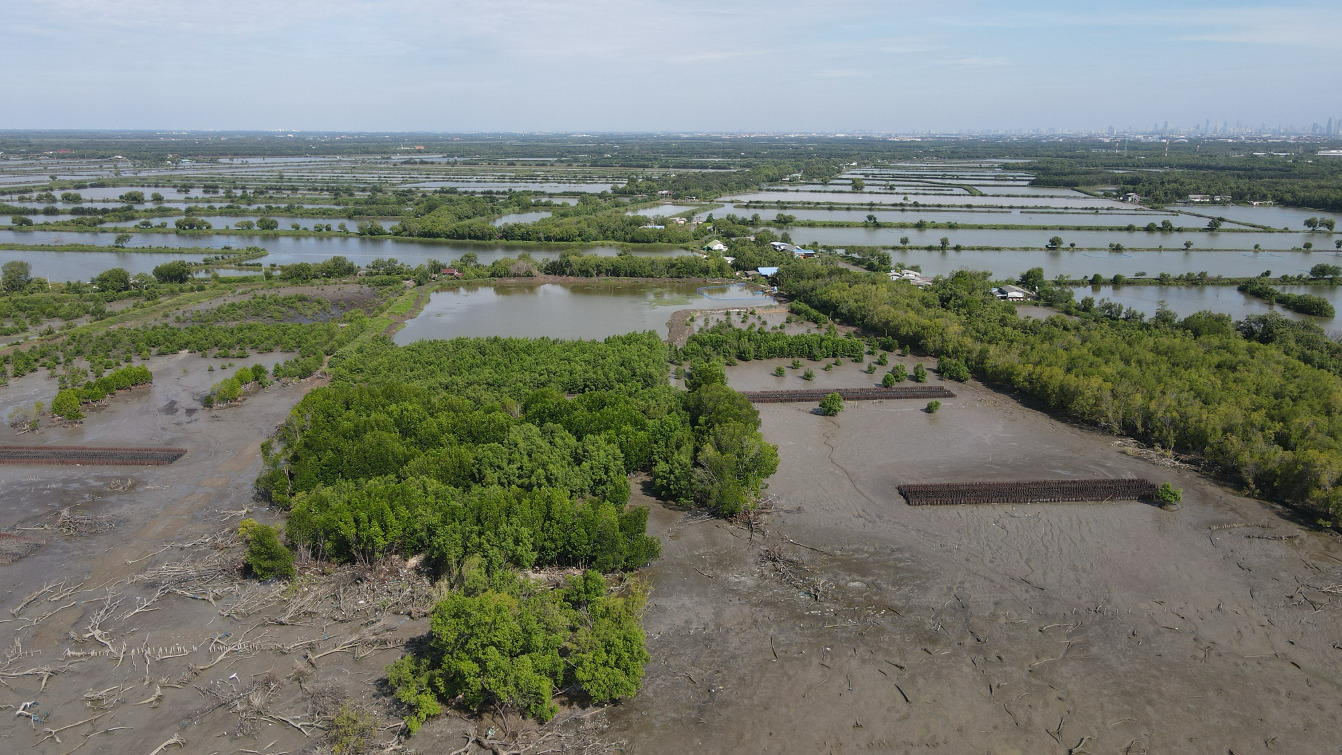
    Researchers recently evaluated a new method: they installed artificial mangrove root systems that mimic the shape of natural mangrove roots, to see whether these would also mimic their function and prevent loss of land to the sea.

    A 15-month trial at 11 sites in Phra Samut Chedi and other parts of Samut Prakan province showed some success, according to a recent study. It found the engineered mangrove roots captured 16 to 88 centimeters (6 to 35 inches) of sediment behind them across 10 locations.

    Unlike hard-engineered structures or short-lived bamboo fences that quickly break down into marine debris, the composite wood-plastic and rubber structures of the artificial mangrove roots allow water to flow through, the researchers said. This creates localized turbulence that encourages suspended mud to settle onto the seabed, they added.

    “Aquaculture farmers sent us a video of the waves hitting their dikes,” Butsawan Bidorn, senior author of the study and an assistant professor of coastal engineering at Chulalongkorn University, Bangkok, told Mongabay. “By the next day, the dike had collapsed and they’d lost everything. They need urgent action — the erosion can cause damage overnight.”

    Butsawan said that while the structures imitate root function rather than exact anatomy, their fast modular installation provides a crucial intermediate pathway for vulnerable communities.

    Field evaluations several months after installation showed that raised sediment levels behind the structures had allowed shrimp farmers at one site to rebuild mud dikes. At another site, it had enabled landowners to resume replanting mangrove seedlings.

    Sompratana Ritphring, an associate professor of water engineering at Kasetsart University in Bangkok, who wasn’t involved in the study, said that while the engineered mangrove roots are an interesting intervention, such a system can’t serve as a universal or permanent fix.

    “At best, it should be a temporary or enabling engineering component that helps create conditions in which a real mangrove ecosystem can establish itself,” Sompratana said. “The ultimate objective should be a functioning natural system, not a coastline permanently dependent on artificial structures.”

    Sompratana added the structures should also be monitored long term so the materials used in them don’t end up as marine litter.

    Read the full story by Carolyn Cowan here.

    Banner image: Aerial view of artificial mangrove root units installed at a study site seaward of an intensively farmed aquaculture zone, with Bangkok’s skyline in the distance. Image courtesy of Warit Charoenlerkthawin.


    Artificial coastline eroding Mangrove offer roots shield temporary Thailands
    NCIJ NETWNCIJ NETWORK
    • Website

    Keep Reading

    How a ‘living breakwater’ in Hawai‘i aims to create coral habitat and protect coastline

    Scientists call on Ecuador to stop the rising trafficking of Galápagos iguanas

    Federal Plan to Elevate Miami Homes Meets Skepticism

    Microplastics pollute nearly two-thirds of corals in Malaysia’s marine protected area, study finds

    Togo’s growing belief-based use trade sweeping up avian biodiversity, says study

    Do not ‘engage formally’: UK officials advised against billionaire-run zoo ahead of CITES meeting

    Add A Comment
    Leave A Reply Cancel Reply

    Editors Picks

    Scientists may have finally explained why our brains and bodies are cross-wired

    November 4, 2026

    How a ‘living breakwater’ in Hawai‘i aims to create coral habitat and protect coastline

    November 4, 2026

    Trump Suffers Rebuke as Democrats Win Big in Congress

    November 4, 2026

    Hungary opens secret police files, 47 years after fall of communism

    November 4, 2026
    Latest Posts

    Florida Race to Replace Byron Donalds Features Candidates Who Have Already Run for Congress

    August 17, 2026

    As rubble clears, Colombia begins focusing on recovery after the earthquake | Earthquakes News

    August 17, 2026

    Trump Shrinks U.S.-South Korea Military Drills to Appease North Korea

    August 17, 2026

    Subscribe to News

    Get the latest sports news from NewsSite about world, sports and politics.

    NCIJ Network is an independent digital news platform delivering trusted investigative journalism, European and global news, in-depth analysis, and fact-based reporting with accuracy, transparency, and integrity.

    Facebook X (Twitter) Instagram Pinterest YouTube

    Scientists may have finally explained why our brains and bodies are cross-wired

    November 4, 2026

    How a ‘living breakwater’ in Hawai‘i aims to create coral habitat and protect coastline

    November 4, 2026

    Trump Suffers Rebuke as Democrats Win Big in Congress

    November 4, 2026

    Subscribe to Updates

    Get the latest creative news from FooBar about art, design and business.

    Type above and press Enter to search. Press Esc to cancel.