


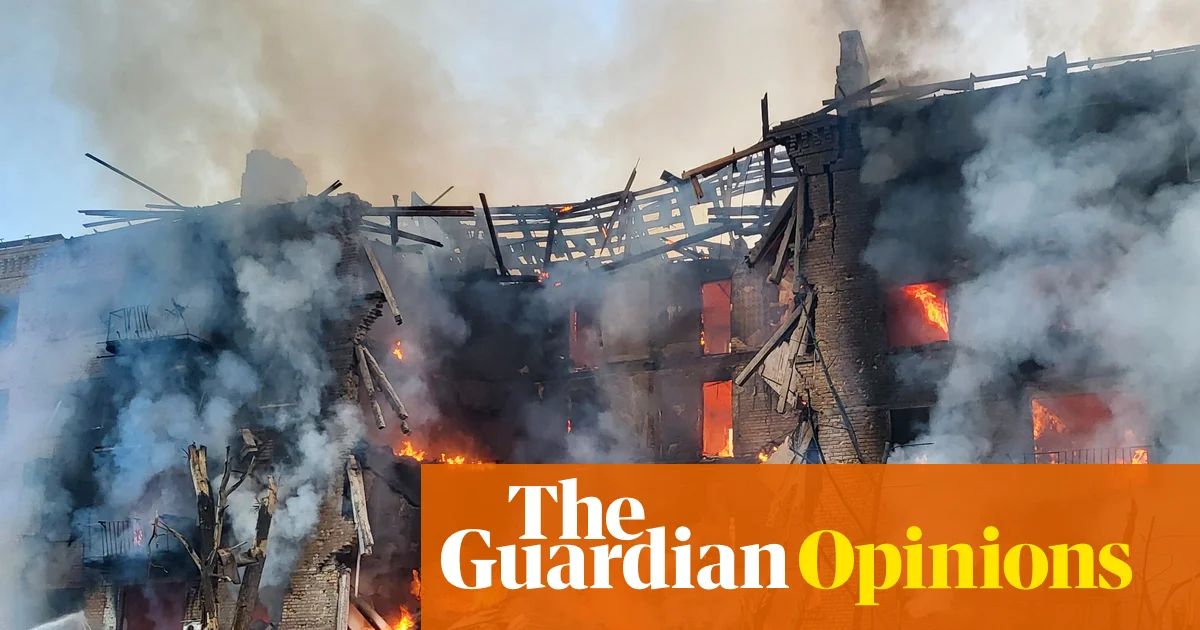
Explosions woke me at 3am the other night. Sitting on the bathroom floor behind two load-bearing walls, scrolling through Telegram to see where Russian missiles were heading, I noticed the light was on. Power had returned while we slept. On pure autopilot, I stood up, stuffed laundry into the washing machine, set a quick cycle hoping it would finish spinning before the next blackout, and sat back down to wait out the attack.
In our fifth year of full-scale war, air raid apps have introduced a new bureaucratic absurdity: threats are colour-coded into yellow for drones and red for missiles, as if a “yellow” drone alert were merely a light autumn drizzle. This one was red. But honestly, ballistic missiles are almost convenient. Unlike the Russian drones that buzz monotonously for an hour and under which we now simply roll over and keep sleeping, hoping for the best, ballistic missiles take just minutes to arrive. A five-minute break on the bathroom floor barely interrupts your sleep, or your laundry.
On Sunday night, when hackers attacked the Ukrainian emergency alert app to warn of an imminent nuclear strike, we didn’t even notice – everyone uses their favourite Telegram channels anyway. After five years of cross-checking missile trajectories in real time, you are simply too exhausted to waste calories on a fake apocalypse, and too prepared for the real one.
I first learned how quickly humans become accustomed to artillery in Mariupol in 2014. Twelve years and two lost homes later, here in Kyiv, the boundary of normal has shifted again. It has been a golden autumn so far, not yet freezing – but after Russian strikes on power plants and substations, blackout schedules have returned. Winter hasn’t even started, yet I am already exhausted by the idea of the winter to come. It feels like clocking in for a six-month shift at an unbearably boring job.
While the washing machine hummed beside me, I switched from missile radars – checking the districts where my family and friends sleep – to international news. On my screen, it was protest season across Europe: thousands of people marching through western capitals, shouting into megaphones, filling the streets.
Watching them from the bathroom floor, I felt a sting of envy: for the vitality and the physical luxury of gathering in a massive crowd under an open sky, on properly lit streets, just to say you disagree. Ukraine is a nation of Maidans, shaped by street protest. Even now, we still come out for Kyiv Pride, the Women’s March, weekly rallies for prisoners of war, or to protest against government decisions. Yet under martial law, freedom of assembly is restricted because in Kyiv any large crowd is an instant target for a missile.
But there is another reason our streets are quiet. Rage requires energy. To be passionately furious for hours, you need reserves to call on.
At 9.49am, a push notification from the power company popped up alongside a tiny dead-battery icon: “Schedules are no longer in effect.” Four-hour blackouts had stretched into six, then two slots of six, and finally emergency shutdowns. In our neighbourhood Telegram channel, the collective outrage of thousands of people was compressed into 39 angry face emojis and 12 praying hands. One scroll above in the same feed was a routine fundraiser for a frontline pickup truck, because the previous one had been destroyed and there was no transportation in which to recover the wounded. You tap an angry emoji, you transfer money for the vehicle, you move on.
Early in the invasion, our home backup battery lasted eight hours, running the wifi, laptops, fridge and lights. By last winter, when the temperature hit -20C, heating vanished for weeks and our flat dropped to 11C, we had entered an economy within an economy: unplugging even the fridge during 30-hour blackouts and moving food to the balcony, next to the camping gas stove where we heated water to wash our hair and fry eggs. You keep the car tank full, rotate water jugs in the hallway, calculate watts, renew the stock of batteries and buy warmer socks.
Something in the city catches fire from direct hits or falling debris every single night. Recently, a drone hit the high-rise right outside my window, setting its upper floors ablaze and killing a neighbour, so in the fifth year of full-scale war I finally sat down to update the fire safety protocols in my home.
Meanwhile, cafes and clubs are still open. We work, make plans, meet friends – sometimes for an exhibition opening, sometimes for a funeral. Only when the grid collapses do you realise how many appliances it takes just to step outside looking like a normal human being. Ironing a shirt is out of the question; taking a hot shower might be a problem; curling tongs are a distant memory; the hairdryer is rationed to two minutes on battery power.
After it gets colder, the local grid starts tripping. When the power returns for a brief two-hour window after marathon blackouts, the entire district simultaneously switches on boilers, washing machines, ovens to cook for three days ahead, and vacuum cleaners (I run mine during air raids too, because its roar drowns out air defence). Within 20 minutes, the overloaded substation blows itself out – taken down not by a Russian missile, but by us. In the building chat, a neighbour screams: “FRIENDS, STOP TURNING EVERYTHING ON AT ONCE!” Sure. Tell that to a mother of two toddlers with a mountain of wet laundry.
after newsletter promotion
During the shutdown, when our district goes dark, the streetlights and traffic lights go with it. I clip reflective strips on to my coat so drivers can see me at the dead intersections. I carry a torch and walk past pharmacies and coffee shops using petrol generators, each droning in its own register – dyr-dyr-dyr – their lights dimmed to save fuel.
When prolonged blackouts and frosts come, the city sets up warming tents, officially named Invincibility Points. Last winter, whenever my home battery ran out, I went and sat in one – another of Kyiv’s invincible titans in a puffer and a beanie, warming my hands around a paper cup of tea, charging my power bank, phone and laptop from a single extension cord, trying to meet a deadline. Around me, people did the same. Or they simply sat over coffee, chatting, glad to be somewhere warm and lit.
Right now, it is afternoon. I am back from my workout, and our scheduled blackout is in full swing. My husband, Sasha, and I keep a strict rule against plugging high-wattage appliances into our EcoFlow battery: no kettles, heaters or toasters, with the sole exception of our coffee machine, which Sasha bought in Mariupol weeks before the full-scale invasion in a burst of naive defiance.
I press the button. The grinder roars, and on the battery’s digital screen the remaining percentage drops in real time – eating the precious watts just to force hot water through ground beans. I take my espresso cup and sit down at my laptop. Outside, the air raid siren starts wailing again. I glance at the app on my phone: yellow. Good.
I go back to my browser with two tabs open: one on the protests in Europe, the other comparing CO2 and powder-based fire extinguishers for the flat.
-
Diana Berg is a Ukrainian artist, writer and cultural manager from Mariupol, and the founder of Platform TU, an independent cultural initiative now operating in exile after Russia’s full-scale invasion
