


As demand for artificial intelligence surges worldwide, China is looking to its renewable energy sector for an advantage in the race to build the data centers that fuel the technology.
Its vast wind, solar and battery industries could help power those facilities with cheaper electricity and bring them online faster by reducing reliance on conventional grid connections.
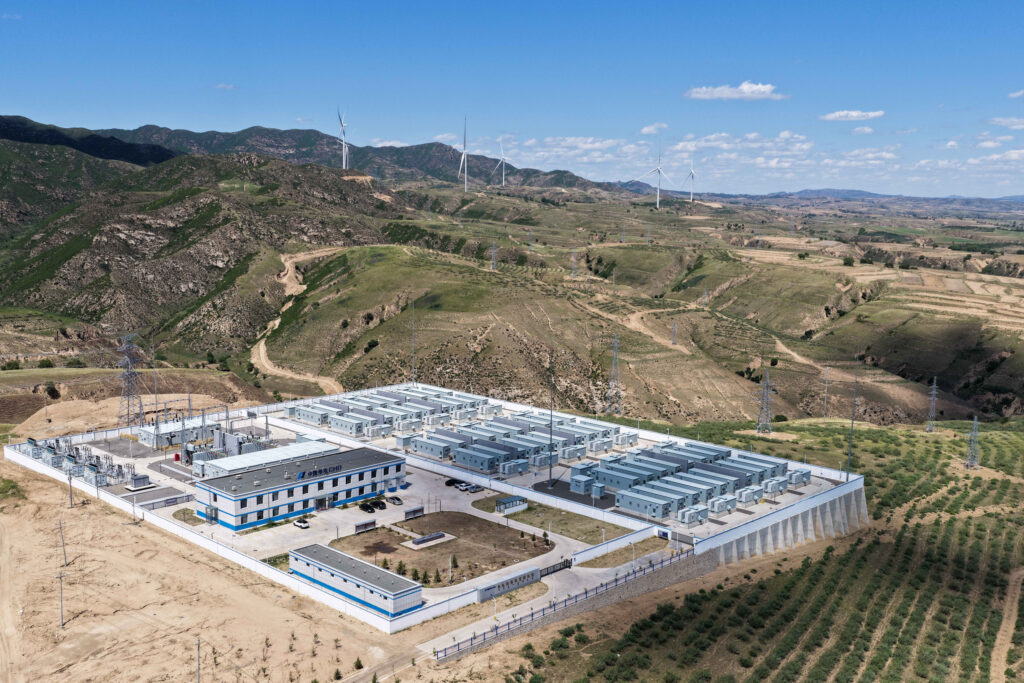
Envision Energy, the world’s second-largest wind turbine supplier, offers a glimpse of China’s approach. In August, the company began operating a data center campus in Ulanqab, Inner Mongolia, powered by renewable electricity supplied directly to the site. Envision says the facility could become the world’s largest standalone AI data center, with plans to expand beyond 2 gigawatts of capacity. The company also says customers can lock in electricity rates 20 percent below grid prices for a decade.
The project highlights the contrasting strategies China and the United States are pursuing to meet AI’s soaring energy demands. The Trump administration has scrapped a requirement that AI data centers built on federal land be paired with clean energy generation. China is taking a different path, targeting renewable sources for more than 80 percent of the electricity used by new data centers in its major computing hubs.
“It’s a sign of how serious China is trying to pair two goals together,” said Kyle Chan, a fellow at the Brookings Institution’s John L. Thornton China Center. “China doesn’t want a trade-off between having faster data center build-out but sacrificing on the energy transition.”
By 2030, China aims to expand its AI computing capacity more than sixfold. That expansion is driving up electricity demand. China’s computing centers consumed about 170 terawatt-hours in 2025, accounting for 1.6 percent of the country’s total electricity use. Beijing estimated that consumption will reach roughly 800 terawatt-hours, or about 6 percent of the national total, by 2030.
The plan also calls for annual renewable electricity generation to rise from 4,000 to about 6,000 terawatt-hours, a roughly 50 percent increase. China has a track record of surpassing its clean-energy targets. Between 2021 and 2025, annual renewable electricity generation was roughly 20 percent higher than targeted.
U.S. data center electricity demand is also surging. Lawrence Berkeley National Laboratory estimated that U.S. data centers consumed 176 terawatt-hours in 2023, accounting for about 4.4 percent of the country’s total electricity use. Its 2024 report projected that annual consumption could reach between 325 and 580 terawatt-hours by 2028.
Energy research firm Wood Mackenzie projects annual additions of 13.2 to 16.4 gigawatts of gas-fired capacity from 2026 through 2035, depending on demand growth. That is more than triple the annual average added from 2023 to 2025.
That surge threatens to erode years of progress in cutting U.S. power-sector emissions— and the potential climate impact extends beyond the grid. A separate Sierra Club analysis, reported by Bloomberg, projects that emissions from new off-grid data centers alone could reach levels comparable to Mexico’s total annual emmissions by 2030.
While testifying before the U.S. House Select Committee on Strategic Competition between the United States and the Chinese Communist Party in April, Chan described a divide in the AI race: the United States leads in large AI models and advanced chips, while China has an advantage in building power plants quickly and at scale.
China is adding generating capacity much faster, with renewables accounting for most of the growth. In 2025, it added an estimated 540 gigawatts of power generation capacity, more than 80 percent of that from renewable sources. During the same time period, the U.S. added 54 gigawatts, 60 percent from renewable sources.
David Fishman, a principal at the Lantau Group, an economic consultancy specializing in Asia-Pacific power and gas markets, agreed with Chan’s assessment of China’s ability to rapidly expand electricity supply.
“China can limit itself to renewable electricity for data centers because it already has such a strong ability to build regular electricity assets,” he said. “You can enjoy this luxury of saying, ‘We want green data centers.’”
This story is funded by readers like you.
Our nonprofit newsroom provides award-winning climate coverage free of charge and advertising. We rely on donations from readers like you to keep going. Please donate now to support our work.
Public opposition presents another challenge for data center expansion in the United States, with concerns about rising electricity bills emerging as an issue ahead of the midterm elections.
A recent Washington Post-ABC News-Ipsos poll found that 72 percent of Americans opposed building data centers in their communities.
In China, data center construction has not sparked a comparable public backlash, Fishman said. Their expansion has not raised retail electricity prices, and many facilities are located far from major population centers. Data centers are also just one of several sources of growing electricity demand in the country.
“If it doesn’t affect your costs, it doesn’t affect your power prices, what is there to worry about?” he said.
Siting data centers away from major population centers is part of China’s national strategy. Launched in 2022, the “East Data, West Computing” initiative steers computing infrastructure toward less densely populated western regions with abundant renewable energy resources.
Inner Mongolia illustrates the appeal. China’s third-largest provincial-level region covers an area roughly 1.7 times the size of Texas and has one of the country’s lowest population densities. About 62 percent of its residents live in urban areas, leaving much of its countryside and desert sparsely populated.
The region also has substantial wind and solar resources. Speaking at an economic forum in June, regional Vice Chairman Zhiqiang Huang said Inner Mongolia accounted for 57 percent of China’s wind power resources and 21 percent of its solar resources.
Chan said China’s ability to build solar projects quickly, combined with its large battery manufacturing capacity for energy storage, makes it easier to secure power for data centers. He sees this as a key reason China is building data centers faster. Chan argues that the United States retains an advantage in AI models and chip efficiency. Whether those strengths will be enough to keep it ahead in the AI race remains to be seen.
To do so, the U.S. must find ways to quickly expand electricity supply while addressing rising costs and community concerns. China’s challenge is whether its renewable energy advantage can keep pace with its ambitions for computing capacity.
“Both countries are trying to play to their strengths and address their own weaknesses,” Chan said.
About This Story
Perhaps you noticed: This story, like all the news we publish, is free to read. That’s because Inside Climate News is a 501c3 nonprofit organization. We do not charge a subscription fee, lock our news behind a paywall, or clutter our website with ads. We make our news on climate and the environment freely available to you and anyone who wants it.
That’s not all. We also share our news for free with scores of other media organizations around the country. Many of them can’t afford to do environmental journalism of their own. We’ve built bureaus from coast to coast to report local stories, collaborate with local newsrooms and co-publish articles so that this vital work is shared as widely as possible.
Two of us launched ICN in 2007. Six years later we earned a Pulitzer Prize for National Reporting, and now we run the oldest and largest dedicated climate newsroom in the nation. We tell the story in all its complexity. We hold polluters accountable. We expose environmental injustice. We debunk misinformation. We scrutinize solutions and inspire action.
Donations from readers like you fund every aspect of what we do. If you don’t already, will you support our ongoing work, our reporting on the biggest crisis facing our planet, and help us reach even more readers in more places?
Please take a moment to make a tax-deductible donation. Every one of them makes a difference.
Thank you,
