


- Indigenous Baniwa fishers share their fishing grounds in the Upper Rio Negro in the Amazon with otters and maintain a largely harmonious coexistence with these top aquatic predators by avoiding each other’s spaces at times, fishing different species and adjusting behavior.
- For many Baniwa, otters are the pajés das águas or spiritual guardians believed to protect fish and the aquatic world.
- The relationship between Baniwa people and otters has been one of evolution: Commercial fur trade involving the communities in the mid 1900s decimated both giant and neotropical otter populations, disrupting a human-wildlife relationship shaped by generations of Baniwa knowledge and culture.
- The Baniwa-otter relationship shows that human-wildlife coexistence depends on more than resource use, conflict avoidance or cultural beliefs alone, according to the researchers: It is also shaped by historical experience, behavioral adaptation, governance and relationships between humans and the natural world.
On a warm, humid morning, along the Içana River in Brazil’s upper Rio Negro Basin, researchers observed a group of Baniwa men heading to the river to check the fishing traps they left in shallow, fast-moving waters.
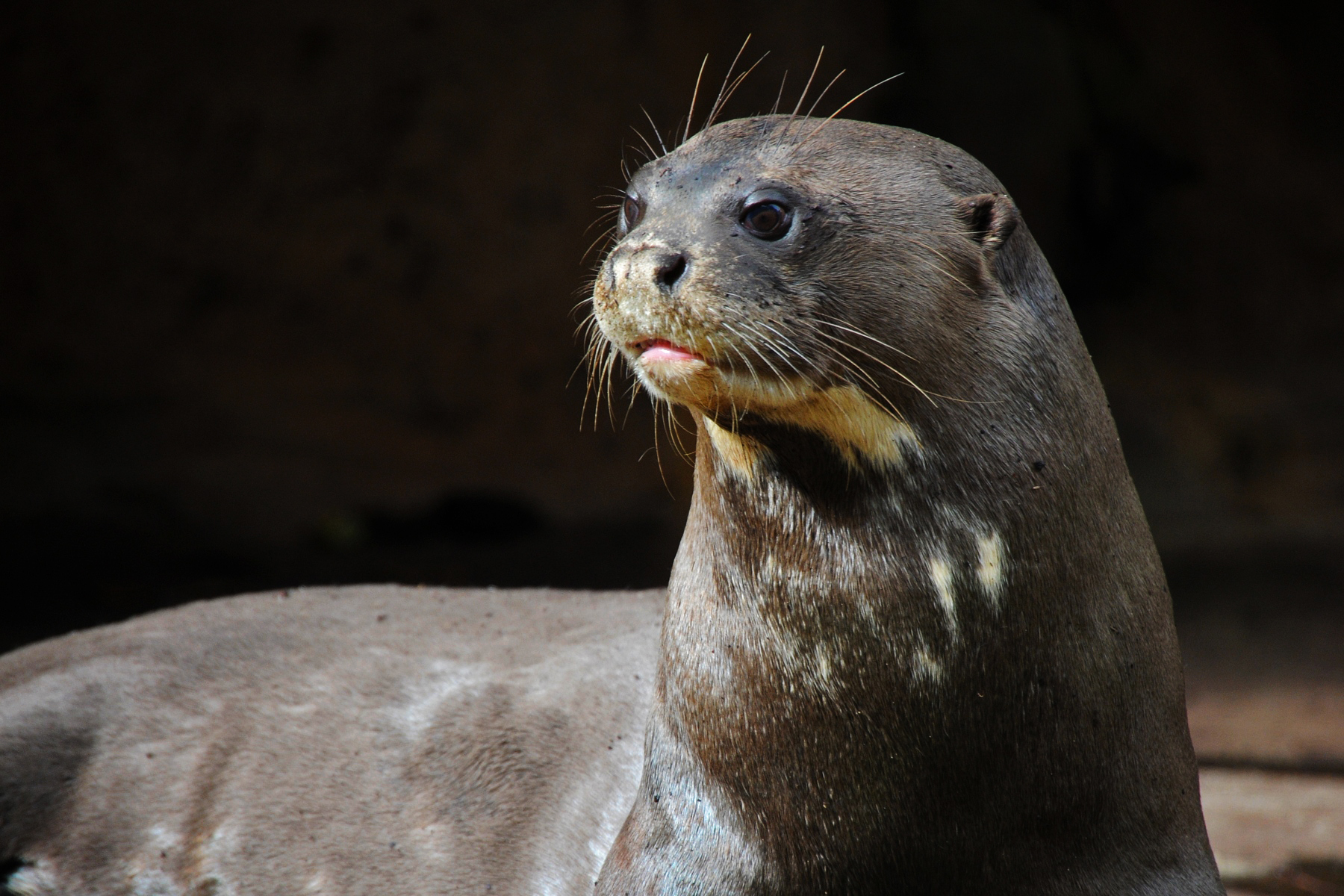
Slightly further downstream, a group of giant otters (Pteronura brasiliensis) was also hunting.
They stayed in the water by the riverbank, their heads popping through the surface and dipping back down like a wild version of the arcade game Whack-A-Mole. One resurfaced with a striped fish held between its front paws before it climbed onto the bank to eat. The sound of it eating carried across the water; sharp cracks as it worked through the bones and wet chomps as it tore through scales and flesh.
The otters’ feeding site along the bank was littered with fish bones and reeked of feces.
“They’re almost impossible to ignore,” Jansen Zuanon, ecologist and fish specialist who contributed to a 2026 study about Baniwa people and otters, told Mongabay.
The Içana flows into the Rio Negro, a major tributary in the Amazon with dark, tea-colored, naturally acidic water. Its rivers and tributaries are home to diverse fish species — though they are not especially abundant. For the Indigenous Baniwa people, who live along the Içana’s banks and tributaries in northwestern Brazil near the Colombian border, fishing is an essential source of protein.
But they aren’t the only ones fishing there: Both giant otters and neotropical otters (Lontra longicaudis) live and hunt fish in this region.
In different parts of the Brazilian Amazon, local and artisanal fishers have accused giant and neotropical otters of eating valuable fish, driving fish away from key fishing grounds and damaging nets. This has fueled the perception of competition, and in some places, conflict has led fishers to kill giant otters and neotropical otters.
But in the Upper Rio Negro, the relationship between Baniwa fishers and otters appears to be different, shaped by coexistence and a complicated history, suggest researchers.
In 2026, ecologist Natalia Camps Pimenta and her colleagues interviewed 19 Baniwa fishers across seven communities along the middle Içana River, in the Upper Rio Negro Indigenous Land. The study explored how relationships with otters had changed over time, from their role as spiritual guardians of aquatic life to their exploitation during the commercial fur trade, and the complex yet relatively harmonious relationship that exists today.

“You have a region where resources are even scarcer [than other rivers in the Amazon], where there is a competitor, and yet people still do not attack these animals,” Pimenta, lead author of the 2026 study, told Mongabay.
Encounters between Baniwa fishers and giant otters are common. In the study, 84% of fishers interviewed reported regularly encountering otters while fishing during the dry season. Yet only 32% described them as competitors; and nearly two-thirds did not identify them in that way.
The question is, why do Baniwa people treat otters differently than fishers in other parts of the Amazon?
The answer, Pimenta said, lies in a “combination of factors: cosmology, cultural values, market demand, external pressure, changes in social arrangements and the diversity of the environment itself.”

Otters, the ‘shamans’ of the rivers
Part of the explanation the researchers provide lies in where and how people and otters fish.
Baniwa fishers and neotropical otters often use the same fishing grounds, particularly in lakes. Giant otters were less associated with the Baniwa’s preferred fishing areas, tending to favor shallow streams, although their habitats still overlap.
The study also found differences in diet, although the groups sometimes ate the same fish. Baniwa fishers favored medium or large fish, while both otter species ate mainly smaller fish. Medium-sized cichlids were among the fish consumed by both Baniwa fishers and giant otters. Overall, the diets of both otter species differed significantly from those of the Baniwa, suggesting limited dietary overlap.
Giant otters also tend to retreat from boats and the sounds of paddling and engines, according to many Baniwa fishers interviewed in the study.
Today, the fishers said they adjust their behavior around otters: Nearly two-thirds said they move to another fishing spot, waited for the otters to leave, or reduced noise to avoid disturbing them. Some linked this wariness to the region’s commercial fur hunting past, suggesting that decades of persecution in the mid 1900s may have shaped how the giant otters respond to people today.
But patterns of spatial overlap, resource use or conflict avoidance can only explain part of the Baniwa-otter relationship, suggests the study. It is part of a larger story of Indigenous cosmology, mixed with history and government regulations, say the researchers.

For many Indigenous peoples in Amazonia, relationships with animals are shaped partly by practical needs, but also by spiritual beliefs and social obligations. These relationships can also influence how people use and care for wildlife, Álvaro Fernández-Llamazares and Pirjo Kristiina Virtanen write in a 2020 review of Indigenous Amazonian views of sustainability.
For many Baniwa, giant otters are the pajés of the waters, spiritual guardians of the health of fish and the aquatic world. Their presence is a sign that fish are present and protected. For several interviewees in the 2026 study, disturbing the otters during fishing activities was considered inappropriate or unnecessary. One fisherman interviewed from Tucumã Rupitá, a Baniwa community, explained why otters should be left undisturbed: “They belong to that place.”
This perception has roots in Baniwa oral history. In a Baniwa elders’ account of creation, published in 2017, Ñapirikoli, the creator of the world and all beings, gathered a group of men who were preparing to become pajés. Ñapirikoli blew dzáato, a snuff made from the bark of a large tree, onto each man to induce visions. Those who mastered their visions remained with Ñapirikoli and became the pajés who care for people in the villages; those who flew away became bats, the pajés of birds. Those who ran into the forest became awakaróna, or curupira, the protector of forest animals; and those who ran into the river became dolphins, otters and giant otters, the pajés of the waters.
“The Baniwa regard giant otters as shamans of the waters, as special spirits that live in that environment,” ecologist Zuanon said.
This is reflected in a broader pattern across Indigenous Amazonian cosmologies, where large predators are often regarded as the owners or protectors of natural resources, Pimenta said.
“Human-wildlife coexistence often occurs in communities in which people share history, memories, stories and feelings of kinship and reciprocity with animals, plants, rivers, mountains and other features of the landscape,” Helina Jolly and Amanda Stronza, conservation social scientists, write in a 2025 essay in Conservation Biology.
Yet, a period of commercial fur trade flipped the relationship between the Baniwa and otters on its head.

‘The age of skins’
In the 1950s and 1960s, traders known as regatões traveled through the Amazon rainforest buying animal skins, driven by demand in international markets. Otter fur became highly prized, along with jaguar, deer, peccary and manatee skins, which were a part of a huge, booming industry: An estimated 23 million mammals and reptiles were killed for their skin in the western Brazilian Amazon between 1904 and 1969.
The trade brought money to the communities. A giant otter skin could be worth the equivalent of months of work, Glenn Shepard, an anthropologist who was part of the 2026 Baniwa-otter study, told Mongabay — enough to buy a gun or a boat.
“There was external, non-Indigenous demand for the skins, and [the Indigenous peoples] were paid to hunt giant otters,” Zuanon said. “So they began actively hunting them.”
Skilled hunters captured them with bows and arrows or using a trap called dzaarokana, also known as matapi, placed near the giant otters’ dens. As the fur trade expanded, firearms replaced these traditional weapons. This period came to be known in the region as the Age of Skins.
The trade swept across communities throughout the Amazon, even into the remotest, hardest-to-reach areas.
“There were no more otter skins left anywhere else,” Shepard said.

Otters, long having been considered a guardian and ally by the Baniwa, were now reduced to a commodity, a fur pelt that could be sold. By the early 1970s, neotropical otter populations had declined, although the species continued to survive in smaller numbers; giant otters, on the other hand, collapsed throughout the Amazon, including from the Baniwa region.
Eventually, Brazil’s 1967 Fauna Protection Law and its participation in international efforts to restrict wildlife trade helped slow down the commercial hunting of otters. The law made the killing, capture and commercial trade of wild animal pelts illegal and the demand declined.
Across the Amazon, otter populations slowly began to recover. In the Upper Rio Negro, however, clear signs of recovery of giant otters would take at least another couple of decades, after the Upper Rio Negro Indigenous Lands were demarcated in the 1990s and outside traders were pushed out of the region.
Some of the Baniwa community associated the otters’ presence with growing or shrinking fish populations. Baniwa elders said that as the giant otters disappeared from the Içana River, the fish also disappeared. The exact reason for a decline in fish is hard to pinpoint. Some told stories that the fish had left with the giant otters, their pajés, retreating into the remote headwaters. Others blamed the use of gillnets, introduced by outsiders, and other changes in fishing practices that took large numbers of fish at once.
“The wise fishers say that, with the return of giant otters to the Baniwa landscape, the fish are also returning, following their pajé,” according to the researchers in a 2017 recounting of oral histories shared by older Baniwa residents.

Coexistence built over generations
The Baniwa largely welcomed the otters back. A 2018 study led by Pimenta found that they viewed the giant otter recovery as a sign of ecological health, particularly the health of fish stocks.
Coexistence cannot be understood solely as a cultural trait, Pimenta said. It also depends on historical, political and economic conditions. Otter populations did not collapse because the Baniwa system of coexistence had ceased to function, but because the international fur trade disrupted these relationships by turning the animals into commodities.
Their recovery was also enabled by a combination of changes in conservation policy, stronger Indigenous territorial rights, and the continuity of local knowledge and management systems.
That kind of coexistence does not happen by chance, she said.
“Even living in an environment known as a ‘river of hunger’, where the availability of fish is naturally limited, the Baniwa have developed ways of using resources that reduce competition and favor coexistence with other predators,” Pimenta told Mongabay.
She hopes the study will change how conservation is approached.
“Instead of viewing Indigenous knowledge merely as a complementary source of ecological information, it should be recognized as a sophisticated system for understanding and managing the world,” she said.
Banner image:A giant otter (Pteronura brasiliensis). Image by Joachim S. Müller via Flickr (CC BY-NC-SA 2.0).
Photos: In the Colombian Amazon, fishing binds a community to river and forest
Elders, conservationists race to record fading sacred ties to Philippines’ endemic birds
Citations:
Fernández-Llamazares Onrubia, Á., & Virtanen, P. K. (2020). Game masters and Amazonian Indigenous views on sustainability. Current Opinion in Environmental Sustainability, 43, 21-27. doi:10.1016/j.cosust.2020.01.004
Jolly, H., & Stronza, A. (2025). Insights on human−wildlife coexistence from social science and Indigenous and traditional knowledge. Conservation Biology, 39(2), e14460. doi:10.1111/cobi.14460
Pimenta, N. C., Macedo, V. W., Zuanon, J., El Bizri, H., Morcatty, T. Q., Shepard, G. H., Jr., & Barnett, A. P. A. (2026). Coexistence in rivers of hunger: Human–otter relations and “Shamans of the Waters” in an Amazonian socioecological system. Frontiers in Conservation Science, 7, Article 1869216. doi:10.3389/fcosc.2026.1869216
Rosas-Ribeiro, P. F., Rosas, F. C. W., & Zuanon, J. (2012). Conflict between fishermen and giant otters Pteronura brasiliensis in Western Brazilian Amazon. Biotropica, 44(3), 437-444. doi:10.1111/j.1744-7429.2011.00828.x
Pimenta, N., Gonçalves, A., Shepard, G., Macedo, V., & Barnett, A. (2018). The return of giant otter to the Baniwa landscape: A multi-scale approach to species recovery in the middle Içana river, northwest Amazonia, Brazil. Biological Conservation, 224, 318-326. doi:10.1016/j.biocon.2018.06.015
At Yerevan’s COP17 biodiversity summit, a steep climb ahead for ‘30 by 30’ target
Related Mongabay podcast: For Australia’s Indigenous Desert Alliance, caring for Country starts with a story. Listen here:
FEEDBACK: Use this form to send a message to the author of this post. If you want to post a public comment, you can do that at the bottom of the page.
Cite this article
Sarah Brown (2026). Between revered and hunted: The journey of human-otter coexistence in the Amazon. Mongabay Conservation news. DOI: https://doi.org/10.66709/news-334366

