


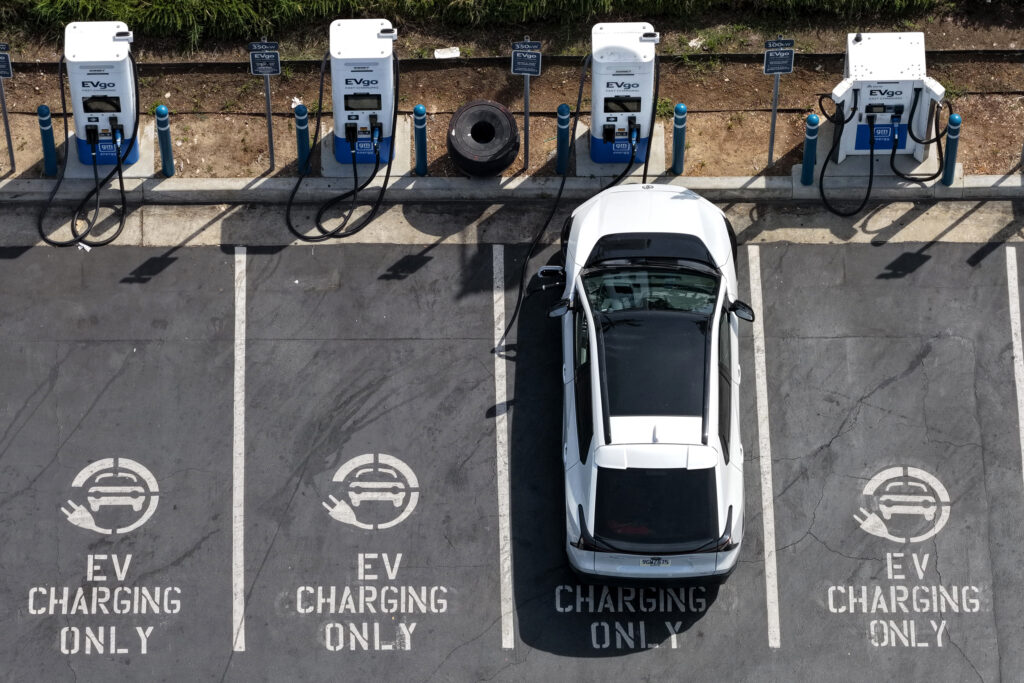
A decade ago, an electric vehicle with more than 300 miles of range would have cost you nearly $100,000.
Today, 300 miles of range sits in the middle of the market and consumers can expect at least 200 miles in even the least expensive models, based on the latest 2027 model-year data on fueleconomy.gov.
This increase in range reflects falling battery costs and technological improvements. It’s helping boost the appeal of owning an EV by reducing range anxiety—the fear of being stranded mid-trip with nowhere to charge.
According to BloombergNEF, the global average price of a lithium-ion battery pack was $108 per kilowatt-hour in 2025, down 8 percent from the prior year and down more than 90 percent since 2010.
That’s “an astonishing number,” said Pavel Molchanov, managing director for renewable energy and clean technology at the financial services firm Raymond James, in an interview.
Molchanov covered rising battery range in a recent report on the EV market, noting that 500 miles of range may be regarded as normal by 2030.
Let’s zoom out to what this may mean for oil demand. EVs accounted for 25 percent of the global market for new cars and light trucks, though they were less than 10 percent in the United States, according to the International Council on Clean Transportation.
At current ownership levels, electric cars and light trucks reduce global oil demand by 2.2 million barrels per day compared with what it would otherwise be, according to the Raymond James report. That’s 2 percent to 3 percent of global demand.
Molchanov expects this share to more than double by 2030, which is one of the reasons he thinks global oil demand will have peaked by then.
Demand is down this year compared to 2025 because of the Iran war, and is likely to rebound when the war ends, he said. But he acknowledges that demand may never recover because of geopolitical changes in response to the war and rising EV market share.
“It is not inconceivable that 2025 was the peak,” he said.
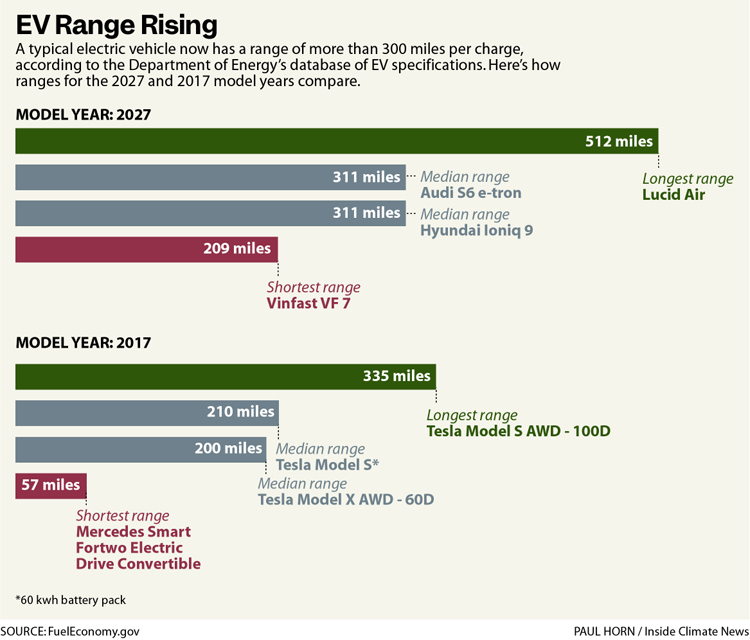
The 2027 model with the most range is the Lucid Air Grand Touring AWD with 19-inch wheels, which can go 512 miles on a charge, according to fueleconomy.gov. Its base price is $114,900, which puts it well outside what most people can afford.
Lucid, based in Newark, California, says it achieves high ranges because its motors, batteries and other components are designed for high efficiency. The efficiency is evident in its ability to go five miles per kilowatt-hour of battery capacity, which is much higher than is typical.
So that’s the top of the list. How about the middle?
The median range is 311 miles, which includes the Audi S6 e-tron and the Hyundai Ioniq 9 AWD Performance. They have base prices of $79,600 and $71,250, respectively.
That’s still too expensive for most buyers, but several other models stand out with long ranges and lower prices: The Chevrolet Equinox FWD has a range of 319 miles and a base price of $36,795, and the Toyota bZ XLE FWD Plus has a range of 314 miles and a base price of $37,980.
The model with the least range in the database is the VinFast VF 7 Plus, with 209 miles. VinFast, a Vietnamese brand that is building a U.S. dealer network, no longer lists the VF 7 on its website, but the VF 8 has 256 miles of range and a base price of $40,400.
To gauge how much batteries have improved, I looked at ranges from a decade ago.
At the top was the Tesla Model S AWD-100D, with 335 miles and a base price of $94,000.
At the bottom was the Smart Fortwo Electric Drive Convertible, with 57 miles and a base price of $28,750.
Looking further back illustrates the scale of improvement, according to Department of Energy data.
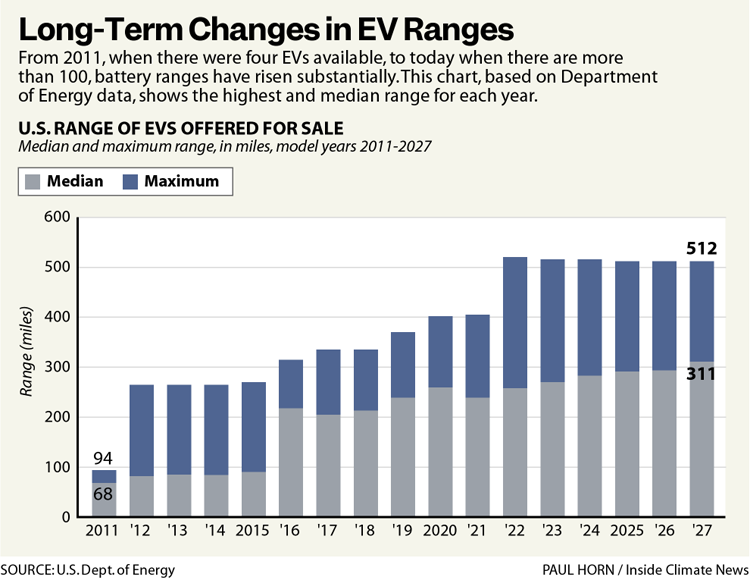
In 2011, there were just four models: the BMW 1 Series ActiveE, the Nissan Leaf, the Smart Fortwo Electric Drive Coupe and the Smart Fortwo Electric Drive Cabriolet. The BMW had the most range with 94 miles.
Now there are more than 100 models and the median range continues to increase.
I don’t think range anxiety is dead, but it’s fading fast because of battery innovation and the expansion of public charging networks. That said, chargers are still rare in some states and regions. But these gaps in the system are less of an issue when a typical battery has enough range to cross an entire state.
Let’s put this in practical terms. For me, EV range reached an important threshold at 240 miles.
This story is funded by readers like you.
Our nonprofit newsroom provides award-winning climate coverage free of charge and advertising. We rely on donations from readers like you to keep going. Please donate now to support our work.
That’s roughly the distance between the Des Moines, Iowa, area where I grew up, and St. Paul, Minnesota, where I went to college. It’s a drive I made many times.
It’s also roughly the round-trip distance between where I live today in Columbus, Ohio, and Cleveland or Cincinnati.
If I can make these drives without recharging, as I could with any of today’s vehicles that get 300 miles on a charge, then range anxiety has ceased to exist for me.
Other stories about the energy transition to take note of this week:
Climate Is on the Ballot, Even if It’s Not in Candidates’ Campaign Messages: Next week’s election is critical for climate-related policies, even though candidates barely discuss the topic, as my colleague Marianne Lavelle reports. It’s a familiar dynamic where climate change appears in the campaign through other issues, such as concerns about energy costs and data centers.
Gubernatorial Races Play an Outsize Role in Climate and Energy Policy: Voters will elect governors in 36 states next week and Democrats are poised to retain most of the seats they now hold and flip several currently held by Republicans. The results, along with legislative elections, could create an opportunity for states to take stronger action to limit greenhouse gas emissions and encourage renewable energy development, as I report for ICN. Wisconsin is among the states to watch, with the potential for Democrats to retain control of the governor’s office and gain majorities in both chambers of the Legislature for the first time in more than a decade.
Democrats Divided Over Push to Restore EV Tax Credits: If Democrats gain majorities in the U.S. House and Senate, they will need to decide whether their clean energy agenda includes restoring consumer credits for buying EVs, as Pavan Acharya reports for Politico. The credits of up to $7,500 for qualifying vehicles helped to accelerate EV sales, but they became a political vulnerability as opponents said the policy mainly helped affluent households. Some Democrats support resuming the credits, but they disagree on whether it should be a top priority.
Ford’s New EV Pickup Comes With More Affordable Home-Power Backup: Ford has said its upcoming Fathom pickup will include an onboard inverter, letting customers use the vehicle’s battery to provide backup power to their homes, as Jeff St. John reports for Canary Media. The Fathom is set to go on sale in early 2027 with a base price of $28,350. Customers will still need to buy additional equipment to allow the vehicle to send electricity to the home, but those costs, with precise prices not yet disclosed, will be much lower than the $7,000 to $10,000 for existing vehicle-to-home charging systems.
Inside Clean Energy is ICN’s weekly bulletin of news and analysis about the energy transition. Send news tips and questions to [email protected].
About This Story
Perhaps you noticed: This story, like all the news we publish, is free to read. That’s because Inside Climate News is a 501c3 nonprofit organization. We do not charge a subscription fee, lock our news behind a paywall, or clutter our website with ads. We make our news on climate and the environment freely available to you and anyone who wants it.
That’s not all. We also share our news for free with scores of other media organizations around the country. Many of them can’t afford to do environmental journalism of their own. We’ve built bureaus from coast to coast to report local stories, collaborate with local newsrooms and co-publish articles so that this vital work is shared as widely as possible.
Two of us launched ICN in 2007. Six years later we earned a Pulitzer Prize for National Reporting, and now we run the oldest and largest dedicated climate newsroom in the nation. We tell the story in all its complexity. We hold polluters accountable. We expose environmental injustice. We debunk misinformation. We scrutinize solutions and inspire action.
Donations from readers like you fund every aspect of what we do. If you don’t already, will you support our ongoing work, our reporting on the biggest crisis facing our planet, and help us reach even more readers in more places?
Please take a moment to make a tax-deductible donation. Every one of them makes a difference.
Thank you,

Reporter, Clean Energy
Dan Gearino covers the business and policy of renewable energy and utilities, often with an emphasis on the midwestern United States. He is the main author of ICN’s Inside Clean Energy newsletter. He came to ICN in 2018 after a nine-year tenure at The Columbus Dispatch, where he covered the business of energy. Before that, he covered politics and business in Iowa and in New Hampshire. He grew up in Warren County, Iowa, just south of Des Moines, and lives in Columbus, Ohio.
