


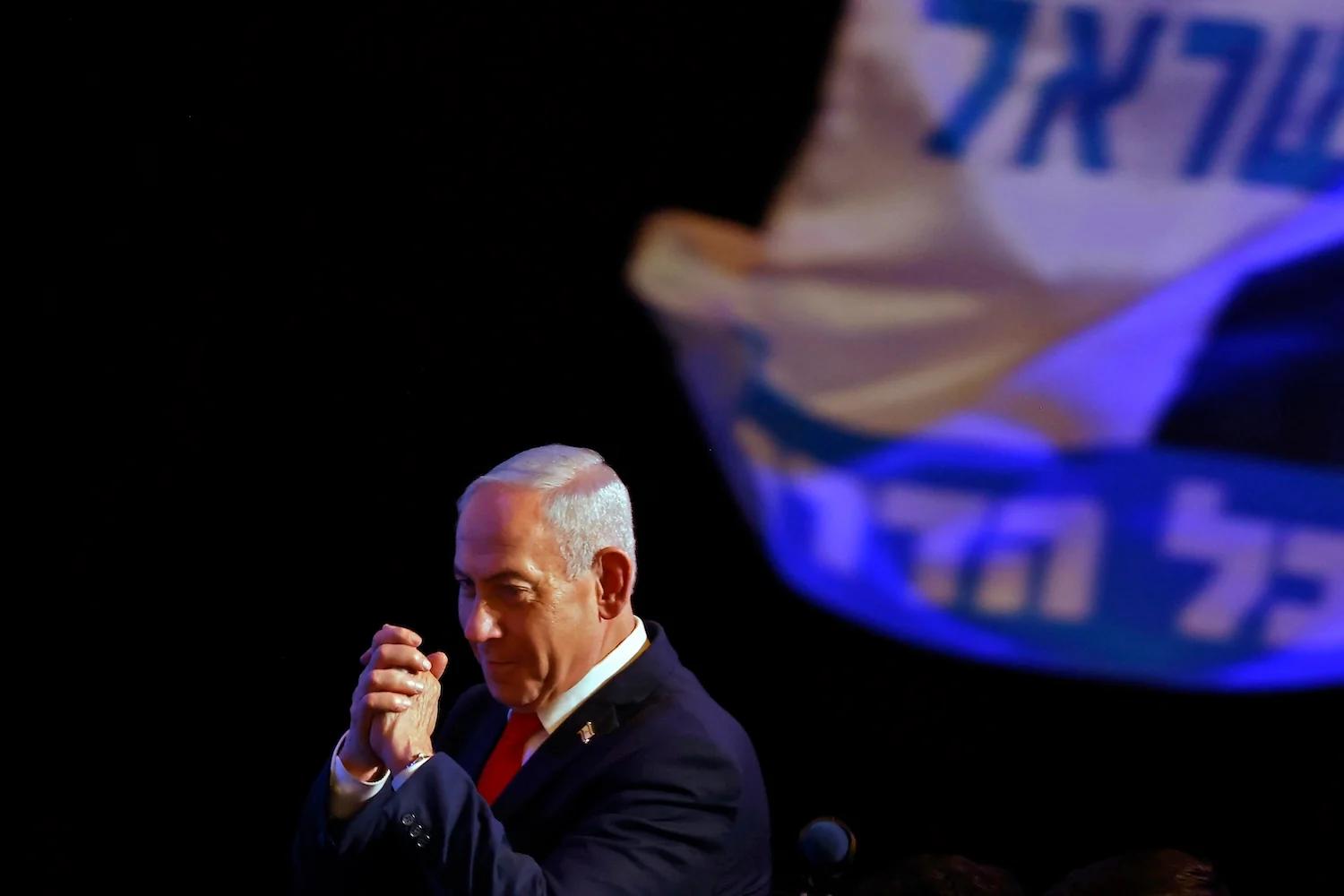
Here’s one way to think about the confusing results of Israel’s general election on Tuesday: Prime Minister Benjamin Netanyahu didn’t win, but he is in the driver’s seat by virtue of the fact that everybody else lost—not just his opponents but his allies, each in their own way. The result is that Netanyahu has no easy path to forming a government and virtually no chance at all of reestablishing the religious far-right coalition that he has led for the past four years. But he could end up at the head of a center-right government with some of the opposition parties. And, failing that, he will lead a caretaker government that will leave him in power probably for several more months, which is enough time to do what is needed to improve his chances before another round of elections.
With around more than 90 percent of the votes counted as of late afternoon on Oct. 28, Netanyahu’s Likud party was down 10 Knesset seats from its current parliamentary representation. But the party is still on its way to being the largest faction in the 120-member Knesset by a wide margin with 26 seats, defying the polls and the political fallout from Hamas’s attack on Oct. 7, 2023. The far-right and ultra-Orthodox parties individually had mixed results but, as a group, dropped five seats to 27. The election left the Netanyahu bloc with 53 seats in the Knesset, the biggest by a significant margin—though still short of a minimum 61-seat majority. With the last of the votes due to trickle in only on Friday, Likud may be able to narrow the number of seats it needs—enough for Netanyahu to entertain thoughts of trying to convince lawmakers from the opposition bloc to defect.
Gadi Eisenkot’s Yashar party was the biggest loser of the day. It won only 21 Knesset seats, less than the polls had predicted and way behind the Likud. Eisenkot’s partners in the opposition—three parties across the political spectrum from left to center-right—performed more or less as expected, but as of Wednesday afternoon, the total opposition bloc had captured 48 seats. The two post-election options that the bloc had been considering—a coalition with the Arab-led parties or a minority government supported from the outside by the Arab parties—are no longer realistic. The Eisenkot bloc is too small to stand much of a chance of finessing a deal. In any case, most of the bloc’s leaders have already made it clear that they wouldn’t agree to it. In short, a Eisenkot government is no longer in the cards.
On paper, the election was a grand success for the Arab-led Joint List and Ra’am parties. Anxious about a religious far-right government’s return to power, Arab voters turned out in very large numbers. The first of the two parties went from five seats in the last Knesset to 12, and the second picked up two seats for a total of seven. But, with the Eisenkot bloc performing so poorly, the Arab-led parties won’t have much opportunity to flex their muscles. The one place that they may be able to is during the interregnum between when the newly elected Knesset sits and a new government is formed or new elections are called. Combined with the Eisenkot bloc, the Arab-led parties would have an ad hoc 67-seat majority that they can use to pass legislation. It is a period that could last a little as a couple of weeks to as long as several months.
The big question is what Israel’s political leaders will do with the difficult results that voters have given them. It boils down to two options—either form a broad center-right government or go into another round of elections.
Two important factors favor a right-center government. One is that Israeli President Isaac Herzog, who will be playing a major role in choosing who forms the next government, has said he prefers a right-center coalition over holding another election. The other is that U.S. President Donald Trump may favor one, as well, to the Washington Post. Buttressing that, Yediot Aharonot cited White House sources as saying the president wants to keep Itamar Ben-Gvir and possibly Bezalel Smotrich out of the next Israeli government and may even weigh in on the process. It is difficult to know whether Trump would exert real pressure on the Israeli leader, but it is easy to see the logic behind it. Ben-Gvir and Smotrich, who lead the previous government’s far-right parties, have been a headache for Trump. In defiance of Trump’s goal of stabilizing the Middle East, they have been fanning the flames of violence in the West Bank and pressing Netanyahu to take a hard line against Gaza’s reconstruction.
Netanyahu might be receptive to appeals by Herzog to form a government with the center and right wing of the Eisenkot bloc, leaving out Ben-Gvir and Smotrich. If legacy is what the prime minister is thinking—at 77, he has led Israel off and on for 30 years—a right-center government could do the trick, enabling him to expand the Abraham Accords to more countries, normalize relations with Saudi Arabia, crack down on settler violence in the West Bank, and begin the work of repairing Israel’s tattered international standing. Netanyahu could position himself as a true national leader rather than a politician who encourages division and incitement for shorter-term advantage.
But such a move would be out of character for Netanyahu, who, in recent years, has shown more concern about political survival than about his place in history. A unity government would alienate him from much of his political base and mean a divorce from his loyal far-right and ultra-Orthodox partners, leaving him at risk of having no allies when the next election comes around. In any event, there is little enthusiasm in the Eisenkot opposition for a partnership with Netanyahu and a lot of distrust for him. For such a government to happen, the two sides would have to agree on terms for each of the bloc’s leaders to serve as prime minister in rotation. But when Benny Gantz made such an agreement with Netanyahu in 2020, Netanyahu found a way out of wiggling out of it and forced new elections before Gantz’s turn came up.
The other option is another round of elections. Israelis went through a series of indecisive back-to-back elections in 2019-2021, and the assumption is there is little appetite among either politicians or the public to go through that again. For Netanyahu, however, it is not a bad option. While his powers as head of a caretaker government are limited, he would have a pretty free hand on military policy and might use that to enhance his standing with voters. Launching one more round of war with Iran is one obvious step he might take.
Counterintuitively, a preelection poll by the Israel Democracy Institute found that a plurality of Israelis preferred another election over a joint government between Netanyahu and Eisenkot. This may reflect the hope by each side that it will improve its position in a new round of voting. But what’s more likely is that it would end in another stalemate between the two big blocs of Jewish-led parties—the only ones that count in the current political environment—and demonstrate just how deeply divided the Jewish population is over fundamental questions.
This post appeared in FP’s The Reading List newsletter. Sign up here.
