


- Climate migration is often considered an adaptation strategy, as it moves people out of harm’s way from the immediate shocks of climate change.
- But a new study involving climate migrants in informal settlements in southwest Bangladesh finds that relocation can create new forms of vulnerabilities.
- As climate migration increases, Bangladesh’s secondary cities lack policy implementations that ensure migrants can access safe housing, services and stable livelihoods after they arrive.
In 2024, disasters displaced 2.4 million people within Bangladesh even as the International Monetary Fund predicts that rising seas could eliminate more than one-seventh of Bangladesh’s land area and nearly one-third of its food production by 2050.
As environmental pressures drive people from their homes, researchers are examining the risks migrants face in the secondary cities where they relocate and whether these cities are equipped to accommodate growing numbers of climate-displaced people.
To cope with increasing climate-related pressures, migration is often viewed as an adaptive strategy because moving away from areas exposed to hazards such as flooding, cyclones, river erosion and sea-level rise can help people reduce their exposure to climate risks and seek safer housing and more stable livelihoods.
In these circumstances, urban informal settlements are often among the first destinations for displaced people. Yet, in Bangladesh, these settlements are risky in nature because of the structural formation, and the residents are exposed to various hazards. This raises a broader question: Are the cities receiving climate migrants equipped to support a safer, more stable future or leaving them more exposed?
A new study published in Climate and Development on climate migrants living in informal settlements in southwestern Bangladesh examines what happens to migrants after relocation to secondary settlements. The study findings suggest that moving away from regions affected by climate hazards does not necessarily mean moving toward safety, particularly when urban planning and social protection systems fail to account for their needs.
Talking to Mongabay via Zoom, Roland D. Smith, a doctoral researcher at the University of East Anglia, and the study’s primary researcher, said he was motivated to examine what happens to people after they migrate in response to climate-related pressures. Smith, whose research examines how climate change affects migration and population displacement, said he wanted to look beyond long-term projections and understand how people’s movements unfold in the “short and medium term.”
Migration is “adaptive” because the migrants “are moving away from the threat of the hazard,” Smith said. “But then it’s not truly adaptive because then they face what I call a portfolio of hazards.”
In the informal settlements he studied in southwest Bangladesh, that portfolio included recurring flooding where drainage was inadequate, insecure housing, inadequate utility services and difficulty finding reliable work. The study describes relocation as a trade-off where households may leave one set of hazards behind only to be confronted with another in the cities where they settle. The study also found that precarious livelihoods like day laboring in brickfields and pulling rickshaw vans made it difficult for many families to save, improve their housing or move elsewhere, limiting both future migration and upward social mobility.
For Smith, protecting people from hazards where they live is only part of the response. Cities receiving migrants also need to consider whether newcomers can find work, access services and exercise their rights. The question, he said, is how to help people “migrate with dignity” and “retain their rights.”
“Rights and needs of migrants are increasingly recognized within Bangladesh’s climate change and disaster policy landscape. In this regard, two policy instruments are particularly noteworthy: the National Strategy on Internal Displacement Management (2021) and its subsequent Action Plan, as well as the National Adaptation Plan (NAP) of Bangladesh,” said Md Ekhtekharul Islam, PhD fellow at the University of Copenhagen, Denmark, and research fellow in the Refugee and Migratory Movements Research Unit, via email.
“The Ministry of Disaster Management and Relief of the Government of Bangladesh adopted the National Strategy on Internal Displacement Management in 2021, which takes a threefold approach to addressing displacement: prevention, protection, and durable solutions,” Ekhtekharul added.

An International Institute for Environment and Development working paper published in February 2025, based on research in Pirojpur in southern Bangladesh and Sylhet in eastern Bangladesh, highlights another layer of vulnerability faced by people displaced by climate change: increased exposure to exploitative working conditions.
The paper found that 92% of participants had experienced at least one form of modern slavery, which includes wage withholding, restrictions on movement, abusive working conditions, threats, intimidation and physical violence by employers.
For internal climate migrants, these risks are particularly concerning, especially given projections that climate change could displace one in seven people in Bangladesh by 2051.
Bangladesh’s policies recognize the need to plan for displacement beyond its largest cities. The 2021 national strategy calls for decent jobs through more decentralized urban growth, and for cities that can accommodate new migrants. Its comprehensive 2022-42 action plan sets out steps for implementation including creating localized databases for monitoring, incorporating disaster and climate change risk mitigation in primary and secondary school curricula for raising awareness, incorporating safe housing arrangements for internally displaced people (IDPs) into township planning, and more.
Separately, the National Adaptation Plan proposes an inventory of climate migrants and measures to manage migration to urban centers. Yet a 2025 analysis by the International Centre for Climate Change and Development (ICCCAD) researcher, Munia Tahsin, found that the plan’s urban interventions do not explicitly address human mobility, leaving a gap between its mitigation measures implementation and its vision for climate-smart cities.
Sumaiya Binte Selim, a researcher at ICCCAD, said secondary cities could ease the pressure on Dhaka and other major urban centers if they offer migrants viable ways to earn a living. Municipalities with ports, export processing zones and other sources of employment may be particularly well placed to do so. But migration does not automatically make people safer.

“Basic access to income generation and safety nets are important,” Selim said. For those who move suddenly, the challenges can extend beyond finding work to adjusting to city expenses and losing social ties. “These actually depict both economic and non-economic losses and damages [of climate change],” she adds.
Nonetheless, Selim sees promise in Bangladesh’s national action plan for displacement management, but questions how it will work in practice. “The plan and activities are really great,” she said, “but following the implementation, I am not sure regarding how and what way those would be achieved.” She also points to a practical obstacle. Municipalities lack detailed records of people moving into and out of their areas, making it harder to plan for their needs.
Ekhtekharul also echoes this concern, noting the lack of a comprehensive mechanism to track internal migration as well as interference from political actors when it comes to policy implementation. “In low-income settlements at migrant destination areas, informal governance is largely mediated by political actors, often determining who gains access to resources and services. Urban resettlement projects in Dhaka have faced significant challenges, primarily due to political interference, as well as the limited consideration of migrants’ agency, priorities, and needs during the design and planning phases,” he said.
When asked about what policy changes would be necessary to make climate migration safer, he underscored justice: “Migrants’ agency should be recognized and supported, and appropriate employment opportunities need to be created not only in cities but also in their places of origin. Previous resettlement projects should be evaluated through rigorous assessment processes to identify gaps, lessons learned, and areas for improvement.”
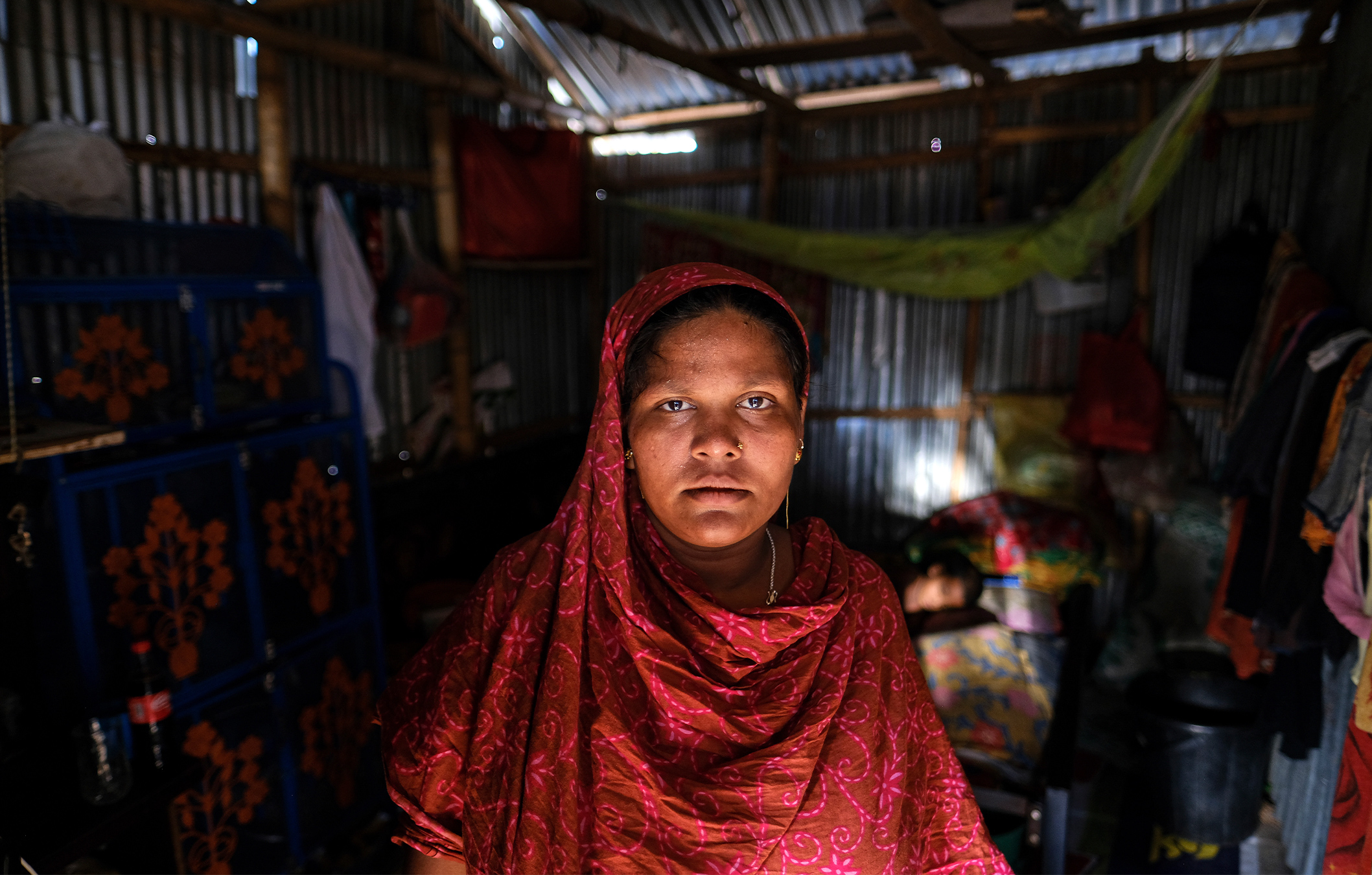
Banner image: Arzu Begum stands by the door of her house in the Mirpur area of Dhaka in July, 2022. Begum’s family was forced to flee their village in Bangladesh when the Meghna River flooded and destroyed their home. They moved to the capital, where they have struggled to pay their rent and food bills on their small incomes. Image by AP Photo/Mahmud Hossain Opu.
Bank credit remains scarce in Bangladesh where climate risks are highest
Climate-resilient housing models slow to gain ground in disaster-prone Bangladesh
Citations:
Ahsan, R., Kellett, J., & Karuppannan, S. (2016). Climate migration and urban changes in Bangladesh. Urban Disasters and Resilience in Asia, 293-316. doi:10.1016/b978-0-12-802169-9.00019-7
Smith, R. D., Nicholls, R. J., Tebboth, M. G., & Kent, A. (2026). Persistent vulnerability and precarious futures: The limits of adaptation in ‘climate migrant’ informal settlements of coastal Bangladesh. Climate and Development, 1-18. doi:10.1080/17565529.2026.2619446
Cite this article
Usraat Fahmidah (2026). Bangladesh’s climate migrants are arriving in cities unprepared to protect them. Mongabay Conservation news. DOI: https://doi.org/10.66709/news-333680

