


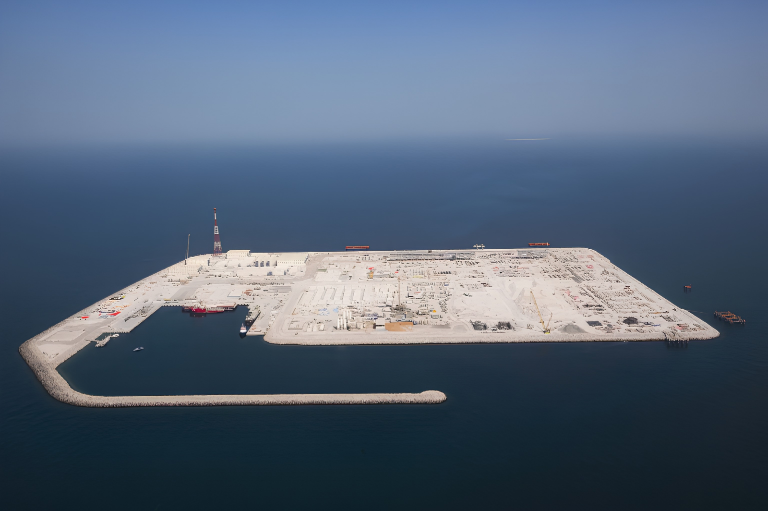
The Hail and Ghasha project, designed with an emphasis on low-emissions technology, aims to operate with net-zero carbon emissions by integrating carbon capture with a target of around 1.5 million tonnes of CO2 per year, low-carbon hydrogen use to replace fuel gas, and relying on less-emission-intensive power sources, such as nuclear and solar.
ADNOC’s partners in the Ghasha concession, aside from Eni and PTTEP, which consolidated their joint stakes under Seela Energies, involved other companies across the broader project lifecycle, including Wintershall Dea, OMV, and Lukoil.
The Ghasha development is envisioned to employ smart technology across all operations, allowing operators, technicians, and site personnel remote access to the project’s operations. Aside from a fully unmanned facility, ADNOC has set its sights on artificial intelligence (AI), such as predictive maintenance, for all critical rotating equipment.
A few months ago, the operator, in partnership with Eni and PTTEP, put into place a structured financing transaction of up to $11 billion (AED 40.4 billion) for Hail and Ghasha sour gas development.
The UAE giant’s financing model follows a series of midstream and infrastructure transactions, including a $4.9 billion (AED 18 billion) oil pipeline partnership and a $10.1 billion (AED 37.1 billion) gas pipeline agreement.
It also comes after build-own-operate-transfer (BOOT) projects, such as the $3.8 billion (AED 14 billion) project to power and decarbonize offshore operations and the $2.2 billion (AED 8.3 billion) project to deliver sustainable water supplies to onshore operations.
