


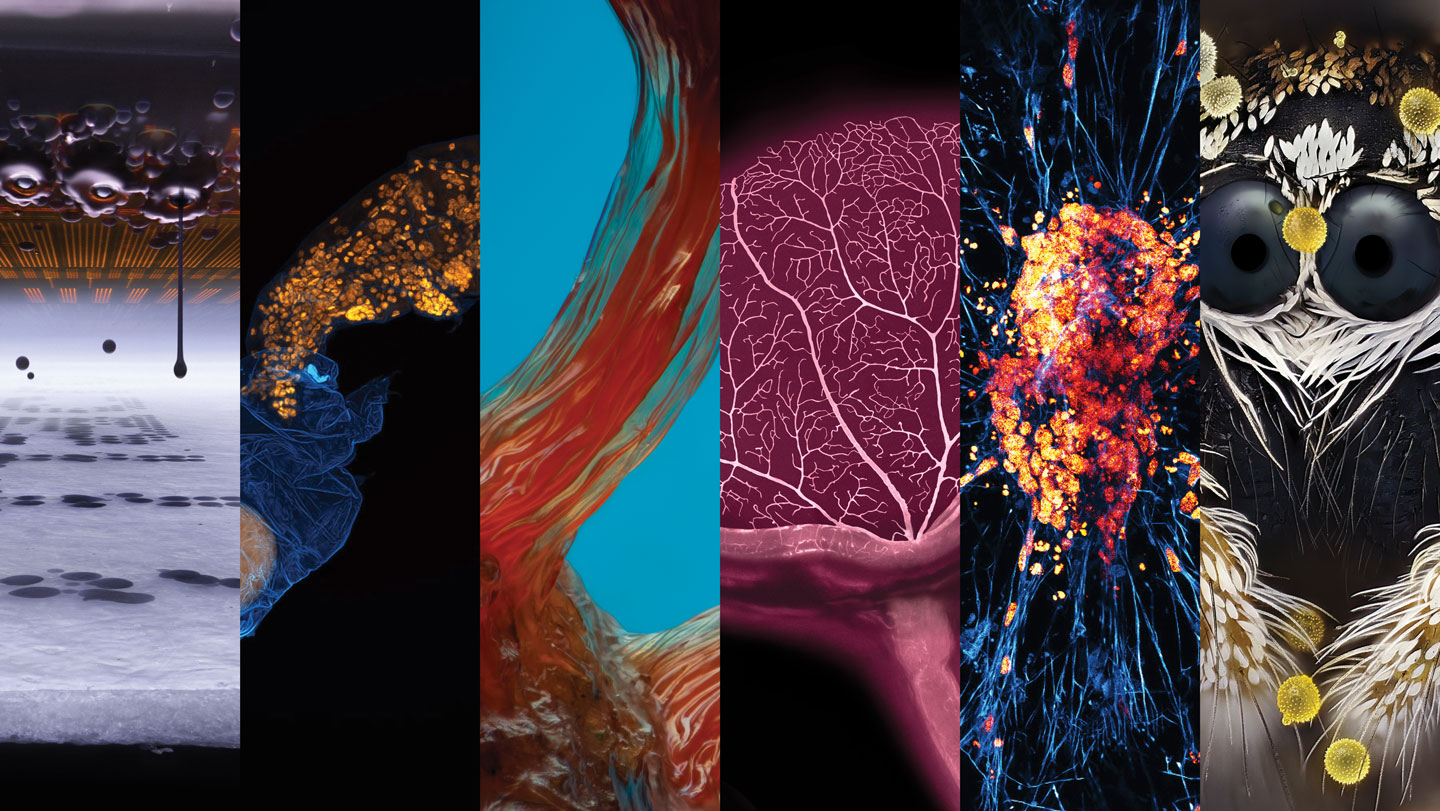
Nestled within a rebuilt inkjet printer, droplets of ink hang suspended above a page. Seen through a microscope, the droplets reveal how an inkjet printer produces crisp, uniform letters.
Ole Bielfeldt, a design student in Cologne, Germany, has been photographing the microscopic world since about 2021. His interest began as a quarantine hobby, when an old school microscope from his attic gave him a way to explore while stuck at home during the pandemic.
His printer image won first place in the 2026 Nikon Small World photomicrography competition. To capture the winning photo, he built a custom rig that moved the paper instead of the printer’s ink nozzles, keeping the nozzles stationary and in focus.
The mini side of ‘macro’
Ole Bielfeldt created this custom rig to catch impossibly fast ink droplets midflight. The contraption is only a bit larger than his head. Swipe through to see what word the printer was spitting out ink to spell.
-

Ole Bielfeldt -

Ole Bielfeldt -

Ole Bielfeldt
Bielfeldt estimates that the droplets traveled at nearly 20 meters per second — too fast for even his best slow-motion camera to resolve. To freeze their motion, Bielfeldt worked in darkness, illuminating the scene with a single brief flash. He instructed the printer to repeatedly spell out “macro,” a nod to his social media handle, macrofying.
Before this project, a printer was “like magic,” Bielfeldt says. Photographing its inner workings helped him understand how it operates.
Bielfeldt no longer takes the magic printers spit out for granted. “It’s so, so advanced technically, but at the same time it’s so, so common,” he says.
His photograph is one of 86 images recognized in this year’s competition, whose winners were announced October 21. Here are some of our other favorites.
Did you capture my jumping side?

This pollen-dusted jumping spider offers a close look at the bristling hairs and some of its eight eyes that are easy to miss with the naked eye.
John-Oliver Dum’s fascination with spiders began as a childhood fear. Dum says he suffered a particularly painful arachnid-inflicted bite when he was young. Several years ago, when he was inspired to study the movements of a curly hair tarantula (Tliltocatl albopilosus), Dum became passionate about capturing their beauty.
Preparations for his photographs can begin years before he submits them to a competition. His wife grows plants selected for their pollen, which Dum uses in his images.
“The biggest challenge was finding a spider like this on the right plants, with the right pollen attached to it, at exactly the right time of year and at exactly the right moment,” he says. “You need to understand not only the spider’s behavior, but also the surrounding insect and plant life and their seasonal rhythms.”
Dum hopes the photograph, which won second place, encourages viewers to look more closely, too. “We first have to see the beauty of this largely unknown world before we can truly understand what we may be destroying,” he says.
Seeing a mouse eye in a new way

It’s not a leaf and it’s not a flower. This cross section of a mouse eye is crisscrossed in fractals of blood vessels and tethered by the optic nerve.
Cell biologists Sinem Karaman and Satu Paavonsalo at the University of Helsinki visualize vascular networks, like blood vessels, to study how they work within tissues. The arrangement, Paavonsalo says, could even point to mechanisms underlying how these systems stop working in obesity and diabetes.
Paavonsalo says the duo set out to capture a mouse eye in 3-D, different from the flattened retinas typically used in her research. After meticulous mounting which required several attempts for an arrangement she was satisfied with, Paavonsalo still didn’t know for certain the image would turn out right.
“I had to hope that the sample was correctly positioned and that the staining was detected throughout the sample,” Paavonsalo says, which made her excitement upon seeing the image even more pronounced. The image won 19th place in the competition.
A tardigrade Easter egg

A water bear emerges from its shed cuticle, and oh! What’s that left behind? This egg will be protected by its mother’s discarded skin.
The tardigrade (Hypsibius exemplaris) is one of nature’s toughest creatures, able to survive space by going into a state of suspended animation. This species, emerging from its former skin, is only about two-and-a-half times as wide as a strand of hair. Evolutionary developmental biologist Gonzalo Quiroga-Artigas captured the image during his studies of these tiny wonders at the University of Montpellier in France.
In the tardigrade life cycle, “egg laying is closely synchronized with molting,” says Quiroga-Artigas. Tardigrades can lay up to about a dozen eggs at once, and the moment one sheds its old cuticle happens quickly enough that it’s easy to miss.
Snapping this image demanded painstaking mounting and imaging of many specimens. Quiroga-Artigas chose this particular one, which won 12th, because “the egg looks almost like a precious gem being left behind by its mother.”
The stretch of a slime mold

This slime mold (Hemitrichia sp.) was found in the heart of Brooklyn, N.Y., sprouting from a decaying log in Prospect Park. The image features the mold’s gelatinous fruiting bodies, which release spores as part of reproduction. To bring the delicate structures into sharp detail, Eric Epstein stacked 240 images.
First, Epstein searched local parks for slime molds to photograph, carefully cutting pieces of waterlogged wood free without disturbing his subjects. “In this liquidy state, any touch would demolish” the fruiting bodies, he says.
One species of slime mold closely mirrors the cosmic web of gas and dark matter connecting galaxies, which helps scientists to more accurately map the cosmos. Another species has fascinated researchers for its ability to pack a store of bacteria to feed the next generation, when it’s near death.
Epstein hopes the photograph hints “at [a] vast array of activity beyond our unaided perception.” The image won sixth place in the competition.
A brain full of stars

This cell could have become anything in the body. Through some scientific nudging, it burst into a brilliant neuron.
Clusters of nuclei, looking like flashpoints in an intricate web, were captured by undergraduate student Faith Fernandes and structural cell biologist James Glover at the University of California, Berkeley.
The image commemorates the team’s first attempt at crafting neurons from a particular kind of stem cell. “I was so instantly enamored with this piece that I made it my computer wallpaper as soon as it was taken,” Fernandes says.
The eruption of color depicts human induced pluripotent stem cells, which can become any type of cell in the body, that have developed into neurons. The neurotubules, which contribute to the structure of and transportation of intracellular molecules, appear blue. Orange indicates where the DNA is located.
The stem cells are created by reprogramming adult cells to a stage before the cell was locked into a path to become a specific type of cell. They are studied for their many potential applications in regenerative medicine.
Fernandes says she hopes that studying these cells will illuminate ways to address neurodegeneration in diseases such as Parkinson’s disease. Already, researchers have used these cells to regrow eye tissue, address premature aging in mouse studies and grow organs. The shot won an Image of Distinction title in the competition.
