


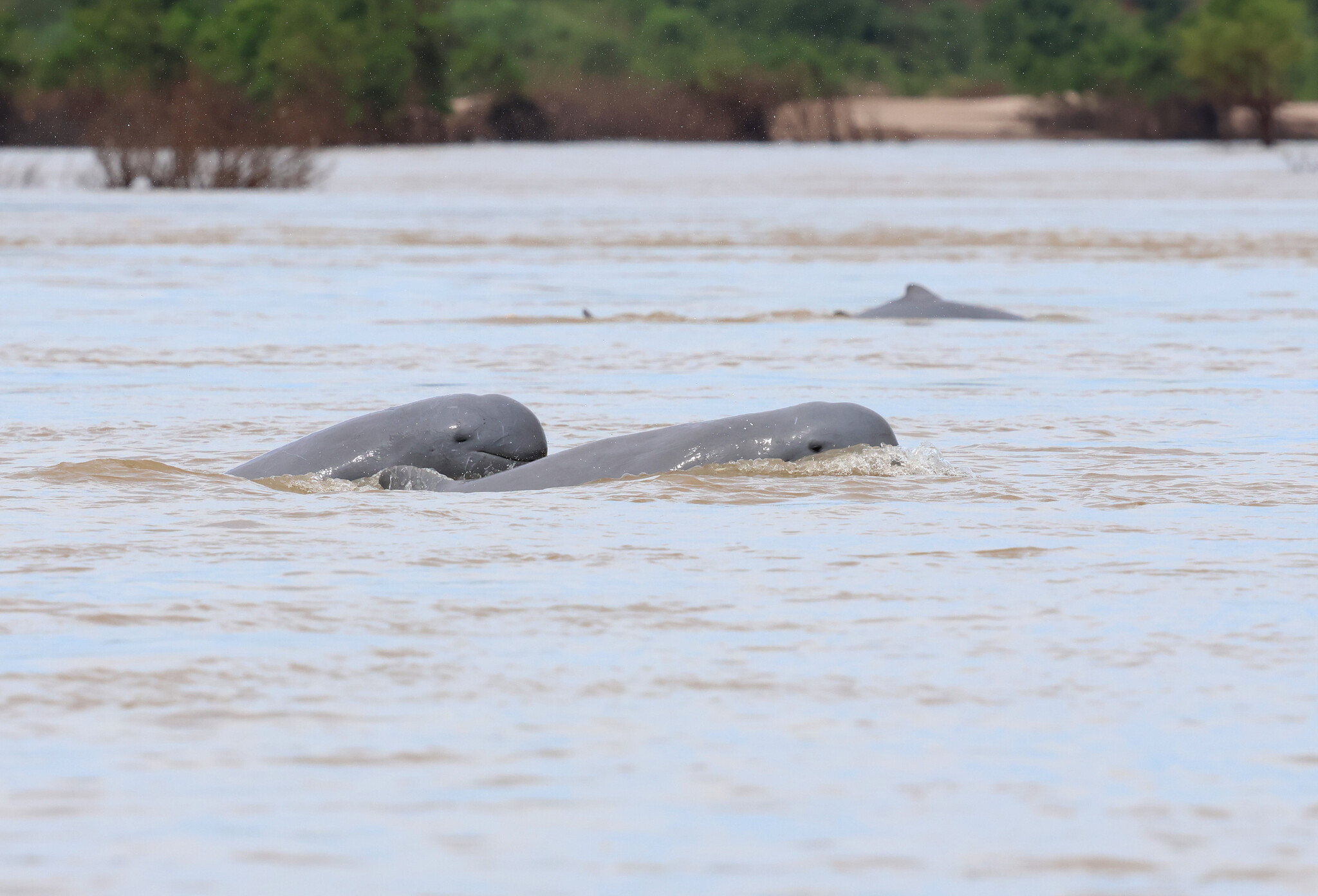
Cambodia’s population of critically endangered Irrawaddy dolphins has increased to an estimated 118 individuals since the confirmed birth of six calves this year. They were born along a 120-kilometer (75-mile) stretch of the river in Kratie and Stung Treng provinces, in the country’s northeast.
Conservation officials say the births are a strong sign that the river’s sole cetaceans can recover if severe environmental threats are curbed, reports contributor Eung Sea for Mongabay.
In Cambodia and Laos, Irrawaddy dolphins (Orcaella brevirostris) are regarded as sacred animals representing the ancestral spirit of the river. They also generate vital ecotourism revenue for riverside communities.
“Irrawaddy dolphins are very important for our community,” said Heang Koeurn, a boat driver at the Kampi dolphin pool, a 60-meter-deep (nearly 200-foot) stretch of the Mekong that serves as a protected habitat for some 20 Irrawaddy dolphins in Kratie. “People here can make more income from tourists by driving them to see the beauty of Irrawaddy dolphins.”
“They are a source of Cambodian national and local pride,” said Ian Baird, a professor of geography at the University of Wisconsin–Madison in the U.S. “They may also inspire people to protect the river and its tributaries from the impacts of more dams in the future.”
Yet the Irrawaddy dolphin population in Cambodia’s section of the Mekong remains far below late-1990s estimates of roughly 200 individuals. The steep decline is largely from electrofishing, habitat degradation, and gillnet entanglement, which is especially deadly for calves, Sea reported.
Additionally, more than 160 dams operating throughout the Mekong Basin have altered the hydrology and fish communities that dolphins rely on for food.
Frances Gulland, chair of the U.S.-based Marine Mammal Commission, likened losing the dolphins to “losing a star from the sky.”
Locals guarding the dolphins’ habitat work with limited resources and face physical risks from illegal fishers, often armed. They earn just $5 to $7.50 per day. “The income is small, but it is out of the goodness of our hearts we keep doing this job,” said Kem Sophat, a river guard.
The consequences of failed conservation were evident in 2022, when the last dolphin in the Anlong Chheu Teal pool, between northern Cambodia and southern Laos, died from net entanglement. Phoy Vanna, an Anlong Chheu Teal community leader, told Mongabay the number of tourists there has since declined.
In 2014, Cambodia’s Fisheries Administration and WWF-Cambodia launched a joint initiative to balance Mekong dolphin conservation with the needs of local fishers.
I Sanaroth, Kampi fisheries chief, told Mongabay that while gillnets are still used within the protected habitat zones, it’s at a small scale.
“The population of the Mekong Irrawaddy dolphins has increased due to joint conservation. Our work is not done,” Sanaroth said.
Read the full story by Eung Sea here.
Banner image: Irrawaddy dolphins are regarded as sacred, representing the ancestral spirit of the river, in Laos and Cambodia. Image © Marc Thibault via iNaturalist (CC BY-NC 4.0).
