


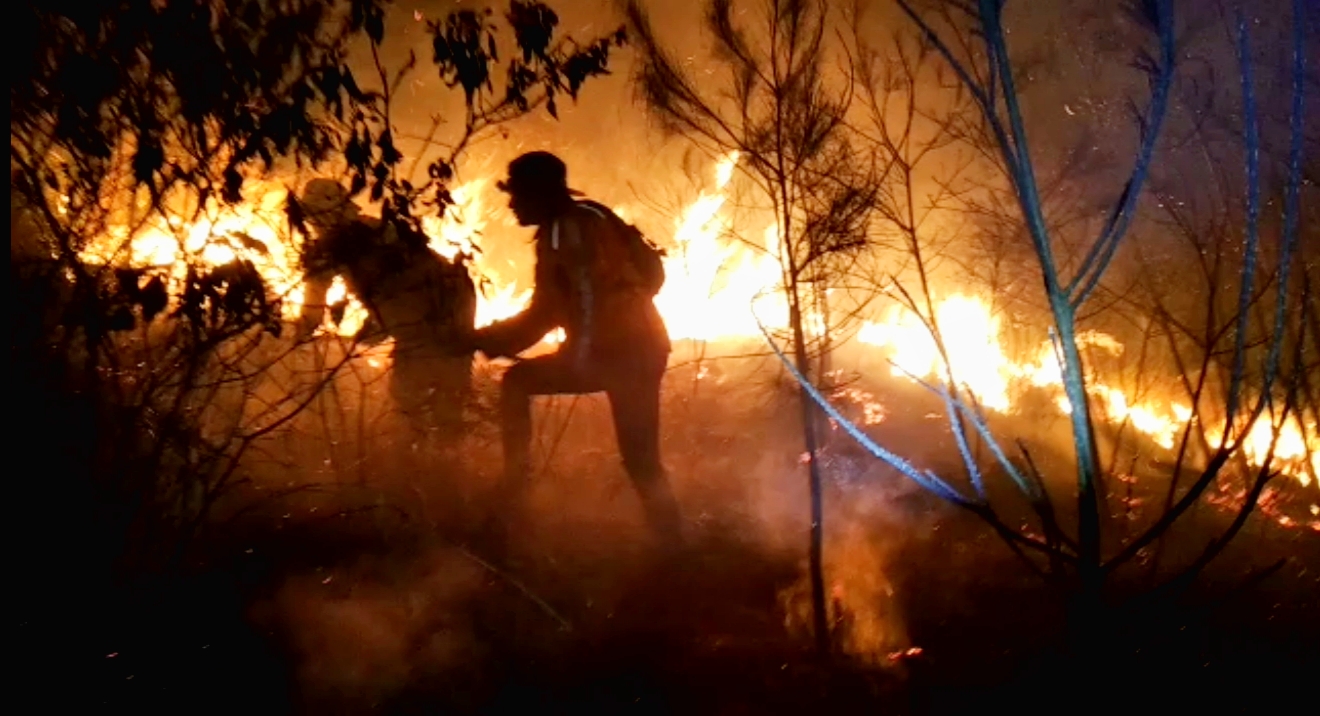
- A national park staff member, two men from a hotel security and services company, and a state firefighter gave their lives on Oct. 15 as they fought to contain a wildfire in the Bromo Tengger Semeru National Park, an active volcanic landscape in Indonesia’s East Java province.
- A further two men — a third worker at the security company and a community firefighting volunteer — were evacuated with burn injuries to a hospital in Surabaya, Indonesia’s second-largest city.
- “Their dedication serves as a reminder that behind every effort to protect nature and society lies struggle, courage, and sacrifice that deserve respect,” a spokesperson for Indonesia’s disaster management agency said in a statement.
- Indonesia’s main dry season is being fueled by the El Niño and positive Indian Ocean Dipole climate patterns, leading to some of the worst wildfires seen in years across the country.
MALANG, Indonesia — Four people were killed on Oct. 15 as they fought to contain a wildfire in the east of Java Island at the Bromo Tengger Semeru National Park, a complex of active volcanoes and one of Indonesia’s best-known tourism destinations.
The fire took place by a savanna and hillside in a crater visited by hundreds of thousands of domestic and international tourists every year.
“Their dedication serves as a reminder that behind every effort to protect nature and society lies struggle, courage, and sacrifice that deserve respect,” said Berton S.P. Panjaitan, a spokesperson for Indonesia’s disaster management agency, the BNPB.
Indonesia’s environment minister identified the four victims as Sukaris, a national park civil servant; Wisnu Yuda Pratama and Sefriel Ardiansyah, who were employees of a hotel services company PT Mitra Indo Permai; and Hendra Rony Wagiyanta, a member of the state firefighting unit, Manggala Agni.
Hendra, who was evacuated to Tongas hospital in Probolinggo, the nearest town, died due to the injuries hours later.
Much of Indonesia’s most severe fire damage occurs in carbon-rich peatlands on the islands of Borneo, New Guinea and Sumatra. Fires are common in other parts of the country, but rarely lead to fatalities.

Sea of sand
On Oct. 10, Bromo Tengger Semeru National Park officers received notification of a fire from the head of Ngadas village, which encompasses a 10-kilometer-wide (6-mile-wide) strip of land to the south of the cone of Mount Bromo.
“Officers went to the location and coordinated with the village government to request personnel assistance in extinguishing the fire,” Rudijanta Tjahja Nugraha, head of the Bromo Tengger Semeru National Park, said in a statement.
That fire was declared under control on Oct. 14 at around 11:45 a.m. However, on the following morning, firefighters at the Cemoro Lawang fire post, to the north of the Bromo volcano, noticed smoke rising over the landscape.
On arrival at the scene in the Mentigen hill area, firefighters called for reinforcements, which included Sefriel, Suraji and Wisnu from PT Mitra Indo Permai, as well as Munawi, a volunteer with the Masyarakat Peduli Api (MPA) community firefighting unit.
Residents and village officials resorted to fighting the fire by hitting it using bats known as gepyok, due to a lack of water access and inaccessible terrain.


The team split reportedly into two groups hoping to enclose the fire from either side. However, a wind gust at around 1 p.m. accelerated the fire and trapped six personnel in the flames. Five others in a different group were able to escape.
Three of the six trapped personnel died at the scene at around 1:30 p.m., while Hendra was critically injured and was pronounced dead at the Tongas public hospital.
Munawi, the MPA volunteer, and Suraji, from PT Mitra Indo Permai, were, at the time of this article publication, receiving treatment for burns at the primary hospital in Surabaya, the capital of East Java province.
The fires raging across Indonesia are the worst since the 2015 and 2019 Southeast Asian haze crises, when strong El Niño and positive Indian Ocean Dipole (IOD) effects fueled widespread drought.
Transboundary air pollution from Indonesia’s wildfires has also drifted to Malaysia and Singapore, prompting health advisories in both countries.
The extent of the public health and environmental crisis will become clear in the coming months, but many researchers fear the wildfires this year may be a biodiversity and public health catastrophe.
The Bromo Tengger Semeru National Park is an active volcanic complex. In December 2021, at least 51 people were killed when Mount Semeru erupted.
Local authorities have since closed Mount Bromo’s Penanjakan viewpoint and restricted access to other areas for both local residents and tourism.
“We need to strengthen early warning systems and emergency response readiness,” said Berton, the disaster management agency spokesperson.
Banner image: Fire has engulfed Mount Arjuno close to Malang. Approximately 20 hectares (50 acres) have been consumed. Image by UPT Tahura R Soerjo.
This story was first published here in Indonesian on Oct. 18, 2026.
‘Perpetuating stupidity’: Indonesia comes under fire for response to burning and haze

