


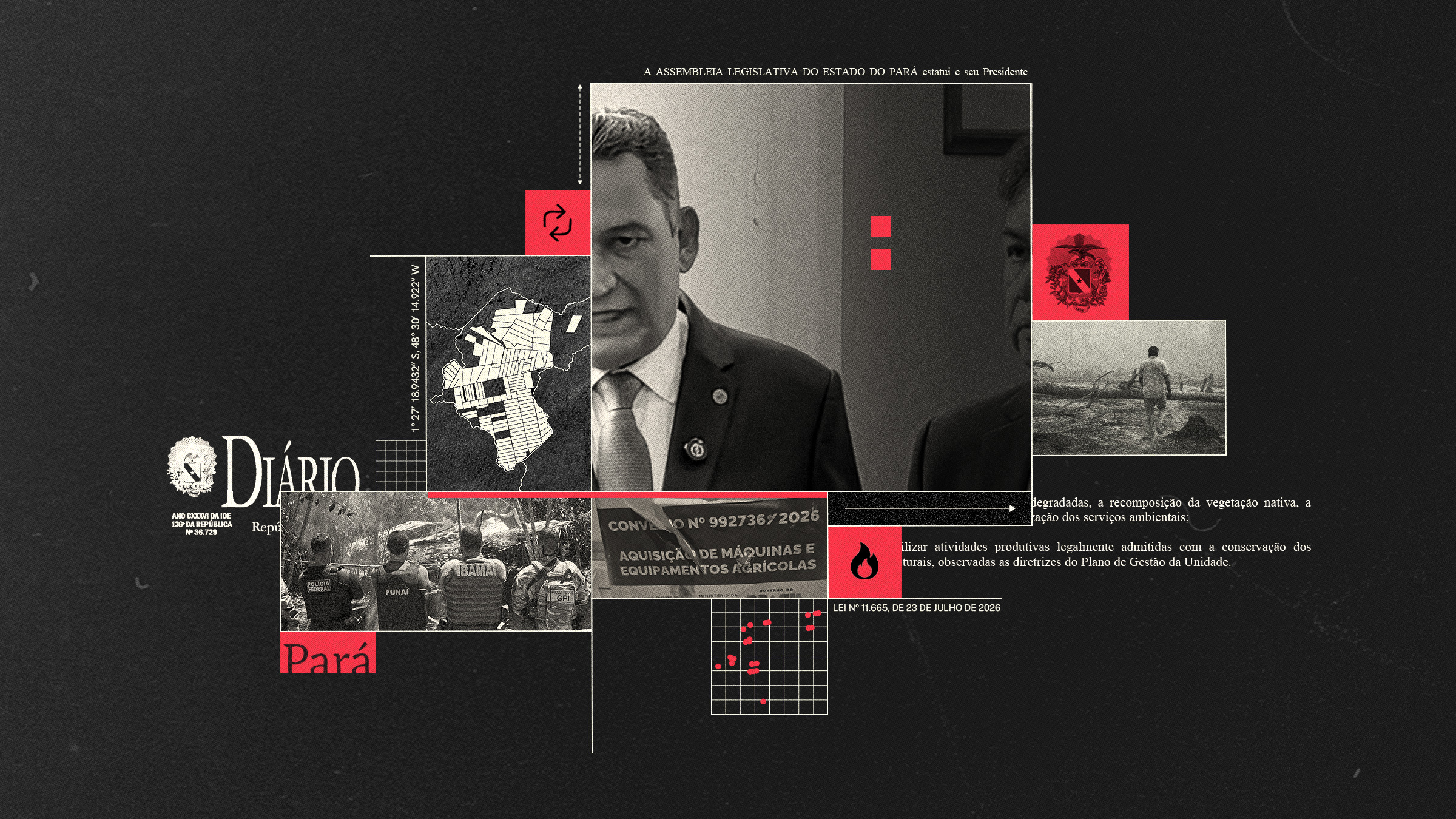
- A new Mongabay investigation lifts the lid on how a fast‑tracked state law in Pará, Brazil, paired with a coordinated social media blitz, legitimized and encouraged around 500 people to invade the Ituna/Itatá Indigenous Territory, home to an uncontacted Indigenous group.
- Data analysis reveals that 97% of land registries inside the reserve are medium or large properties; dozens of registrants already own other farms outside the territory, undermining politicians’ claims that small farmers need the land.
- At the center of this case is state legislator Francisco “Torrinho” Torres, a rancher bankrolled by big agribusiness and hit with millions in environmental fines for deforestation and Indigenous land grab.
- Experts warn about the risk of an ongoing genocide of the isolated Igarapé Ipiaçava people, unless authorities act immediately to evict the occupiers.
The polished leather of Francisco “Torrinho” Torres’ shoes gleamed as he walked toward the lectern in the plenary chamber of the Pará state legislature in the Brazilian Amazon. The 57-year-old rancher-turned-politician moved unhurriedly as he prepared to deliver a speech that would set in motion a series of events leading to new invasions of the Ituna/Itatá Indigenous Territory.
It was June 30, 2026, in what seemed to be a routine session for the state representative from one of Brazil’s largest Amazonian states. Behind his sharp suit and the supportive nods of his agribusiness allies was a track record of environmental fines, a corruption investigation, and land disputes.
In a brief speech, Torres defended a bill he’d authored to create a new state-run environmental protection area, APA Bacajaí. He presented the measure as a solution for families struggling to farm and rural families in need of land regulation.
Three other state representatives took the stand to support the proposal. They spoke of farmers who had waited decades for land titles, of families unable to access credit without them, and of the uncertainty created by the possibility of an Indigenous land claim.
It only took 24 minutes for the chamber to pass the bill into law unanimously.
There were no objections and no requests for technical notes — even though it was known that the new 142,400-hectare (about 351,900-acre) reserve would overlap entirely with the Ituna/Itatá Indigenous Territory. The area has been under a land-use protection order since 2011 to safeguard the Indigenous Igarapé Ipiaçava people who live there in voluntary isolation.

Brazil’s Constitution also states that Indigenous lands are the property of the federal government, which is responsible for their demarcation and protection. Citing these provisions, Brazil’s Federal Public Prosecutor’s Office said the creation of the state-level APA Bacajaí was incompatible with the protection of federal lands designated for Indigenous peoples living in voluntary isolation.
Federal prosecutors and Brazil’s Ministry of Indigenous Peoples (MPI) told Mongabay that the state law created legal uncertainty and increased territorial pressures on the Indigenous people, whom the Observatory of Isolated and Recently Contacted Indigenous Peoples (OPI) and Survival International say are now in danger of being wiped out completely.
In an APA, private landowners can still build homes and raise livestock. Those fears were realized just weeks later, on Aug. 13, when nearly 200 people invaded the Indigenous territory, smashing through the security gates, tearing down warning signs, and setting up camps inside.
Meanwhile, the story that the state representatives told to justify the new law — of beleaguered farmers finally getting a chance to regularize their land claims — doesn’t match what’s happening on the ground.
A new analysis by Mongabay and Brazilian environmental non-profit organization Instituto Dados found that 97% of the total 213 illegal land claims filed through the self-declaratory Rural Environmental Registry (CAR) inside Ituna/Itatá since 2015 are for medium or large-sized properties, suited for big agricultural enterprises, rather than the small properties of struggling rural farmers.

Four years ago, investigations found a similar discrepancy in the size of properties, while politicians persisted with the misleading narrative. This continues to be the case at present, as Mongabay found, along with a trail of documents and social media posts pointing to strategies to remove restrictions on Indigenous territories in Pará state to benefit rural producers. The latest politician caught peddling the inaccurate portrayal is Torres, the owner of a massive farm with a record of environmental fines, and a lawmaker with ties to a beef exporter sourcing cattle raised inside Ituna/Itatá.
“The predominance of medium and large properties indicates that this is not an occupation by subsistence family farmers,” said Heron Martins, executive director at the Instituto Dados.
According to Martins, a spatial analyst with decades of experience assessing Amazon land titling, the pattern of registrations in public land suggests the use of CAR registrations as a tool for retroactive legalization. “The registry does not require prior proof of title; it functions as ‘documentary evidence’ to pressure for future regularization or compensation if people are evicted.”
Deforestation patterns support this reading, revealing how a surge in land registrations tends to pave the way for land grabbers to encroach on public land that could be designated as Indigenous territory, Martins said.
According to Brazil’s Constitution, Indigenous territories are federally protected, with collective, inalienable possession by Indigenous peoples, making it illegal to file a CAR registration for land inside Indigenous territories.
The analysis also reveals that dozens of people who filed a CAR registry inside Ituna/Itatá already own properties elsewhere and therefore don’t need that land to survive.
But the economic reality of the wider population is different. In Senador José Porfírio, the municipality where much of Ituna/Itatá lies, most employed people (52%) earn half the monthly minimum wage, roughly $162, according to the Brazilian Institute of Geography and Statistics (IBGE). Only 1,414 of the 25,576 people in the municipality are formally employed.
Yet, Senador José Porfírio sits at the heart of one of the Amazon’s most lucrative agricultural frontiers. Pará ranks 12th among Brazil’s 27 states by GDP, at 254.55 billion reais (about $51 billion) in 2023, according to IBGE. Its economy is made up of services, extractive industries, including mining and energy, and a rapidly growing agricultural sector. Meanwhile, more than 64% of the state’s population lived below the internationally defined poverty line in 2024, well above the national average of 51%.
While politicians have leveraged this disparity by promising land, titles, and agricultural wealth to gain votes, our data indicate that the primary beneficiaries of these land claims are not the low-income families at the center of their campaign platforms.
‘Invasion front-runners’
Instead, the findings of our investigation point toward a different beneficiary: large, commercially viable property owners who form the political base that have long backed Torres and his allies.
Sources who spoke on condition of anonymity told Mongabay that vulnerable families are trying to settle in Ituna/Itatá. However, they said, these migrants are used as pawns by powerful businesspeople, politicians, and land grabbers, known locally as grileiros, who orchestrate and encourage the occupation to establish a foothold on the land.
This follows a well-documented pattern of land grabbing in the Amazon.
Givanildo dos Santos Lima, an environmental analyst at IBAMA, the federal environmental protection agency, told Mongabay over WhatsApp messages that the timing of the invasion immediately after the announcement of the new state law “demonstrates that the [invading] group remains politically organized and wields significant influence within the state legislative assembly.”
“It was not an isolated attempt,” he said. “Everything was orchestrated in coordination.”


Lima said the modus operandi of these groups usually involves promising small rural farmers land rights, encouraging them to invade the Indigenous territory while they themselves remain at a distance.
Anthropologist Helena Palmquist, deputy coordinator of the OPI, who has been monitoring the situation in Ituna/Itatá via satellite imagery and field reports, told Mongabay that there’s a term used for these small rural farmers: “Invasion front-runners.”
According to IBAMA’s Lima, “The [real instigators] distribute certain areas for free to gain the support of a large group of people — a mass of individuals used to argue that the occupation of the area is a ‘fait accompli,’ thereby preventing the official ratification of the Indigenous territory.”
A coordinated approach
When the state government turned the alleged dream of these families into law, Torres, who was then campaigning for his successful reelection to the state legislature, rushed to announce it to his 38,000 followers on Instagram on Aug. 11:
“For years, families lived without knowing if they could stay on their own land,” he said. “Some saw their homes burned, their property destroyed and their life’s work threatened. Now, they have a path to work within the rules, regularize their status and live with greater security.”

One day later, settlers started mobilizing. In WhatsApp messages obtained by Mongabay that circulated among farmers’ groups in Senador José Porfírio, an unidentified man discussed the best way to access Ituna/Itatá.
He claims he was ordered to do so, though he didn’t say who issued the order.
“Can we enter already?” asked the man. He explained that people were being instructed to go in and “clean the paths” and stay there. In another message, another unidentified man said he wanted to clear a road, “even if with a machete,” so people could reach the paths and check whether anyone was already there.
After news of APA Bacajaí spread online, Ituna/Itatá quickly became a tinderbox.
The invasion of the territory comes amid a broader political shift in Brazil, where politicians aligned with far-right presidential candidate Flávio Bolsonaro are set to govern seven of the nine Amazonian states, including Pará. Indigenous communities have also recently reported receiving audio threats that farmers plan to invade their territories if Bolsonaro wins the Oct. 25 presidential runoff.
Mongabay analyzed data from INPE, Brazil’s space agency, and found a sharp increase in forest fires in the days after the new law was approved, jumping from zero alerts in August to 23 signs of fires inside Ituna/Itatá by Oct. 13.

The latest wave of environmental destruction builds upon a well-established history of illegal land grabbing that began in 2016. In 2019, Ituna/Itatá was Brazil’s most deforested Indigenous territory. From 2015 to 2025, it lost 19,532.7 hectares (48,266.4 acres) of primary forest, as irregular occupations and invasions became more frequent for cattle ranching and other agricultural activities.
Uncontacted groups, a hoax?
While the APA Bacajaí law first appeared on the legislative agenda in June 2026, state political and government officials had been strategizing for more than a year to remove restrictions associated with Indigenous territorial protections in Pará.
Documents obtained by Mongabay via freedom of information requests show that on May 8, 2025, former Pará governor Helder Barbalho wrote to Brazil’s Ministry of Agrarian Development and Family Agriculture, requesting meetings to discuss restrictions on public land in the state. Barbalho said Funai’s interest in creating new Indigenous territories was having a “severe impact” on Pará’s territorial planning and creating “profound legal uncertainty and social instability.”
The stated purpose was to develop “urgent and concrete solutions” to remove the restrictions then imposed on the Indigenous lands.
Over the following months, documents show that the federal government formally established a working group with voting membership strictly limited to a small group that included a few federal entities, such as the Ministry of Agrarian Development and Family Farming and the Department of Land Governance, and officials from the state land institute, ITERPA. The working group met twice in 2025 to discuss the allocation of several areas of interest to Funai, including Ituna/Itatá. Civil society organizations were excluded from the process.
The internal documents reveal that Barbalho’s administration spearheaded the initial push against Indigenous land restrictions, driving the same political agenda that underpins the new state law introduced by his ally, Torres.


Meanwhile, outside of government offices and legislative chambers, a small network of politicians, such as former state legislator Aveilton Silva de Souza and former senator Zequinha Marinho, as well as businesspeople and social media influencers like the lawyer Diogo Luiz Franco de Freitas have helped delegitimize Indigenous land protections. A flurry of social media posts built a parallel narrative: that Funai was expanding Indigenous territories at the expense of long-established rural farmers, and that families were being displaced from the land they had occupied for decades.
Another frequent topic of discourse among farmers, politicians, and settlers is that the Igarapé Ipiaçava are an invention.
Funai has organized expeditions to confirm the existence of the group since 2010, when the team found at least 37 pieces of evidence of human presence, including broken tree branches, new trails, and footprints of an adult and possibly a teenager.
In the last Funai expedition, in 2021, a team visited the southwestern portion of the reserve and found ceramic fragments, food residue — including a red-footed tortoise (Chelonoidis carbonaria) that had been consumed using a technique considered characteristic of isolated peoples — and a pattern of vegetation consistent with Indigenous occupation. Although Funai calls the evidence found throughout the years “compelling,” the uncontacted group is still considered “under study” as its presence has not been technically confirmed.

Several of the politicians who contributed to the narrative that casts doubt on the existence of the isolated group claim agribusiness and the productive sectors as their main legislative priority. They’ve received campaign donations from agribusiness-aligned businesspeople and have also been hit with several environmental fines for deforestation in areas under special preservation. In the 2022 elections, for instance, slaughterhouse and agribusiness owner Roberto Resende Paulinelli donated 20,000 reais (about $4,000) to de Souza’s election campaign.
Other Indigenous groups, including the Assurini and the Xikrin, who live near the reserve, have also reported finding evidence that isolated groups are present in the area. “Some of our elders would join Funai’s expeditions to look for these groups at the Ituna/Itatá and would come back mentioning that they’ve found the signs of their presence,” a Xikrin Indigenous person, who asked not to be identified due to safety concerns, told Mongabay in an interview.
The person said they fear for their lives every time they leave the reserves. Death threats and confrontation with settlers are frequent: “We feel like animals trapped in the zoo.”
The Xikrin person described how community members won’t even stop to buy water, a snack, or coffee from any of the municipalities in the region because the people who live there are “against them.”
To protect themselves when they leave their communities, they no longer apply the traditional body paint they’ve used since time immemorial to symbolize their cosmology and identity.
“We have to go disguised,” they said. “The [Xikrin] have a lot of apprehension about being there. It’s a fear of dying, right? That’s the reality.”
Environmental rights advocacy group Global Witness documented 26 killings of land and environmental defenders in Brazil in 2025, twice as many as last year, including seven Indigenous people. Half of the verified attacks occurred in Pará and Rondônia, mostly linked to land conflicts driven by agricultural and extractive expansion.
“Sometimes people think, ‘Oh, maybe there’s a risk of genocide in the future,’” Sarah Shenker, Brazil director and senior researcher with Indigenous rights advocacy group Survival International, told Mongabay in an interview.
“What we are watching is an ongoing genocide.”

On Aug. 26, a federal court ordered the government to deploy the National Public Security Force within 48 hours to contain the invasion of Ituna/Itatá. As of Oct. 13, they hadn’t yet arrived.
The Ministry of Justice and Public Security told Mongabay in an email that it’s ready to deploy the forces, but has not yet received formal consent from the Pará government.
Mongabay reached out to the Pará government for comment, but didn’t receive a response by the time this story was published.
‘Torrinho,’ the rancher turned politician
State legislator Francisco “Torrinho” Torres de Paula Filho has built a political platform centered on the defense of agribusiness and the state’s productive sector, and has spent years fighting against Indigenous land demarcation. One of his main targets was the Apyterewa Indigenous Territory, which has come under attack in recent years and lost 30,347 hectares (74,989 acres) of land between January 2019 and September 2022 to illegal logging and cattle ranching.
When federal agents moved to clear invaders from Apyterewa in 2022, Torrinho publicly argued that farmers were the real victims in the region. He claims uncontacted groups, such as the Igarapé Ipiaçava people of Ituna/Itatá, simply don’t exist.
In 2023, he convened an “agro crisis” commission in the state legislature — and gave the mic to Wilson Paulo da Mota, a local rural farmers’ union boss with land registered inside Ituna/Itatá. Mongabay and environmental and human rights NGO Earthsight later linked da Mota to timber illegally extracted from Ituna/Itatá. IBAMA fined him 5.7 million reais (about $1 million) for clearing 956 hectares (2,363 acres) of forest there.
IBAMA has fined Torres’ own company, Agropecuária Barra do Baú, 10 times since 2012, adding up to 18.5 million reais (about $3.7 million), for unauthorized deforestation in Barra do Baú. The megafarm sits inside the Triunfo do Xingu APA, an area under special preservation. According to reporting, by Brazilian newspaper Folha de S.Paulo, three environmentalists were murdered on that same farm. José Gomes (also known as Zé do Lago), his wife, and their daughter lost their lives following land disputes with Torrinho’s family in 2022, according to news reports.
Torres co-owns the Barra do Baú farm with his business partner, Vania Marcia Carneiro de Paula, who was fined 1.5 million reais (about $303,000) by IBAMA in 2019 for unauthorized deforestation on a farm called Bau III in São Félix do Xingu municipality. Torres’ brother, Joao Cleber de Souza Torres, former mayor of São Félix do Xingu, claims the farm on the CAR database.
Beyond cattle, Torrinho controls timber, mining, and grain businesses. His declared assets are valued at more than 5 million reais (about $1 million), according to his public records.
His latest and previous electoral campaigns were heavily bankrolled by the de Oliveira family, owners of Frigol, one of Brazil’s major beef exporters. Several family members serve on the board of directors or act as legal representatives of the company.
Previous investigations have revealed how cattle raised illegally in Ituna/Itatá are laundered through fraudulent permits and sold directly to major slaughterhouses run by Frigol and industry peers JBS and Marfrig.

Torres is also being probed for corruption. On July 1, news outlets reported that Federal Police had carried out a search of Torres’ office at the Legislative Assembly of Pará (ALEPA), as part of an investigation into the suspected diversion of federal education funds in São Félix do Xingu. The investigation involves administrative contracts signed between 2014 and 2024, totaling approximately 50 million reais (about $10 million).
Investigators suspect money laundering and possible ties to illegal gold mining in the Xingu region, news reports said.
Mongabay reached out to Torres’ office to request an interview multiple times, but received no response.
‘They just want to open up the land at all costs’
Shenker from Survival International described the Ituna/Itatá case as “a whole network of Indigenous people’s enemies, in one of the most violent parts of the country, scheming to open up this land for profit.”
“They don’t care whether there are uncontacted people there or not,” she said. “They just want to open up the land at all costs.”
For Shenker, the delay in sending police to evict the invaders is not a bureaucratic hiccup but part of a longer pattern of impunity that has repeatedly exposed isolated peoples to disease, violence, and displacement. She calls what’s unfolding in Ituna/Itatá not a hypothetical future risk, but a process already underway as roads are carved through the forest, fires spread, and armed groups move deeper into territory long recognized as home to people who choose to live on their own.
The Xikrin source said these invasions by powerful farmers and ranchers are being repeated in other Indigenous lands in the region. “It’s a group that isn’t dissociated from each other,” he said. “They are always interconnected.”
Banner image: Graphic by Emilie Languedoc/Mongabay with images courtesy of Brazil’s Ministry of Indigenous Peoples (MPI), Torrinho Torres/Instagram and Beptemexti Kayapó.
Invaders storm Indigenous Amazon land, threatening isolated people
Feedback: Use this form to send a message to the author of this post. If you want to post a public comment, you can do that at the bottom of the page.

