

Close Menu
NCIJ Network NCIJ Network
    What's Hot

    Targeted ads installed Candiru spyware in zero-click attacks

    October 16, 2026

    NASA’s Hubble Spies Spiral’s Edge

    October 16, 2026

    The uplifting story of one of Zimbabwe’s pioneering women rangers

    October 16, 2026
    Facebook X (Twitter) Instagram
    Trending
    • Targeted ads installed Candiru spyware in zero-click attacks
    • NASA’s Hubble Spies Spiral’s Edge
    • The uplifting story of one of Zimbabwe’s pioneering women rangers
    • Despite high stakes for energy future, Wisconsin’s utilities scale back campaign spending — so far
    • British students, like their French peers, have been known to challenge authority | Education
    • Trump admin cut down 430 trees at DC golf course renovation site, court docs confirm
    • Russia Appears to Step Up Efforts to Influence U.S. Voters
    • No 10 leaves option open to impose Chinese EV tariffs if UK joins EU scheme | Trade policy
    • About
      • Our Team
      • Editorial Policy
      • Editorial Independence
      • International Support
    • Trust & Standards
      • AI Usage Policy
      • Conflict of Interest Policy
      • Corrections Policy
      • Ethics Policy
      • Fact-Checking Policy
      • Source Protection
    • Get Involved
      • Guide for Sources
      • Support Independent Journalism
    • Legal
      • Cookie Policy
      • Privacy Policy
      • Terms of Use
    Facebook X (Twitter) Instagram
    NCIJ Network NCIJ Network
    Friday, October 16
    • Home
    • World
    • Ai
    • Business
    • Politics
    • Health
    • Crypto
    • Science
    • Technology
    • Cybersecurity
    • Defense & Security
    • Economy
    • Energy
    • Europe
    • More
      • Fact Check
      • Investigations
      • Opinion & Analysis
      • Environment
    NCIJ Network NCIJ Network
    Home»Opinion & Analysis

    The Guardian view on Winnie-the-Pooh: now we are 100 | Editorial

    NCIJ NETWNCIJ NETWORKBy NCIJ NETWNCIJ NETWORKOctober 16, 2026 Opinion & Analysis No Comments3 Mins Read
    Share
    Facebook Twitter LinkedIn Pinterest Email

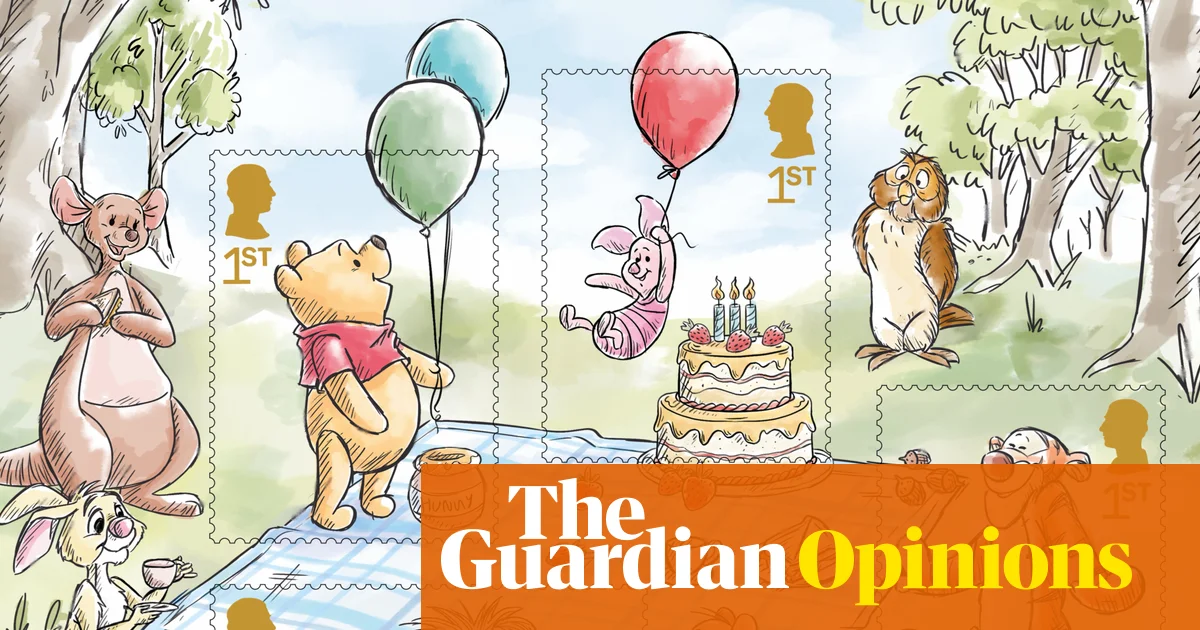
    “Pooh, promise you won’t forget about me, ever. Not even when I’m a hundred,” Christopher Robin implores his bear in the final chapter of AA Milne’s The House at Pooh Corner. This week Winnie-the-Pooh himself turned 100, and he certainly hasn’t been forgotten. Birthday celebrations have included a week of special programmes, introduced by the queen, on Radio 4; a collection of Royal Mail stamps; and a Google doodle.

    Not bad for “a bear of very little brain” who appeared in four slim books. Winnie-the-Pooh, illustrated by EH Shepard, was published on 14 October 1926 and had sold 150,000 copies in the US by the end of the year.

    Despite his success, the honey-loving bear was resented by both Milne and his son Christopher Robin Milne, the first for eclipsing his work as a playwright and comic writer, the latter for stealing his childhood. And he was too sugary for some. “It is that word ‘hummy,’” Dorothy Parker wrote waspishly under her pseudonym Constant Reader, “that makes the first place … at which Tonstant Weader fwowed up”. PG Wodehouse and Evelyn Waugh were equally sniffy. But generations of children disagreed. Winnie-the-Pooh was voted No 7 in the BBC Big Read poll in 2003.

    Pooh’s position as Britain’s favourite bear is under threat from a younger ursine model. Separated by 32 years and one day, Michael Bond’s A Bear Called Paddington was published on 13 October 1958. These two polite and accident-prone bears differ in more than a taste for honey or marmalade.

    Both stories were created in the aftermath of war: Winnie-the-Pooh was Milne’s escape from the horrors of the Somme; Paddington was inspired by evacuees in the second world war. Pooh was based on a toy from Harrods, Paddington on a solitary teddy that Bond found in a toyshop on Christmas Eve. The Hundred Acre Wood is a sheltered rural idyll; Paddington arrives at a bustling postwar London station. Both are beloved at Buckingham Palace, but it was the bear from Peru who was invited to tea for the platinum jublee of Queen Elizabeth II.

    Thanks to three hit films and now an award-winning musical, Paddington has shaken off his slightly fusty image to become an emblem of modern Britain. Where Paddington is progressive, Pooh seems stuck in a posher past.

    Aside from being one of the world’s biggest merchandising franchises, Winnie-the-Pooh’s cultural afterlife has been bumpier. Screen adaptations have been mixed, from Disney’s 1966 animation, which EH Shepard declared “a complete travesty”, to the indie slasher horror Winnie the Pooh: Blood and Honey, made after Milne’s US copyright expired in 2022. Pooh has become an unlikely symbol of political dissent in China after President Xi was visually likened to him in 2013, with protesters in Hong Kong picking up the comparison in 2019.

    According to a Canadian medical journal, each character represents a form of neurodivergence or mental health disorder: Tigger stands for ADHD, Piglet for anxiety, Eeyore for depression and so on. The article may not have been entirely serious, but the author Matt Haig has described Winnie-the-Pooh as “the ultimate self-help book”. Pooh is not just a “silly old bear”. In our speeded-up age, where children spend more time on screens than outdoors, Milne’s world of freedom and innocence remains deeply comforting, for “in that enchanted place on the top of the forest a little boy and his Bear will always be playing”.

    • Do you have an opinion on the issues raised in this article? If you would like to submit a response of up to 300 words by email to be considered for publication in our letters section, please click here.

    Editorial Guardian view WinniethePooh
    NCIJ NETWNCIJ NETWORK
    • Website

    Keep Reading

    British students, like their French peers, have been known to challenge authority | Education

    The Guardian view on the banks: too big to fail cannot mean too big to tax | Editorial

    European-Flagged Ships Can Deter Russia’s Black Sea Piracy

    Unleashing Africa’s Women Agripreneurs by Ana Maria Loboguerrero

    Uruguay to Give Asylum-Seekers New Path to Permanent Residency

    Endless fun with a legendary book of placenames | Rural affairs

    Add A Comment
    Leave A Reply Cancel Reply

    Editors Picks

    Targeted ads installed Candiru spyware in zero-click attacks

    October 16, 2026

    NASA’s Hubble Spies Spiral’s Edge

    October 16, 2026

    The uplifting story of one of Zimbabwe’s pioneering women rangers

    October 16, 2026

    Despite high stakes for energy future, Wisconsin’s utilities scale back campaign spending — so far

    October 16, 2026
    Latest Posts

    Heard about the ‘luteal uglies’? Women know more about our hormones than ever – and that’s beautiful | Rhiannon Lucy Cosslett

    August 12, 2026

    On fragile Sumatran peatland, a farmer fights to bring back lost mangroves

    August 12, 2026

    Too many choices complicate female frogs’ sex lives

    August 12, 2026

    Subscribe to News

    Get the latest sports news from NewsSite about world, sports and politics.

    NCIJ Network is an independent digital news platform delivering trusted investigative journalism, European and global news, in-depth analysis, and fact-based reporting with accuracy, transparency, and integrity.

    Facebook X (Twitter) Instagram Pinterest YouTube

    Targeted ads installed Candiru spyware in zero-click attacks

    October 16, 2026

    NASA’s Hubble Spies Spiral’s Edge

    October 16, 2026

    The uplifting story of one of Zimbabwe’s pioneering women rangers

    October 16, 2026

    Subscribe to Updates

    Get the latest creative news from FooBar about art, design and business.

    Type above and press Enter to search. Press Esc to cancel.