

Close Menu
NCIJ Network NCIJ Network
    What's Hot

    SecTor 2026 Reveals a Rapidly Shifting Cybersecurity Landscape

    October 16, 2026

    Artemis II results show how much science people can do at the moon

    October 16, 2026

    The Guardian view on the banks: too big to fail cannot mean too big to tax | Editorial

    October 16, 2026
    Facebook X (Twitter) Instagram
    Trending
    • SecTor 2026 Reveals a Rapidly Shifting Cybersecurity Landscape
    • Artemis II results show how much science people can do at the moon
    • The Guardian view on the banks: too big to fail cannot mean too big to tax | Editorial
    • Does video show Katie Zacharia struggling to answer beauty pageant question?
    • In Europe’s tech capital, Irish labor unions are booming amid AI-driven layoffs – POLITICO
    • Ex-top official Olly Robbins reaches settlement with government over sacking
    • Hampshire Reform councillor calls ITV report ‘vote interference’
    • Here’s Exactly How Tesla Made Its New 230-Mph Car ‘Fly’
    • About
      • Our Team
      • Editorial Policy
      • Editorial Independence
      • International Support
    • Trust & Standards
      • AI Usage Policy
      • Conflict of Interest Policy
      • Corrections Policy
      • Ethics Policy
      • Fact-Checking Policy
      • Source Protection
    • Get Involved
      • Guide for Sources
      • Support Independent Journalism
    • Legal
      • Cookie Policy
      • Privacy Policy
      • Terms of Use
    Facebook X (Twitter) Instagram
    NCIJ Network NCIJ Network
    Friday, October 16
    • Home
    • World
    • Ai
    • Business
    • Politics
    • Health
    • Crypto
    • Science
    • Technology
    • Cybersecurity
    • Defense & Security
    • Economy
    • Energy
    • Europe
    • More
      • Fact Check
      • Investigations
      • Opinion & Analysis
      • Environment
    NCIJ Network NCIJ Network
    Home»Science

    Horned dinosaurs’ weapons evolved to handle the forces of combat

    NCIJ NETWNCIJ NETWORKBy NCIJ NETWNCIJ NETWORKOctober 16, 2026 Science No Comments4 Mins Read
    Share
    Facebook Twitter LinkedIn Pinterest Email

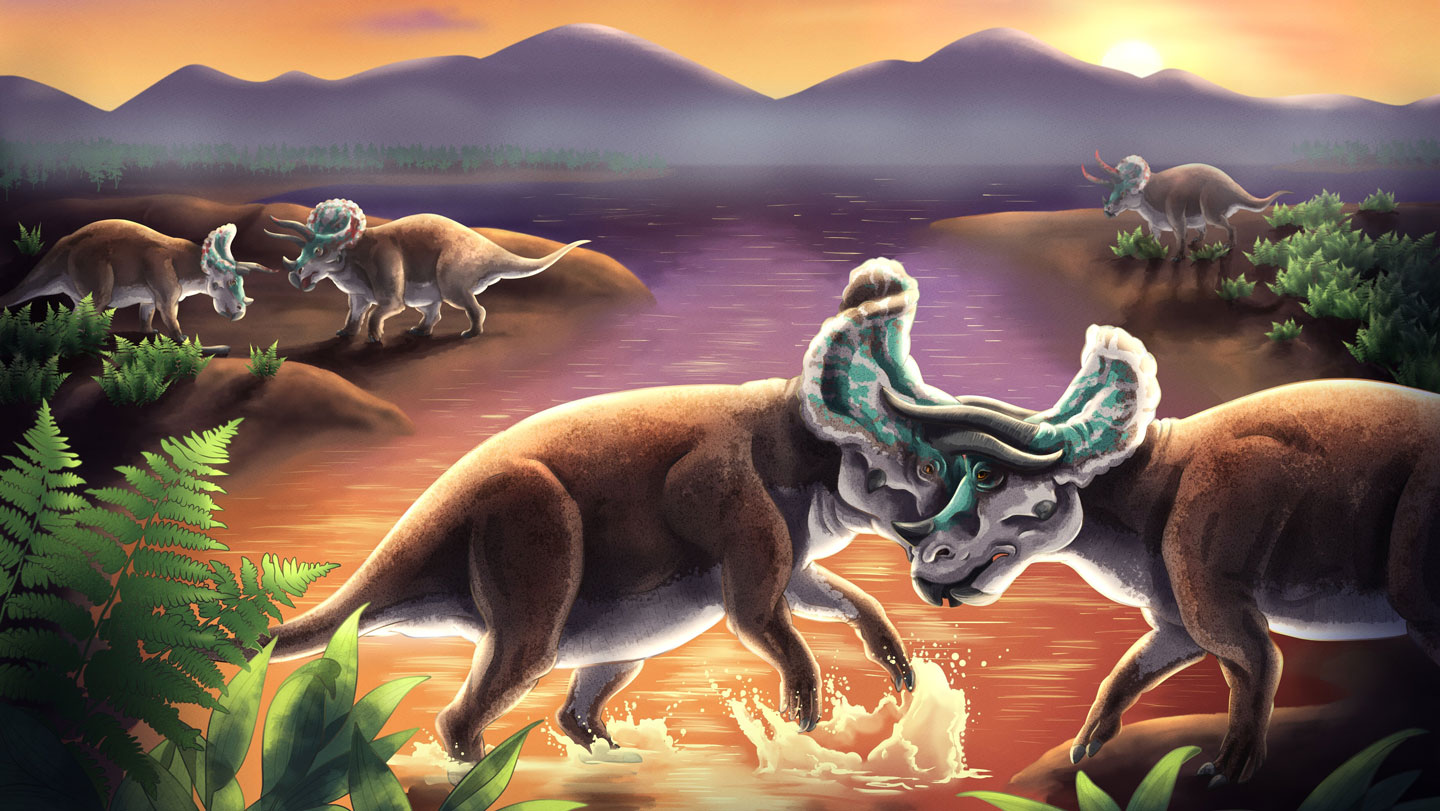
    Triceratops’ massive skulls were built for horn-to-horn grappling. The rhino-like Centrosaurus could withstand stabbing its nose horn up and down. And the parrot-faced Psittacosaurus would have been wise to avoid a fight: Its head was ill-suited to handle blows.

    New simulations using 3-D models of the heads of five different horned dinosaurs reveal what forces the skulls could withstand in battle. The results provide insight into how these dinosaurs evolved to use their face-based armory in combat, researchers report September 24 in PeerJ. 

    Sign up for our newsletter

    We summarize the week’s scientific breakthroughs every Thursday.


    Ceratopsians — horned dinosaurs like Triceratops — have been hypothesized to use their imposing headgear as armaments for battling with other members of the species.

    Fossilized facial injuries consistent with head-to-head violence have provided physical clues. “We know from many fossils that ceratopsian skulls tended to get banged up a little bit … in very particular spots on the frill or on the cheek,” says Andrew Farke, a paleontologist at Raymond M. Alf Museum of Paleontology in Claremont, California. But little else was known about how ceratopsians actually used their horns in battle.

    Studying the biomechanics of the animals’ weaponized skulls could provide information on what movements and forces the dinosaurs evolved to tolerate. Such biomechanics research had previously been done on the bite stresses of theropod dinosaurs like Tyrannosaurus and on the forces felt by the club tails of armored dinosaurs, says vertebrate paleontologist Eric Austin Ames Jr.

    Ames and his colleagues at the University of Bristol in England developed digital 3-D models of six skulls across five ceratopsian species spread across the group’s evolutionary tree. They simulated the combat stress experienced across the skull, varying the direction of attack and how the weaponry was used. Higher stresses in the skull meant a greater risk of mechanical failure, Ames says. The dinosaurs are more likely to have evolved to fight in a way that was well-tolerated by the skull’s mechanics. 

    Researchers simulated the stresses on the ceratopsians’ skulls under different fighting behaviors. For example, on the Triceratops skull, the team simulated forces from a single horn stabbing (left), horns interlocking a quarter of the way up the shaft (middle), and horns locked at an angle (right).E.A. Ames, A.J. Rowe and D.J. Button/PeerJ, 2026, 3-D Model Courtesy of the Smithsonian Institution (Copyright: Smithsonian Institution)

    The team found that early members of the group from about 125 million years ago — like the hornless, husky-sized Psittacosaurus — didn’t have skulls well-suited for combat of any type. The pig-sized Protoceratops had a skull that tolerated ramming fairly well. Larger, later-diverging species  like Centrosaurus and the three-horned Triceratops and Spiclypeus appeared adapted to a wider range of combat styles. 

    Centrosaurus may have been a specialized stabber, lunging its head to jab at opponents. “When we tested [the skull] with vertical forces, it actually handled the stresses really well,” Ames says. “But when we tried side-to-side, it did not perform very well.”In contrast, Triceratops and Spiclypeus had skulls that tolerate the forces generated by interlocking horns and wrestling.

    Ames thinks ceratopsians’ horns and frills probably first evolved for social and sexual display, but were soon used for full contact purposes. “Throughout their evolutionary history, their [horns’ traits] started to really explode in diversity and that coincided with different intraspecific combat styles,” he says. “This is something we see in modern herbivores.”

    Much like with the antlers and horns of modern deer, buffalo or antelope, these weapons could have easily been turned on predators as well. “These adaptations are kind of like a Swiss Army knife,” Ames says. “They can be used for multiple things.”

    The team created its 3-D models from surface scans of fossilized skulls. More detailed models that better simulate the complicated internal structure of these dinosaurs’ immense, bizarre skulls could provide even more insight to this prehistoric fight club, Farke says.

    combat dinosaursweapons Evolved forces handle horned
    NCIJ NETWNCIJ NETWORK
    • Website

    Keep Reading

    Artemis II results show how much science people can do at the moon

    USC scientists discover how to create a never-ending supply of cancer-fighting cells

    I Am Artemis: Allison Mjoen

    Rigorous Analysis Confirms NASA’s Artemis II Heat Shield Performance 

    210-million-year-old dinosaur discovery reveals a lost world in Africa

    Isaias Dims the Gulf Coast

    Add A Comment
    Leave A Reply Cancel Reply

    Editors Picks

    SecTor 2026 Reveals a Rapidly Shifting Cybersecurity Landscape

    October 16, 2026

    Artemis II results show how much science people can do at the moon

    October 16, 2026

    The Guardian view on the banks: too big to fail cannot mean too big to tax | Editorial

    October 16, 2026

    Does video show Katie Zacharia struggling to answer beauty pageant question?

    October 16, 2026
    Latest Posts

    Heard about the ‘luteal uglies’? Women know more about our hormones than ever – and that’s beautiful | Rhiannon Lucy Cosslett

    August 12, 2026

    On fragile Sumatran peatland, a farmer fights to bring back lost mangroves

    August 12, 2026

    Too many choices complicate female frogs’ sex lives

    August 12, 2026

    Subscribe to News

    Get the latest sports news from NewsSite about world, sports and politics.

    NCIJ Network is an independent digital news platform delivering trusted investigative journalism, European and global news, in-depth analysis, and fact-based reporting with accuracy, transparency, and integrity.

    Facebook X (Twitter) Instagram Pinterest YouTube

    SecTor 2026 Reveals a Rapidly Shifting Cybersecurity Landscape

    October 16, 2026

    Artemis II results show how much science people can do at the moon

    October 16, 2026

    The Guardian view on the banks: too big to fail cannot mean too big to tax | Editorial

    October 16, 2026

    Subscribe to Updates

    Get the latest creative news from FooBar about art, design and business.

    Type above and press Enter to search. Press Esc to cancel.