


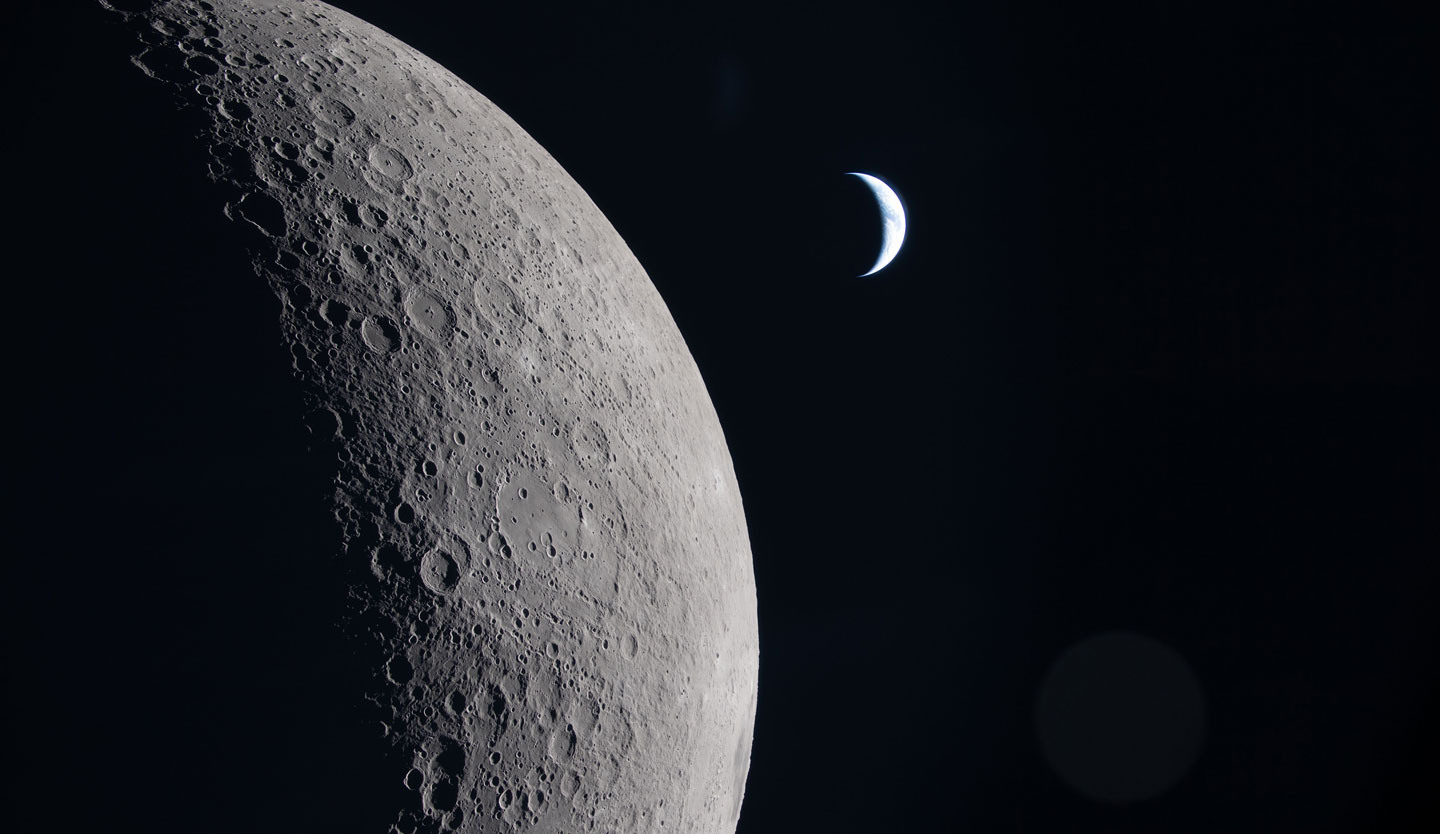
Six months after the Artemis II mission sent four astronauts around the moon, the value of their closeup view is coming into focus. The first science results, released on October 7, reveal details of the moon’s array of colors, how often it gets hit by tiny rocks and lessons for squeezing as much science as possible out of future human lunar missions.
“We worked extremely hard to make sure we were able to maximize lunar science return from wherever we could in this mission,” said Artemis II flight science operations lead Kelsey Young at a virtual Lunar Surface Science Workshop meeting on October 7. “This is creating yet another tool in our toolbox as planetary scientists to understand our moon, our solar system, even our own planet.”
NASA’s Artemis II mission sent four astronauts on a 10-day journey around the moon in April — the first time humans had been anywhere near our natural satellite in more than 50 years. Astronauts Reid Wiseman, Victor Glover, Christina Koch and Jeremy Hansen spent about seven hours in close proximity to the moon taking scientific observations, describing the moon’s surprising colors and textures and witnessing a solar eclipse from space.
Almost all of that event was livestreamed. But the astronauts took thousands of photos, notes and audio recordings that weren’t immediately made public. Part of the science team’s job was to digest those observations and release the data to anyone who wants to study them within six months of splashdown on April 10.
With three days to spare, the team released three reports and a massive data archive on October 7, the 67th anniversary of when the Soviet Luna 3 spacecraft took the first photograph of the farside of the moon. The results offer a rare test of what trained human observers can add to lunar research and what NASA can learn for future missions to the lunar surface.
“We’re really excited to release all of this data,” earth scientist Sara Schmidt of NASA Johnson Space flight Cener in Houston said during the meeting. After six months of hard work, “this is enabling science to happen for the next, I don’t know, 60 years, if not more.”
How astronauts learn to observe the moon
Surprisingly, the most valuable data from the mission were not the mind-blowingly gorgeous photos, but the astronauts’ verbal and written descriptions of what they were seeing.
Before launch, the astronauts had extensive training in lunar geology and science observations. They were an extension of the science team, said field geologist Cindy Evans also of NASA Johnson Space Flight Center, one of the astronauts’ instructors.
“You could hear it in their voices. They understood the language of geology,” she said.
That training was meant to help answer a question Young hears often: What can humans add that a camera can’t?
During the flyby, the astronauts worked in pairs. Two of them spoke to mission control on the ground, giving periodic updates to the science team on what they were seeing. The other two recorded themselves describing their observations and reactions and used a stylus to annotate specially made maps of the moon that had been uploaded to their tablets during flight. Those notes, doodles and recordings were not made public until now.
The idea was to give the crew high tech field notebooks, Young says.
“If you have any field experience, you know your field notebook is your best friend,” she said in the meeting. On Earth, geologists capture nuance and context in written and spoken words, as well as sketches, she said. “We wanted to provide the ability to capture that nuanced information from the crew.”
One example of this was when Koch sketched her view of the Orientale basin, detailing differences in texture and layers around the crater.
“Sketches can be so powerful,” Young says. “They’re quick and dirty and that’s exactly the right thing to do. You’re capturing that nuance really quickly before it leaves your brain.”
Some of the most unique observations came during the 54 minutes when the moon eclipsed the sun, giving the astronauts a view of the solar corona, interplanetary dust and other stars and planets. That was a favorite moment for planetary scientist Jennifer Heldmann of NASA’s Ames Research Center in California.
“That audio showed their sheer joy and amazement in what they were seeing and where they were,” Heldmann says. “They were so blown away by what they were seeing, while also taking very relevant science observations.”
But some of the most affecting moments were when words failed. When Glover and Koch saw the Earth emerge from behind the moon, for a while all they could say was “Oh my gosh!”
“I guess I should be trying to describe it, but I mean, good grief,” Glover’s tablet recorded him saying.
“No, I tried, but it’s impossible,” Koch agreed. “You might be able to fly a spaceship and talk, but if you can see that and talk, you just ain’t right.”
Astronauts spotted tiny impacts on the moon
Another thing the astronauts were able to see during the eclipse were impact flashes — tiny blips of light marking where bits of rock hit the moon.
“It’s a pinpoint of light,” Hansen said in his recorded observations. “It’s not like a meteor, you didn’t see anything else, it’s just like a bloop.”
Before launch, the science team identified and prioritized observations they hoped the crew would be able to make during the flyby. Impact flashes were at the top of the list. Seeing the flashes would give scientists a way to estimate how often the moon is struck by incoming rocks, and how large those rocks are. That’s an important thing to know for protecting future missions where astronauts will walk on the surface or build a long-term moon base.
Scientists didn’t know whether the astronauts would see any flashes at all. They saw five. The flashes were “pinpricks of light lasting less than a second, with no color associated with the flash,” Heldmann said at the meeting.

Comparing the number of flashes per minute to theoretical models of how many impacts the moon might experience, scientists determined that the incoming rocks were tiny, about 8.5 grams and just over 4.5 centimeters across — about the size of a golf ball.
“With these observations, we believe that the Artemis II crew set a record for the smallest meteorites ever optically observed to impact the moon,” Heldmann said.
The resulting craters are probably less than a meter wide, too small for cameras on NASA’s Lunar Reconnaissance Orbiter to see.
That’s good news for future astronauts. Artemis IV, planned for 2028, is supposed to bring astronauts to the lunar surface for the first time since Apollo. If successful, it will be a two-week mission using landers from spaceflight companies Blue Origin or SpaceX. The probability of dangerous impact during such a mission is less than 1 in 10 million, Heldmann said. For a larger moon base meant to last a decade, the probability is higher, but still low.
“Now we can start to quantify those impact probabilities, which turns out are very very low,” she says. “Crews will be very safe.”
The moon has more color than it seems
The moon’s muted colors were another high-priority observation for the science team. Lunar hues and brightnesses can change with terrain roughness, surface temperature and mineralogy — and they’re much more discernable with human eyes than with cameras. The crew also saw how colors changed as the viewing angle and light levels changed.
“This is such a cool demonstration of the value of human eyes as scientific sensors,” said planetary scientist Ariel Deutsch, also of NASA Ames.

Combining the crew’s observations with other data going back to the 1970s let scientists connect colors to composition. Blues were associated with titanium-rich volcanic rocks. Browns reflect different iron levels. Greens are from glass formed during volcanic eruptions or asteroid impacts.
Future astronauts could use this information to create terrain maps and to find specific materials on the moon for sample collection or resources.
The crew also was enamored with the terminator, the boundary between light and dark, which revealed lunar topography in a new way.
“Even as rugged as the far side looks … man, when you look at the terminator, it is just, like, impossibly rugged,” Wiseman said during the flight. “And it reminds you that the whole farside is that way. It’s just the terminator is really bringing out the shadows and the hills and the valleys. And it is just — it’s unbelievable.”
The lighting at the terminator is similar to what future astronauts might expect at the moon’s south pole, where the sun will be low on the horizon and may cast dramatic shadows.
“We want to make sure we have a good handle on that for both science and operations and exploration,” Heldmann said.
What Artemis II taught NASA for future moon missions
With the lessons from Artemis II in hand, now it’s the next astronauts’ turn.
Some recommendations coming out of Artemis II focus on improving conditions in the spacecraft and weaving science into mission planning better. For example, due to time constraints, the astronauts’ cameras were not calibrated before flight. The team is now trying to calibrate them back on Earth, but it can’t re-create how the windows affected images because the windows were charred on the way back through Earth’s atmosphere.

Another takeaway from Artemis II is to continue to refine and train astronauts in descriptive notetaking. The audio notes will be even more important for the first landed missions, where astronauts in spacesuits will not be able to write in a notebook.
“We want to train astronauts to be field scientists, regardless of the landing site, regardless of the mission that they’re given,” Young says.
The buddy system of two astronauts at the windows, two talking to the ground, led to better science, the team concluded.
“The crew had scientific discussions and tried to understand what they were viewing,” Heldmann says. For surface missions, where time is limited and choices must be made quickly, that collaboration will be even more important.
The crew also commented on how helpful it was.
“When we actually do go down there to the surface, I know for safety reasons that we would never send someone alone, but I just want to really emphasize how important the discussion time was,” Glover said. “When we started to talk, we not only got better science discussion, we got better human connection.”
