


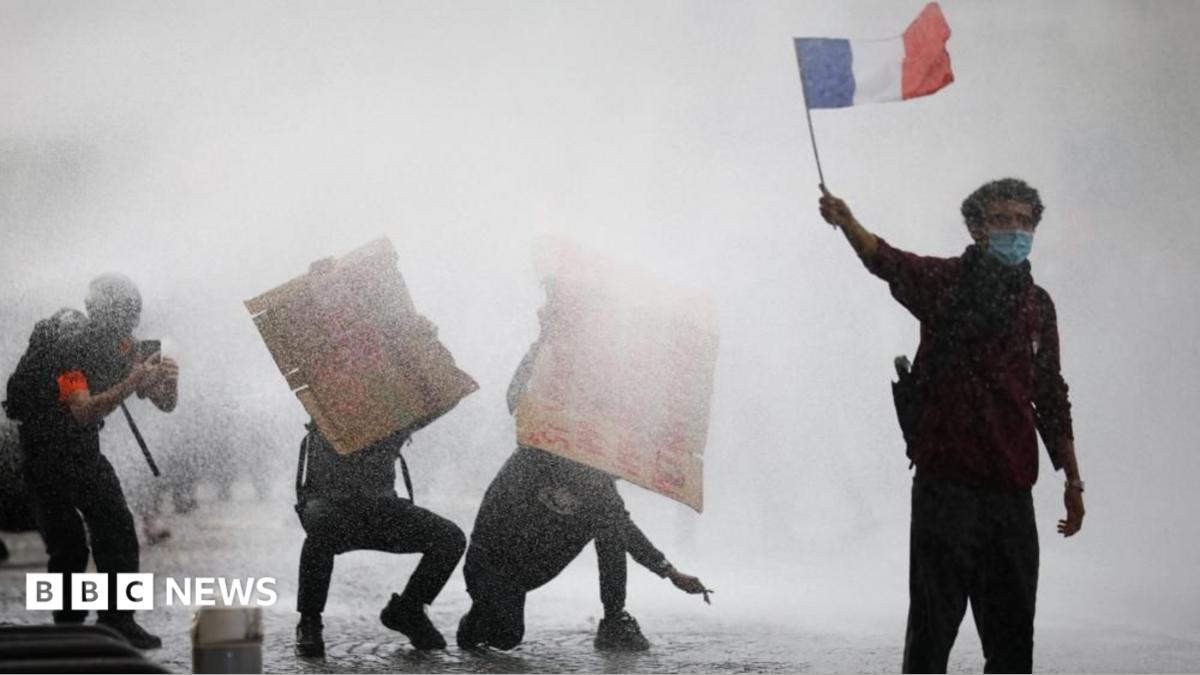
But “Mélenchon for President!” is a chant you often hear amongst the students in the streets.
Supporters applaud his desire for a wealth tax in France, for lowering the voting age to 16 and for being the only presidential candidate to turn up to French schools to examine the state of them, several demonstrators told me.
For Marine Le Pen, the nationalist anti-immigration favourite in France’s presidential race, the solution is cutting the country’s €11bn contribution to the EU’s budget.
There is, though, reason to doubt that any new French president, from the left or the right, will be able to break the impasse over France’s finances.
France is far from alone in Europe right now faced with an ageing population, a generous welfare state to run and a national economy squeezed by outside pressures such as US President Donald Trump’s trade tariffs and the war in the Persian Gulf.
Whether in France, Germany, Sweden or Italy, there is an inherent tension between politicians who hesitate to tell voters the truth about shrinking public finances, the defence establishment’s demand for higher defence spending and citizens’ insistence on improved public services.
In France, that pressure is particularly acute. French public expenditure, at about 57% GDP, is one of the steepest amongst wealthy nations worldwide.
Social spending, particularly on pensions, is exceptionally large, while French citizens pay one of the highest overall tax and social contribution burdens in Europe. Simply put, they expect a welfare and public service bang for their buck.
But economist Anne-Laure Delatte does not believe having a new president will ease her country’s financial migraine.
“We need constitutional change. A new system. A new Republic,” she told me.
“Our Fifth Republic is centred around a powerful president. Parliament is there to block him or her rather than to find consensus or to make new laws.”
For France to progress, she says, that has to change.
The French parliamentary election that follows the 2027 presidential vote is likely to be as divided as ever, she believes: “We need a system where MPs have more power and should learn consensus and coalition-building from our European neighbours.”
In her opinion, education had to be protected and funds better distributed. It was an investment in France’s financial future, she told me.
“Our current system of inequality in schooling and low wages for teachers means we lose out from benefiting from the best and brightest across French society. That is not only unfair on individuals but our economy ultimately loses out on innovation and productivity.”
Re-writing France’s constitution is not on the cards, at the moment. So, what about the here and now, I asked centrist politician Anne-Catherine Loisier.
She’s a senator for the Centrist Union in France’s upper house of parliament and vice president of the parliamentary group for sciences and technology.
