


- The Commission for the Conservation of Southern Bluefin Tuna (CCSBT), a multilateral body that manages the stock of southern bluefin tuna, held its annual meeting Oct. 5-8 in Brussels.
- Seabird protections drew debate, and a modicum of conservation progress was made: The parties agreed on 13 priority seabird species and designated high-risk areas for them.
- However, the designations don’t carry any new mandatory protections: Due to the reluctance of some members, the commission stopped short of adopting proposed conservation measures for the high-risk areas, most notably tighter seabird bycatch mitigation requirements.
Seabird protections drew debate at the annual meeting of the Commission for the Conservation of Southern Bluefin Tuna (CCSBT), held Oct. 5-8 in Brussels. The eight-member multilateral body that manages the stock has long struggled to curb seabird deaths caused by longline fishing targeting southern bluefin tuna (Thunnus maccoyii) across several oceans.
This year’s meeting saw a modicum of progress on the issue. Based on recent modeling, the parties agreed on 13 priority seabird species for conservation efforts and designated high-risk areas for them. However, the designations don’t carry any new mandatory protections: Due to the reluctance of some members, the commission stopped short of adopting proposed conservation measures for the high-risk areas, most notably tighter seabird bycatch mitigation requirements.
Oliver Yates, head of the marine program at BirdLife International, a U.K.-based NGO, told Mongabay that the identification of high-risk areas was “a good step forward” but said it was a problem that “they’ve not then adopted any management action to accompany the fishing activity in those spatial areas.”
“[T]hey recognise bycatch of seabirds is a very serious issue but again agreed to do nothing about it,” Yates, who attended the Brussels meeting, added in a text message.

Long line for fishing, short life for birds
The CCSBT is one of five regional fisheries management organizations (RFMOs) that govern tuna fishing across the world, both in national and international waters. Unlike the other four, which manage multiple stocks across fixed geographical areas, the CCSBT focuses on a single species, southern bluefin tuna, throughout its vast range across the Southern Hemisphere.
CCSBT has a mandate to protect ecologically related species, and conservationists have repeatedly sounded the alarm about the issue of seabird deaths in the fishery. Albatrosses and petrels are among the seabirds that become hooked as they feed on baited fishing lines and drown as the lines sink. Large longliners can drop thousands of baited hooks at a time.
An estimated 30,000 seabirds are killed annually by longliners in the Southern Hemisphere, according to a new report from the CCSBT and the U.N. Food and Agriculture Organization. Stephanie Borrelle, Yates’ colleague at BirdLife, told Mongabay that figure was a major underestimate because, among other reasons, it didn’t include Chinese vessels. There’s no specific figure for seabird deaths from longliners targeting southern bluefin tuna due to lack of data, she said.


Japan and Taiwan have two of the largest industrial longliner fleets targeting southern bluefin tuna, which is sought after as sashimi, especially in the Japanese seafood market. Australia is also a major player at CCSBT, but most of its catch comes from purse-seine nets that pose far less risk to seabirds.
The 13 priority seabird species named at the meeting are all albatrosses that were already among those listed under the multilateral Agreement on the Conservation of Albatrosses and Petrels (ACAP). Most of the 13 have a threatened IUCN status. At the Brussels meeting, an ACAP official warned of a “conservation crisis” affecting seabirds.
Alongside identifying the 13 seabird species, members designated high-risk areas for them. One question was how much area to designate. (More technically, the question was what proportion of the total modeled risk those areas should account for.) The CCSBT’s seabird working group, which met in March 2026, had recommended choosing among three possibilities, which effectively meant designating either 11, 20 or 32 grid squares on the map as high risk. Each grid square measures 5° latitude by 5° longitude. In Brussels, members chose 11, the least extensive of the three options. Some observers and members were pushing for a greater coverage area.

No concrete new protections
The designations set the table for future protections, but CCSBT members failed to agree to accompanying mandatory conservation measures. The March 2026 working group report called for a “toolbox” approach that would give members flexibility to implement one or more conservation measures: Increasing monitoring, reducing fishing effort or strengthening mitigation measures in the high-risk areas.
Building on that report, Australia and New Zealand came to the Brussels meeting with a paper arguing that mitigation measures should be the highest priority. The recommended using three mitigation tactics together: Bird-scaring “tori” lines to keep seabirds away from hooks as they’re deployed from a vessel’s stern; line-setting at night (when seabirds are less active); and branch-line weighting, which causes hooks to sink more quickly so birds have less access to them. This is known as “three out of three.” The duo also offered hook-shielding devices as a standalone alternative, as two other tuna RFMOs already allow. The devices cover baited hooks until they sink, then release them. They’re highly effective but can be expensive.
Fishing fleets from CCSBT member nations targeting southern bluefin tuna are already subject to the seabird protection rules of other tuna RFMOs when they’re in those RFMOs’ areas. The Australia and New Zealand plan would’ve added a layer of protection beyond the requirements of other RFMOs.
To build flexibility into the proposal, Australia and New Zealand suggested that members could choose an alternative to the “three out of three” approach: Staying under a maximum bycatch rate of 0.05 birds per 1,000 hooks.

Australia and New Zealand’s proposal wasn’t adopted. Further discussions are planned at a CCSBT intersessional meeting in March 2027 and at the next annual meeting.
“Some Members stated that they needed more time to evaluate the impact on their fishery before making a decision,” the official meeting report says.
Taiwan led the opposition to adopting the proposal this year, with its delegation stating that it wouldn’t agree to the rules at this time, according to Yates of BirdLife. Japan and South Korea also expressed reservations about the proposal, Yates said. Like many RFMOs, the CCSBT operates by consensus, so a single dissenting member can block the adoption of a measure.
Yu-Lun Zheng, an assistant at Taiwan’s fisheries agency, told Mongabay in an email that: “Our position is that the specific requirements and practical implications of the proposed measures should first be clarified and thoroughly discussed among Members before a decision is made on whether and how to implement them. This position reflects the need for thorough technical assessment and discussion, rather than opposition to seabird conservation or efforts to reduce seabird bycatch.”
“In particular, the specific implementation requirements, quantitative parameters, expected reductions in seabird bycatch and mortality, and arrangements for monitoring and evaluating effectiveness need to be clearly established,” Zheng added.
The Japanese delegation “actively participated in the development of the recommendations” of the CCSBT’s seabird working group, including the toolbox approach, Taisuke Iwano, assistant director of Japan’s fisheries agency, told Mongabay in an email. Iwano said that Japan in fact supported a more extensive designation of high-risk areas.
“Japan understood the Australia/New Zealand proposal as a useful contribution that sought to further elaborate elements of the toolbox approach. At the same time, the proposal had not been considered by [the working group] and therefore required careful examination,” Iwano added.
Seonhye Kim, a policy officer in South Korea’s Ministry of Oceans and Fisheries, told Mongabay in an email that: “We support the objectives of the proposal put forward by Australia and New Zealand. At the same time, we believe that further progress should be pursued graudally [sic], taking into account the different circumstances of each Member.”
The need for enforcement
Yates said that setting rules was only part of the battle for conservationists; making sure they’re enforced is also a challenge. He said some CCSBT members still aren’t compliant with previously adopted seabird measures, even as conservationists push for more protections.
“The first thing they need to do is tidy up that non-compliance, and that would then help reduce the impact,” Yates said. “But it’s getting so severe now for some of the seabird populations that some of the members have been calling for additional management action across CCSBT, and that’s being led by New Zealand and Australia.”
How persuasive Australia and New Zealand will be remains to be seen. The CCSBT members have a major opportunity, Yates said.
“It’s like a tantalizing cliffhanger from our point of view because they could do a really good thing here, but not if Japan and Taiwan feel there’s no pressure for them to do it,” he said.
What about the tuna?
Southern bluefin tuna stock has been on the rebound for much of the past two decades. Though the species remains endangered, the population is now at about 28% of its historical size, from before intensive commercial exploitation, up from about 5% in 2010. The CCSBT parties set the total allowable catch (TAC) using a semi-automated, science-based system called a harvest strategy.
In Brussels, the parties formally agreed to increase the TAC by 3,000 metric tons to 23,647 metric tons for 2027-2029, following scientific advice.
How to allocate that total catch among countries was a major source of debate at this year’s meeting. Like last year, the Indonesian delegation called for a larger share of the catch, invoking equity for developing states. Unlike last year, when members failed to reach a deal, this time they struck one in which no long-term changes to share allocations were made but Indonesia received a set of temporary catch-related concessions for 2027-2029.
The allocation negotiations took place without NGO observers present. The Pew Charitable Trusts, a U.S.-based NGO that had a representative at the meeting, criticized the lack of transparency, according to the official meeting report.
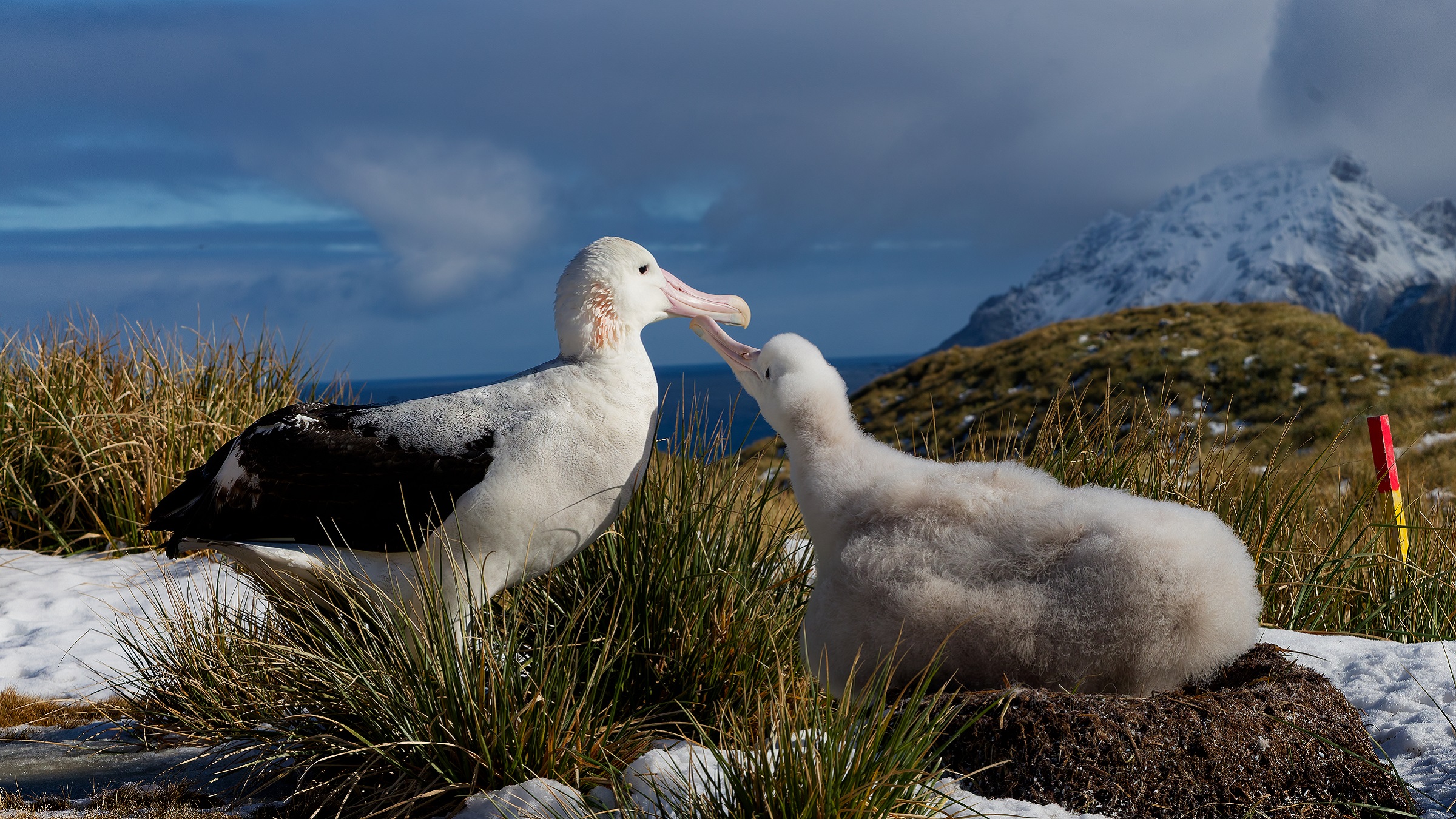
Banner image: Wandering albatrosses on South Georgia, a remote island in the South Atlantic Ocean that’s a key breeding spot for this and other albatross species. The species’ population on the island has declined significantly in recent decades. Image courtesy of Jamie Latimer/@westcorkbirder.
FEEDBACK: Use this form to send a message to the author of this post. If you want to post a public comment, you can do that at the bottom of the page.
Cite this article
Edward Carver (2026). Nations at southern bluefin tuna meeting stop short of adopting new seabird protections. Mongabay Conservation news. DOI: https://doi.org/10.66709/news-332681

