


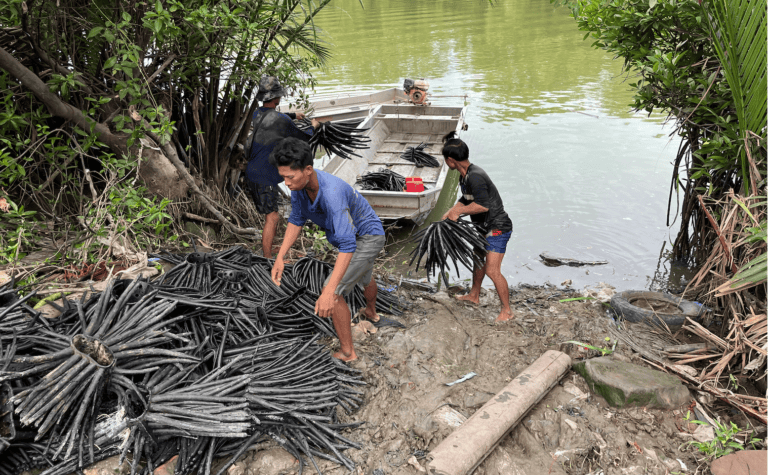
- Coastal communities living along one of Thailand’s fastest-eroding shorelines are trialing a new system of coastal protection based on artificial mangrove roots.
- A new study that assessed the results of the new system’s first year of deployment recorded positive signs of sediment buildup behind the structures, giving researchers hope that artificial mangrove roots could be a viable alternative to traditional methods that often have limited success.
- By helping establish the physical conditions that support natural mangrove recovery, the researchers say, the system could function as an effective hybrid nature-based solution — a mechanism whereby engineered or “bioinspired” structures work in consort with natural ecological processes.
- Experts caution that while useful, the artificial structures should best be viewed as a temporary solution that requires more long-term monitoring, maintenance, and ultimate removal, leaving behind a functioning natural system.
Residents of Phra Samut Chedi, one of Thailand’s most erosion-prone districts, have long struggled against coastal erosion. It’s located in the muddy heart of the Chao Phraya River Delta, where Bangkok’s major watercourse empties into the Gulf of Thailand. Here, roughly 20-60 meters (about 66-200 feet) of land is claimed by the sea annually, eating into farmland and forcing families to relocate their homes. However, a new study suggests a new coastal defense system based on artificial mangrove roots could offer struggling communities some respite.
Trialed at 11 sites in Phra Samut Chedi and other parts of Samut Prakan province over 15 months, the nature-inspired system encouraged a varying amount of sediment deposition at 10 of the sites, according to the study published in Ocean & Coastal Management. Success varied by site, ranging from 16-88 centimeters (6-35 inches) of sediment retention, depending on localized conditions.
By helping stabilize the shoreline, the researchers say the system could potentially function as an effective hybrid nature-based solution — a mechanism whereby engineered or “bioinspired” structures work in consort with natural ecological processes, such as mangrove restoration.
Butsawan Bidorn, senior author of the study and an assistant professor of coastal engineering at Chulalongkorn University in Bangkok, said the dynamic nature of the Chao Phraya Delta means rapid and accessible solutions are key.
“Aquaculture farmers sent us a video of the waves hitting their dikes,” Butsawan told Mongabay in an interview. “By the next day, the dike had collapsed and they’d lost everything. They need urgent action — the erosion can cause damage overnight.”
The researchers say the early results indicate artificial mangrove roots could provide communities facing imminent land losses with a rapid, durable alternative to existing coastal protection methods that have typically yield mixed results at best.
Sinking and exposed land
Coastal erosion in the upper Gulf of Thailand is caused by the combined effects of sea-level rise, fueled by climate change, and land subsidence, exacerbated by limited integrated planning. Land is sinking due to too much construction, excessive groundwater extraction, and a shortage of sediment arriving downstream because of damming and other human activities upstream.
A major challenge around Phra Samut Chedi is its exposure to high wave energy. Multiple attempts to shelter the coast from strong surges through mangrove restoration, mud dikes, and bamboo fences have proved ineffective under these conditions, the study notes.
Bamboo fences, intended to trap sediment and protect mangrove areas, typically break down within one to two years, for instance, creating navigation hazards and marine debris. Meanwhile, the challenges of relandscaping the shoreline so that tides don’t drown new mangrove seedlings often stymie replanting efforts.
Hard engineered solutions have also proved problematic, the study says, with projects consistently getting stuck in bureaucratic delays or drawing criticism over the exacerbation of erosion along adjacent sections of coastline.

A modular and rapid-deployment design
With few alternative solutions on the table, local residents were eager to trial the artificial mangrove root method, which offers a “practical intermediate pathway” between conventional methods, Butsawan said.
Initially designed by researchers at Bangkok’s Kasetsart University in 2016 and refined by teams at Chulalongkorn University, the artificial mangrove root system mimics the structure and physical function of natural mangrove roots.
Each unit comprises a central trunk made from a wood-plastic composite with rubber root-like projections radiating outward to dissipate wave energy and trap sediment.
“Physically, it’s not like a mangrove root actually, but we imitate the function of it,” Butsawan said. Multiple units are mounted on modules measuring 50-120 m (about 160-390 ft), which are then installed in multiple rows to create a permeable barrier.
This modular and lightweight design that makes use of locally available materials means the system is simple to manufacture and install quickly, Butsawan said. It took only two years to go from the initial setup meetings between community residents, local authorities, and the research team, to having the structures fully operational.
The modules can in fact be installed within two to four weeks at individual sites, Butsawan noted, making them invaluable for community-led efforts to quickly protect sites that are fast eroding before more permanent measures can be arranged.

Structures trap, build up sediment
To assess how the system performed during its first year at Phra Samut Chedi, the researchers analyzed satellite data and 3D maps from drone-based, high-precision laser-mapping surveys conducted eight to 15 months after installation.
They found a vertical buildup of sediment, 16-88 cm high, behind the structures at 10 of the 11 study sites, and no detectable change at one site. In contrast, unprotected parts of the shoreline continued to suffer significant erosion: the satellite data indicated that more than 10 m (about 33 ft) of untreated land was lost to the sea at several locations.
According to the researchers, the permeability of the artificial mangrove roots likely enables them to effectively trap sediment. Unlike bamboo fences, which are semi-rigid structures, artificial mangrove roots allow water to flow through them, which increases turbulence levels and promotes suspended sediment to settle into the seabed.
Stakeholder workshops held eight months after installation also yielded several accounts of remarkable transformations at several sites, with farmers and landowners reporting calmer conditions and fewer problems with strong waves.
At one site, shrimp farmers were able to rebuild mud dikes and reclaim previously inundated aquaculture ponds. At another site, a landowner resumed mangrove planting along a shoreline that had lost 21.5 hectares (about 53 acres) of land over the past two decades, with aerial monitoring in early 2026 showing well-established mangrove seedlings growing at the site.

Site-specific conditions influence performance
However, the technique does have some limitations. Sediment retention was most significant at sites near river mouths compared to sites farther offshore.
Structures in deeper settings with higher wave energy were less effective, indicating the approach depends on having enough sediment in the water for the structures to capture and build up. In other words, artificial mangrove roots cannot create new land if there isn’t enough sediment in the water to build it.
“Without the sediment supply, this solution cannot work,” Butsawan said, noting artificial mangrove roots are most likely to work where the hydrology, seabed topography, and wave exposure are suitable. “Our results provide promising evidence, rather than a claim that we’ve found a universal solution to coastal erosion.”
Solutions should be tailored to the specific hydrological and sedimentary conditions at each site, she added. Further research under a range of different conditions will also be necessary to understand how the positioning and configuration of the artificial mangrove units impacts their performance, she said.
More work is also needed to identify potential ecological impacts and trade-offs from coastal erosion solutions. Conservationists, for instance, have cautioned against replanting open intertidal mudflats in the Gulf of Thailand with mangroves, saying it could worsen the loss of stopover habitats for shorebirds migrating along the East Asian-Australasian Flyway.
Sompratana Ritphring, an associate professor of water engineering at Kasetsart University, who wasn’t involved in the study, said the artificial mangrove root system is an interesting engineering intervention. However, she said she would caution against concluding it can provide sustainable coastal protection in the long term.
“The major limitation is that coastal protection is extremely site specific,” Sompratana said. “A system that achieves effective results at one site will not yield the same results if applied at a different site. Even along the Upper Gulf of Thailand, coastal conditions can change substantially over relatively short distances.”
Long-term monitoring will be needed, she said, to determine whether sediment continues to accumulate over five or 10 years under varying climate conditions, and whether that results in a self-sustaining mangrove ecosystem.
Sompratana described the system is an “enabling structure,” rather than the final coastal defense.
“At best, it should be a temporary or enabling engineering component that helps create conditions in which a real mangrove ecosystem can establish itself,” she said. “The ultimate objective should be a functioning natural system, not a coastline permanently dependent on artificial structures.”
The durability and life cycle of the materials used to make the artificial structures must be continuously monitored to ensure they don’t end up as marine litter, Sompratana added. “Any synthetic or composite structure installed permanently in the intertidal zone needs a simple plan for inspection, maintenance, replacement, and eventual removal.”

Toward nature-based solutions
Butsawan and her team are continuing to study the sites at Phra Samut Chedi, to document long-term sediment dynamics and how seasonal climate and extreme weather affect the system’s performance. They’re also testing artificial mangrove roots in several other provinces, including Samut Sakhon and Prachuap Khiri Khan in the Gulf of Thailand, and Phang Nga province in the Andaman Sea. There’s also international interest, with plans for collaboration and implementation in Indonesia.
The team is also eager to team up with botanists and ecologists to investigate to what extent the structures are creating conditions suitable for mangrove establishment and growth. Laboratory tests are also underway to further refine the design of the units and understand how to optimize the placement of modules along the shore in different field conditions.
As Thailand’s government seeks to diversify its approaches to coastal protection under the National Strategy (2018-2037), Sompratana said coastal communities, who know shorelines and local needs best, should have a more meaningful role in defining problems and co-designing solutions.
“I would like to see coastal projects move toward genuine co-design and adaptive management, where communities, engineers, ecologists, and government agencies examine several alternatives together and continue to modify the intervention based on monitoring results,” she said.
For Sompratana, achieving stability for coastal communities in Phra Samut Chedi and across the upper Gulf of Thailand comes down to whether the delta land can keep pace with sea-level rise. Addressing the underlying drivers of land subsidence and tailoring coastal erosion measures to individual sites will therefore be key, she said.
“Can sediment accumulation and ecosystem growth keep the coastal surface high enough?” she said. “If not, the coast will remain vulnerable regardless of how many small shoreline structures are installed.”
Banner image: Residents of Phra Samut Chedi district install the artificial mangrove roots along the upper Gulf of Thailand coast. Image courtesy of Warit Charoenlerkthawin.
Carolyn Cowan is a staff writer for Mongabay. Her reporting focuses on wildlife, ecology, and communities responding to environmental challenges across Southeast Asia.
Citations:
Sok, K., Bidorn, B., Burnett, W. C., Sasaki, J., & Sola, P. (2022). Seven decades of shoreline changes along a muddy mangrove coastline of the upper Gulf of Thailand. Earth Surface Processes and Landforms, 47(6), 1425-1438. doi:10.1002/esp.5324
Charoenlerkthawin, W., Sattabongkot, T., Srinil, N., Burnett, W. C., Takagi, H., Otarawanna, S., & Bidorn, B. (2026). A community-enabled bioinspired innovation to mitigate severe erosion in a subsiding mega-delta: Lessons from the Chao Phraya Delta, Thailand. Ocean & Coastal Management, 281, 108345. doi:10.1016/j.ocecoaman.2026.108345
Charoenlerkthawin, W., Sattabongkot, T., Srinil, N., Aye, Y. N., Pujianiki, N. N., & Bidorn, B. (2025). Field evidence of a nature-inspired solution to mitigate the impacts of hard coastal structures. Ocean-Land-Atmosphere Research, 4. doi:10.34133/olar.0107
See related story:
Thailand’s budding mangrove restoration plans spark both hope and concern
FEEDBACK: Use this form to send a message to the author of this post. If you want to post a public comment, you can do that at the bottom of the page.

