


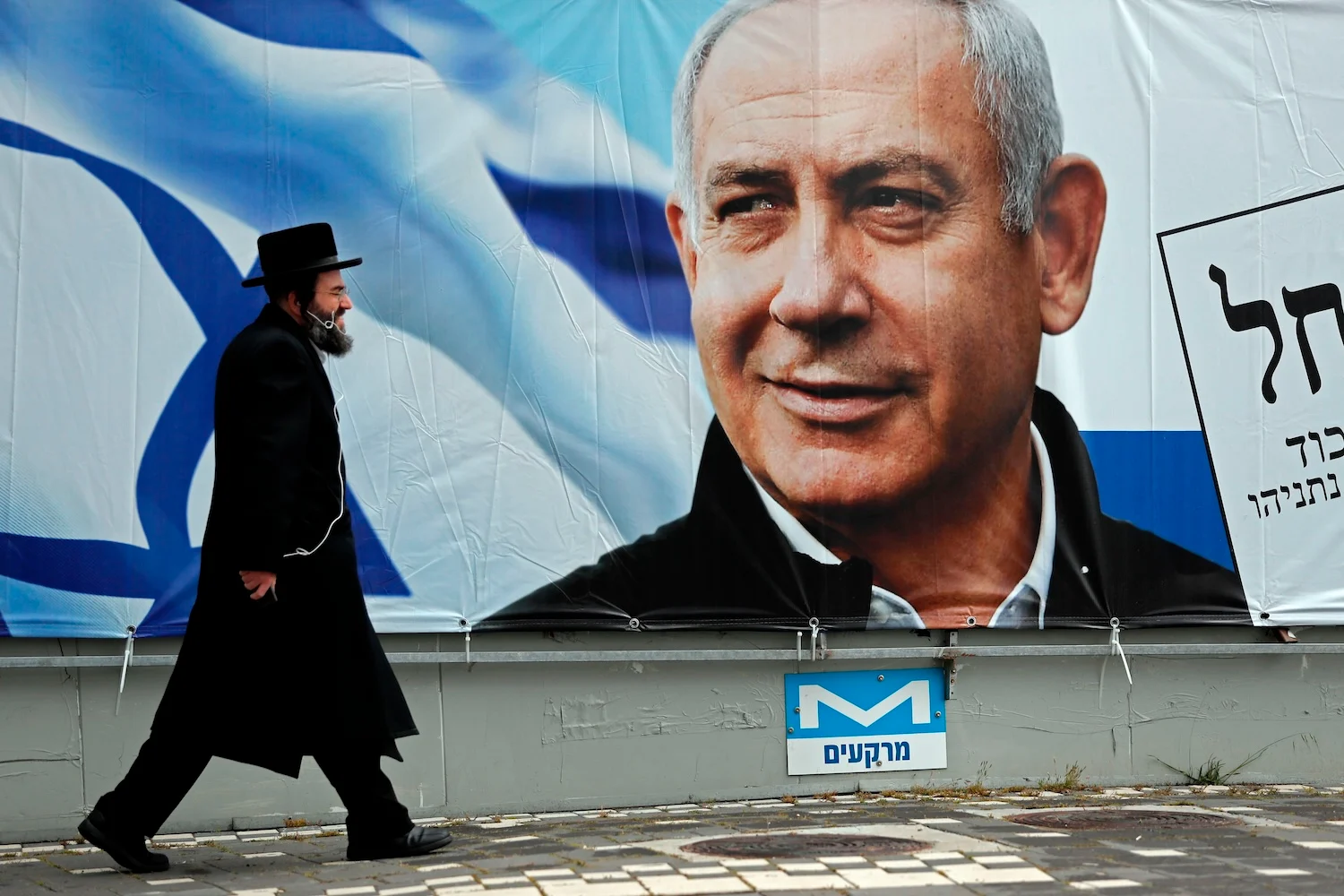
Israel’s ultra-Orthodox community is the country’s fastest-growing population group, with an average fertility rate of around 6.5 children per woman. By 2050, nearly 1 in 4 to Israelis is projected to be Haredi.
Those facts have been known for some time. But as a national election approaches on Oct. 27, they have become the focus of Israeli politics. As Israelis prepare to vote, many are asking themselves whether the growing Haredi community is adding to the country’s troubles—and whether anything should be done about that. Their answer to that question could determine the election outcome.
Haredim largely resist compulsory military service, and their contribution to the formal economy remains limited. Although many Haredi women work, a large proportion of men devote themselves to Torah study. The community has fiercely guarded its way of life, leveraging its political influence in coalition governments and presenting itself as the guardian of Jewish spirituality.
Since Oct. 7, 2023, however, Israel has fought prolonged wars in Gaza and Lebanon as well as a confrontation with Iran, increasing the demand for military personnel. Non-Haredi Israelis have become increasingly vocal in opposing what they see as an unfair distribution of the burden. Must they risk their lives while Haredi men remain at home? Many see Haredi life as a privilege in times of war—and one that the country can no longer afford.
Divisions within Israeli society have deepened, particularly as the Israel Defense Forces (IDF) has warned of a shortage of as many as 12,000 soldiers and called on the ultra-Orthodox to help fill the gap. Around 80,000 Haredim aged 18-24 are reportedly believed to be eligible for military service but have not enlisted. If they continue to refuse to enlist but keep growing in numbers as data suggests, the proportion of the population available for military service will shrink over time.
As elections approach, the public debate in Israel is focused less on a two-state solution, reconstruction in Gaza, or peace with the Palestinians than on Israel’s security. The clash between Haredi and non-Haredi Jews has emerged as one of the country’s most consequential fault lines.
In 1948, as the state of Israel was established, its first prime minister, David Ben-Gurion, agreed to exempt around 400 yeshiva students from compulsory military service. The arrangement reflected a desire to preserve a small community of full-time Torah scholars in the aftermath of the Holocaust. Some Haredim frame the protection of Torah study as a kind of spiritual defense of Israel, sometimes invoking the idea of a “Torah Dome.”
The IDF, meanwhile, was conceived as a unifying force charged with defending the new state in what its leaders saw as a hostile neighborhood. Military service became compulsory; children from wealthy and powerful families as well as those from humble backgrounds had to serve their country. Over the decades, however, the Haredi population grew rapidly, reaching an estimated 13 percent of Israel’s population—roughly 1 million people in a country of more than 9 million.
In June 2024, Israel’s Supreme Court ruled that blanket exemptions for yeshiva students could no longer be sustained without a legal basis and ordered the government to begin conscripting eligible Haredi men under the existing law. The ruling triggered a political crisis. The ultra-Orthodox parties Shas and United Torah Judaism (UTJ) argued that full-time Torah study was essential to preserving Jewish religious life. They opposed compulsory enlistment and, in 2025, withdrew from Prime Minister Benjamin Netanyahu’s governing coalition over the failure to block the compulsory draft.
Haredi communities have since mounted fierce resistance to compulsory enlistment, blocking roads and clashing with police when they came to collect draft evaders. In a recent incident, hundreds of ultra-Orthodox protesters clashed with military police in the city of Modiin as officers attempted to arrest a Haredi man who evaded the draft. The officers eventually left without making the arrest.
Earlier this month, the IDF acknowledged that it had struggled to enforce enlistment orders effectively, with some draft evaders attempting to leave the country. Officials told the attorney general’s office that more than 150 Haredi men had tried to fly abroad in the previous month alone.
In what critics regarded as a politically expedient move ahead of the election, Netanyahu’s government passed legislation earlier this year intended to temporarily prevent arrests and other enforcement measures against Haredi draft evaders. In September, the High Court annulled the law, finding it to be in violation of the principle of equality.
For now, both Shas and UTJ are keeping their options open. UTJ candidate Moshe Rosenthal has said the party will join a government that can preserve military-service exemptions for yeshiva students. “We will go with whoever commits to passing a conscription law that can withstand High Court scrutiny. After the elections, the leading rabbis will decide,” he said in response to the question of whether the party was open to alliance with Gadi Eisenkot—Netanyahu’s main challenger.
Netanyahu’s stated position is that anyone “who does not study Torah” should enlist. He has also promised that recruits should be able to “enter as Haredi and leave as Haredi,” referring to military frameworks designed to allow ultra-Orthodox men to maintain their religious practices, including strict rules on interaction with women soldiers.
“There is a lot of mistrust toward the IDF among Haredim,” Rabbi Yehoshua Pfeffer told me. “These are young boys, and there is a concern over what they might be exposed to,” he said, referring to mixed-gender environments and secular culture. “There are special units for the Haredim in the IDF, but they need more,” he added, calling for military frameworks tailored to Haredi religious requirements.
Many mainstream political leaders, meanwhile, have called for the burden of prolonged military operations and reserve duty to be distributed more equally.
Politician Benny Gantz has emerged as a prominent advocate of conscription, calling for a new draft law to be enacted before the next government is sworn in. Avigdor Lieberman, leader of the Yisrael Beiteinu party, has described the Haredi leadership’s opposition to military service as “anti-Jewish,” arguing that there is no inherent contradiction between Judaism and serving the state.
Naftali Bennett, a religious-nationalist politician, has also moved toward supporting compulsory enlistment since Hamas’s Oct. 7 attack. “October 7 changed everything, because we need those soldiers,” he said earlier this year. Bennett has drawn a red line against forming a government dependent on ultra-Orthodox parties unless they change their position on conscription. Yair Lapid, the leader of the liberal Yesh Atid party, has similarly committed to drafting Haredi men.
Eisenkot, the leader of a new political party and former IDF chief of staff whose son was killed in action during the Gaza war, has called for universal service. His proposal would encompass both Haredim and Arab citizens of Israel. “A universal service law. Everyone must serve: Haredim and Arabs,” he told the Jerusalem Post in September. Under his proposal, Haredi men would be incorporated into military service, while Arab citizens would undertake national or civilian service.
Rabbi Pfeffer, who recently served as a reservist in the army, said he believes that it is unrealistic to expect every Haredi man to enlist. The solution, in his view, is to attract large numbers of recruits rather than insist that everyone perform national service. “If 75 percent of Haredim say, ‘We want to join,’ the leadership, any political party, will lap it up,” he said. “So it isn’t about equality, that all have to serve, but those who are not studying Torah must serve.”
When I asked whether his position aligned with Netanyahu’s, Pfeffer said most parties understood the limits of compulsory enlistment. The real challenge, he argued, was to achieve meaningful recruitment numbers and build enough trust to persuade Haredi men to join the army. The task was difficult, he said, but not impossible. Pfeffer stressed that the community is not a monolith.
According to a recent survey, close to half of Israelis and half of Jews polled believed that it was possible to conscript more young Haredi men and that more pressure should be applied, alluding to the withdrawal of state benefits. “Among Haredi respondents, 36% say there is no chance of conscription, but notably, 45% acknowledge that Haredim can be conscripted by agreement with the leadership,” the authors of the report wrote.
Moti Leitner, a Haredi deputy mayor of the city of Beit Shemesh who has served in the IDF, recently launched a new Haredi political party, Haredi Public. He has called on Haredim to take more responsibility, arguing that enlistment is one way to protect those who remain in yeshivas to study Torah.
Leitner has cautioned against coercive enlistment and expressed opposition to cutting benefits as a means of punishing draft evaders. Instead, he advocates positive financial incentives to encourage service, alongside greater integration into the workforce. Beyond military service, Leitner also wants Haredi schools to teach science, mathematics, English, and other core subjects that would enable young people to acquire professional skills and find employment.
“We will work to expand appropriate educational frameworks, vocational training, and employment opportunities. We will replace the politics of poverty, which fights against providing tools for job market integration, and implement a plan that enables a life of Torah grounded in honorable livelihood and financial independence,” Leitner said.
The economic stakes are substantial. According to a study by Israel Democracy Institute, the country could forgo as much as 10 percent of its economic growth by 2050 if Haredi men remain largely outside the labor market.
In 2018, the Israeli television drama Autonomies imagined a divided Israel. On the other side of the wall were not Palestinians but the ultra-Orthodox. In this dystopian alternative reality, Israel was split into a secular state governed from Tel Aviv and a separate Haredi territory ruled by ultra-Orthodox leaders.
It was a fictional scenario, but it raises important questions. As the stresses of wartime mount and the sacrifices continue to be unevenly distributed, could Israelis soon turn against one another?
