



This story is part of an investigation conducted by an international team of journalists based at The Outlaw Ocean Project. Read the other stories here.
In January 1966, a South African ship caught fire at sea. In port in Bristol, England, after firefighters pried open the smoking container, the conflagration spread and burned for five days. A little over a month later, a Liberian steamship caught fire near Rotterdam, ignited a storage area with barrels of petrol and sank. The month after that, a Danish ship caught fire off Long Beach, California, injuring three firefighters, killing a longshoreman and causing over a million dollars in estimated damages.
The culprit in each fire was fishmeal, a dark yellow powder made by drying and pulverizing fish that, if left untreated, is known for spontaneously combusting as it decays and oxidizes.
Tied to at least 90 ship and plant fires from the 1950s through the 1970s, fishmeal’s combustibility was a serious worry for seafarers, insurers and dock workers, according to a sweep of historical news coverage by The Outlaw Ocean Project, a news organization in Washington, D.C.
A crew abandons ship as the SS South America burns in Rotterdam in 1966. Credit: Sepia Times, NY Daily News, Evers, Joost/Anefo
In 1967, American feed producer Cargill announced a solution: ethoxyquin.
A fire retardant previously used to keep rubber tires from drying out and applied as a preservative on fruits and alfalfa, production of the antioxidant was soon ramped up.
“Antioxidant treatment has made bulk handling an easy matter,” the director of the Canadian Department of Fisheries told an industry publication in 1966, arguing it should be required for fishmeal shipments.
The chemical was highly effective. By the 1970s, press-reported fires dropped sharply—from a typical 16 ship fires a year, according to the Liverpool Underwriters Association, to five.
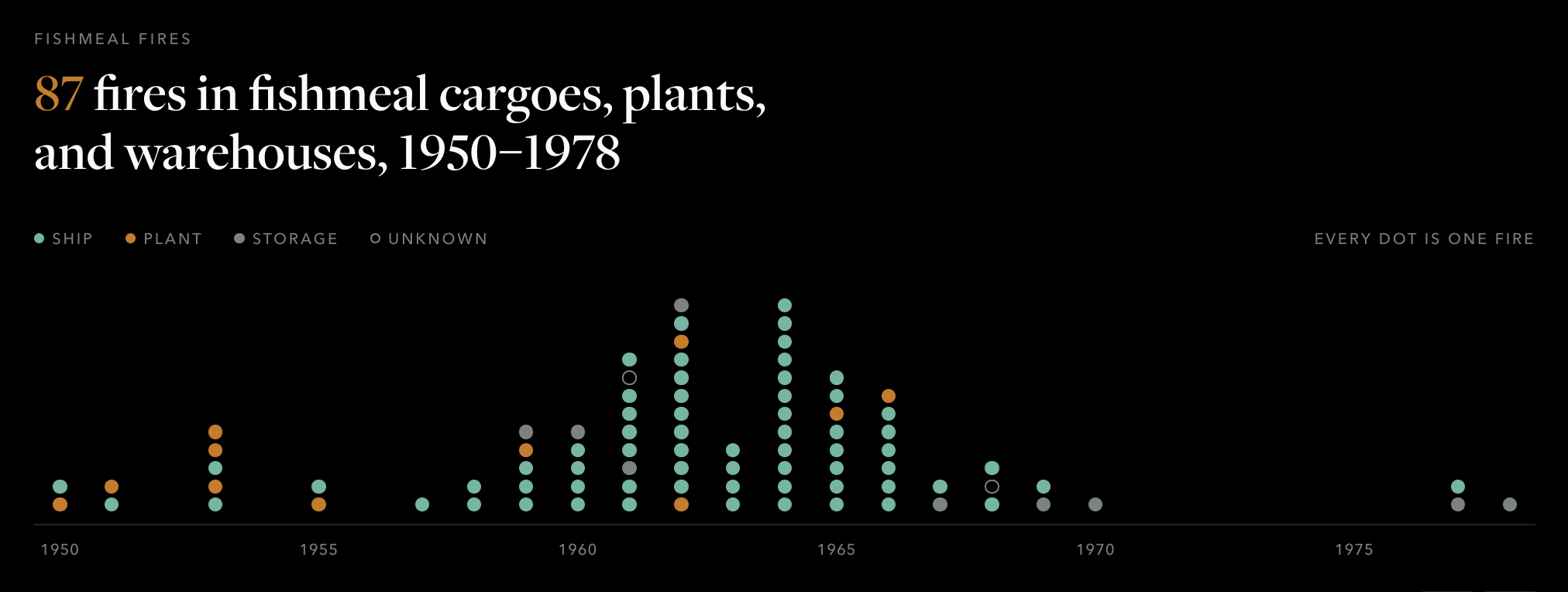
By 1976, the U.S. Coast Guard imposed mandatory ethoxyquin treatment on fishmeal shipments, and three years later, the United Nations body that oversees maritime activity recommended fishmeal be treated with it “to prevent spontaneous combustion.”
But there was a problem: Ethoxyquin is a carcinogen.
“Toxic effects had been observed in laboratory animals fed high concentrations of ethoxyquin,” said a 1969 paper by U.N. food and agriculture authorities.
As its use in animal feeds and aquaculture grew, a 1987 study by British researchers found the chemical “caused severe damage” and had a potentially “carcinogenic effect” in rats. In 2015, the European Food Safety Authority said an impurity within ethoxyquin, known as p-phenetidine, was capable of causing mutations in genetic material.
There is a lack of scientific consensus on whether it is safe to eat farmed seafood raised on feed treated with ethoxyquin, but some countries have considered the risk to be high enough to justify banning or limiting the use of the chemical. In 2017, the European Commission suspended authorization for its use in animal feed across the European Union.
Today, ethoxyquin has been banned in the U.K. and by members of the European Economic Area, including Norway, Iceland and Liechtenstein. But ethoxyquin, within limits, is still permitted in animal feed in Australia, Japan, South Korea and the U.S.
With more than half of the seafood eaten worldwide now coming from fish farms, and with the majority of such species fed fishmeal and fish oil, studying the chemicals added to feed is critical for understanding the possible contamination of our global food supply.
Although ethoxyquin is not banned in the U.S., it has been at the center of a half-dozen lawsuits, typically involving claims of false advertising. Some lawsuits targeted seafood companies for marketing their products as “sustainable” even though they contained ethoxyquin, while others
highlighted the potential risks that the additive poses to the environment.
In 2022, a New York resident brought a class-action lawsuit against Aldi Inc., a German supermarket chain with stores in the U.S., alleging its Atlantic salmon products were falsely labeled as “sustainable” due to “environmentally destructive” practices. The complaint cited the EU’s ban on the chemical and a study linking ethoxyquin to mortality and deformations in fish and crustaceans, noting the chemical “poses a risk for aquatic life.” The case was settled out of court.
The same year, a New York and a California resident jointly sued Gorton’s Inc., a seafood company, for labeling its frozen tilapia as “sustainably sourced” despite containing ethoxyquin. This lawsuit also cited the “risk for aquatic life” and the European Union’s ban, and was settled out of court.
In Canada, the country’s Food Inspection Agency requires feeds containing ethoxyquin to carry a label declaring that it meets the legal limits, but the agency does not specify how it tests for the chemical in feeds. Inspectors also do not check whether ethoxyquin ends up in the seafood itself, according to the agency’s latest food inspection report from 2022.
And a 2024 audit of the Canadian agency by the EU found it completed only about 40 percent of its planned inspections, citing “systematic and significant under-delivery” in terms of testing seafood products.
Cargill said in a statement that it has assessed alternative antioxidants since 2005 and no longer uses ethoxyquin in its global salmon feed business or in any market where ethoxyquin is not authorized for use in aquafeed. The company also noted that it did not develop ethoxyquin. Globally, producers and feed makers have also increasingly shifted to alternatives, including natural additives such as rosemary extract and vitamin E compounds.
“More and more destinations are not accepting ethoxyquin, starting with our local Peruvian market,” said James Frank, managing director of the Peruvian fishmeal company MSICeres, during a 2022 webinar. He added that 100 percent of Peru’s fishmeal exports to Europe, Canada, the U.S. and Australia are now ethoxyquin-free, a shift also seen among companies in the U.K. and Norway.
The most popular alternative to ethoxyquin is now butylated hydroxyanisole, or BHA, favored for its lower costs and strong antioxidant properties compared with fully natural additives. But like the chemical it aims to supplant, BHA has its own significant health risks, according to researchers.
The U.S. National Toxicology Program identified BHA as “reasonably anticipated to be a human carcinogen” as early as 1991, and Japanese researchers found it caused malignant tumors in laboratory rats in 2008.
In February, the U.S. Food and Drug Administration announced it was reassessing the safety of the substance as a food additive.
To address the world’s insatiable hunger for seafood, the aquaculture industry will continue to expand. Perhaps there’ll be a shift away from carnivorous fish, or a replacement will be found for fishmeal. But for now, the aquaculture and fishmeal industries find themselves in a perilous loop: pivoting from deadly ship fires to a carcinogenic fire retardant, and then to yet another one.
About This Story
Perhaps you noticed: This story, like all the news we publish, is free to read. That’s because Inside Climate News is a 501c3 nonprofit organization. We do not charge a subscription fee, lock our news behind a paywall, or clutter our website with ads. We make our news on climate and the environment freely available to you and anyone who wants it.
That’s not all. We also share our news for free with scores of other media organizations around the country. Many of them can’t afford to do environmental journalism of their own. We’ve built bureaus from coast to coast to report local stories, collaborate with local newsrooms and co-publish articles so that this vital work is shared as widely as possible.
Two of us launched ICN in 2007. Six years later we earned a Pulitzer Prize for National Reporting, and now we run the oldest and largest dedicated climate newsroom in the nation. We tell the story in all its complexity. We hold polluters accountable. We expose environmental injustice. We debunk misinformation. We scrutinize solutions and inspire action.
Donations from readers like you fund every aspect of what we do. If you don’t already, will you support our ongoing work, our reporting on the biggest crisis facing our planet, and help us reach even more readers in more places?
Please take a moment to make a tax-deductible donation. Every one of them makes a difference.
Thank you,
