


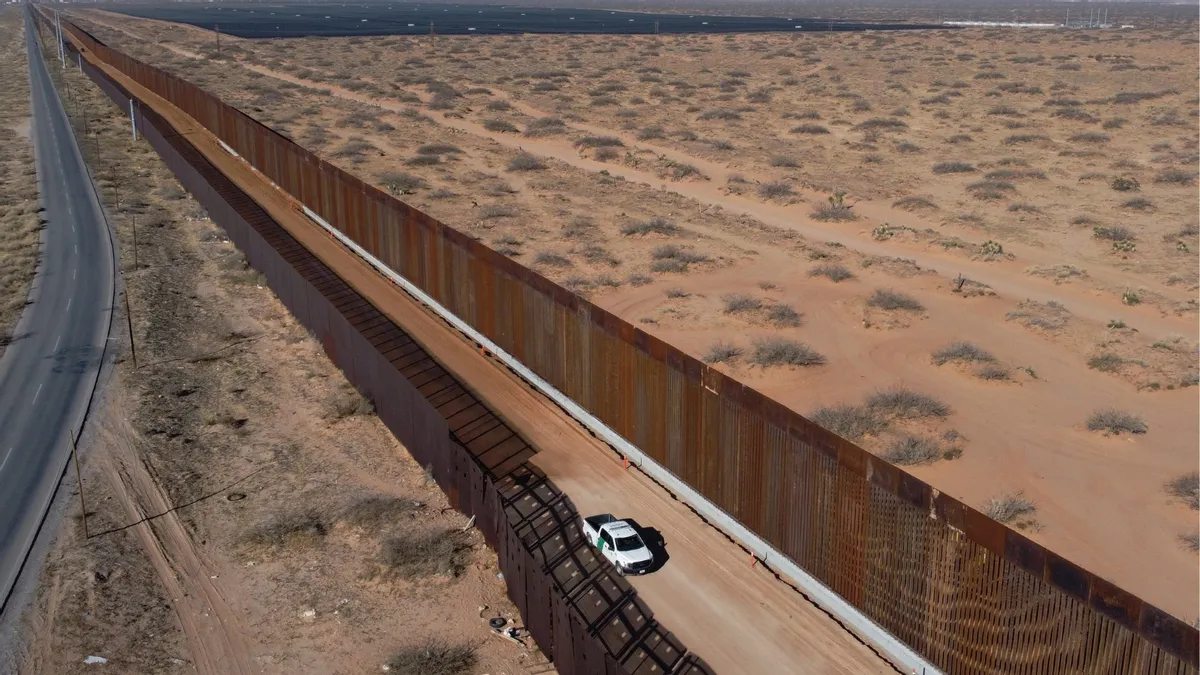
The U.S. Department of Homeland Security waived New Mexico water laws in an effort for the federal government to keep access to water wells for border wall construction, despite officials calling it “unconstitutional” amid lawsuits from the state.
Rumors that the U.S. Department of Homeland Security allegedly illegally used water from New Mexico in order to aid in construction of its border wall circulated in October.
Specifically, people claimed that DHS had issued a waiver to remove the state’s protections and ownership of the water wells despite ongoing disputes with land owners and lawsuits against the federal government’s actions regarding its construction plans.
The claim was true.
On Oct. 2, the Homeland Security Secretary Markwayne Mullin issued a directive — available to read on the Federal Register — that it was “necessary to waive certain laws, regulations, and other legal requirements in order to ensure the expeditious construction of barriers and roads in the vicinity of the international land border in the state of New Mexico.”
Included in the waiver was the entirety of the New Mexico Water Code.
The directive further described the El Paso Sector, a Customs and Border Protection jurisdiction that includes all of New Mexico, as an “area of high illegal entry” to justify the move.
A spokesperson for CBP, which is part of DHS, told Snopes via email the agency was “coordinating with the State of New Mexico and the U.S. Department of Agriculture to develop a broader groundwater management strategy” and stressed the importance of how “water is required for road construction, concrete production, and dust suppression associated with border wall construction.”
They wrote that “CBP recently instructed the barrier construction contractor to pause on the installation of any new groundwater wells in collaboration with the State of New Mexico and as an initial step in minimizing or avoiding impacts to groundwater water resources,” adding they were committed to working with local landowners.
A spokesperson for New Mexico’s Office of the State Engineer told Snopes via email:
We have informed the CBP that all water used for the project must come from permitted sources, and we have instructed them in how to do that. To date, they have been unwilling to do so, and they continue pumping water from illegal wells. Therefore, while a pause in drilling new wells is a good first step, more must be done to ensure that New Mexicans’ water supply is not threatened by this project.
The agenda for a meeting of New Mexico’s Courts, Corrections and Justice Committee on Oct. 6 showed that Nathaniel Chakeres, general counsel at the New Mexico’s Office of the State Engineer, made a presentation regarding the illegal drilling and resulting waiver, which he called “unconstitutional.”
Searchlight New Mexico, an investigative journalism outlet, quoted Chakeres as telling the committee that “the water of New Mexico is owned by the public for appropriation by private parties. That’s in our constitution, and the federal government accepted that constitution when we became a state.” Snopes attempted to locate video of the committee meeting but was unable to.
The committee’s website appeared to host the minutes from its meetings for public review, but none were available for the meeting in question as of this writing.
In Chakeres’ presentation, as one local report pointed out, he “shared an image of an open well casing that sat roughly six inches above pooled surface water,” which meant “the next rain storm could send oil, gas or construction chemicals into the groundwater.”
That report, by Source New Mexico, quoted Chakeres as saying, “It’s appalling. We were shocked when we came out and saw this. No New Mexico drillers drill wells like this.”
New Mexico’s battle for water at the border
The battle between the state and the federal government’s attempts at border wall construction first made headlines in June when the government attempted to seize land belonging to a Roman Catholic diocese in New Mexico after the church refused to agree to an acquisition, leading to a lawsuit.
In July, area farmers met to discuss the issue of federal drilling on the border, voicing their concerns over a dwindling water supply and “unmonitored tapping of border aquifers.”
In August, the Office of the State Engineer threatened to revoke licenses of the companies contracted by the Trump administration for the border wall project.
One local news report wrote the officials had found multiple “unauthorized” wells in protected water basins, along with possible safety violations, with one that had the “imminent risk of groundwater contamination.”
CBP reportedly agreed to stop drilling following the voicing of these concerns, however, by the end of August, the state sued the federal government and the border contractors, citing that no formal effort was made to cease the drilling. The ongoing legal struggles led to the introduction of the waiver on Oct. 2.
When reached for comment, DHS also provided a statement from CBP Commissioner Rodney Scott that was first released in August, discussing an unrelated CBP project in southern Arizona in which the department is cutting through tribal land for construction. The department has not yet responded to a follow-up about what, if anything, the statement about the Arizona project has to do with the situation in New Mexico.
