


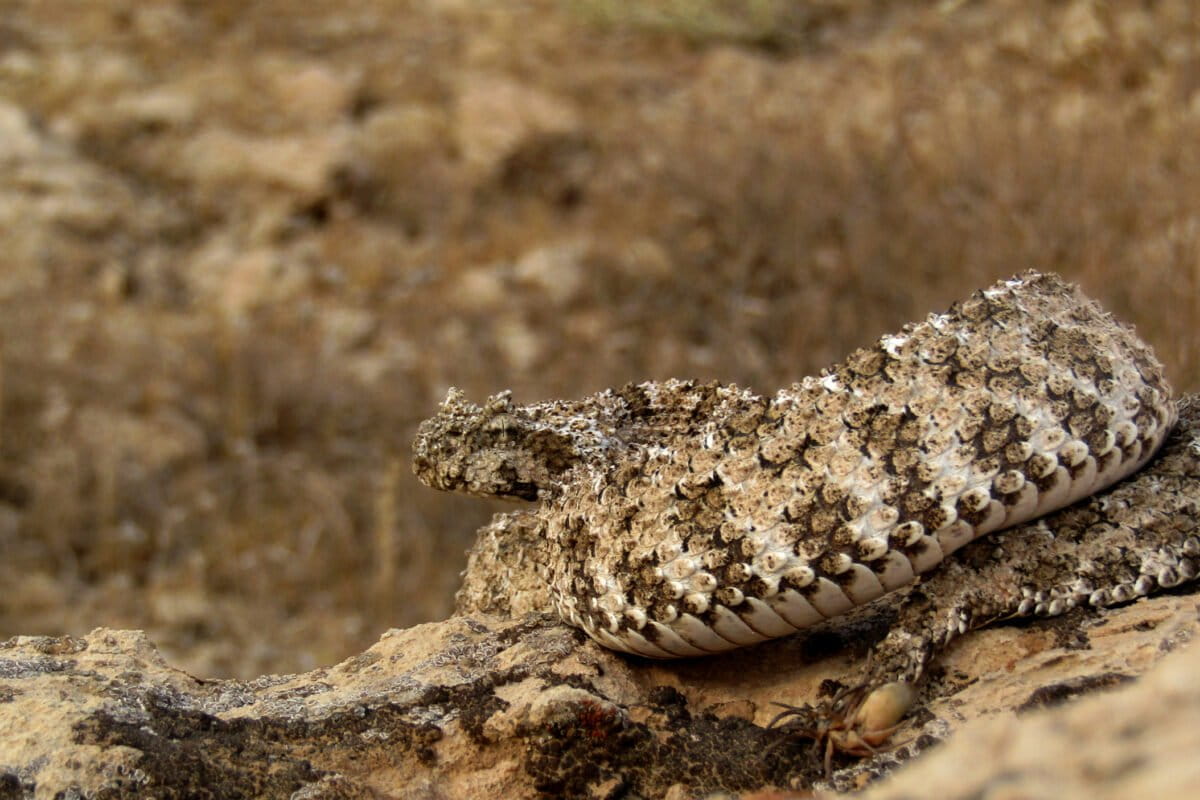
The Iranian spider-tailed horned viper, a rare snake endemic to western Iran, hunts by holding its body completely still while twitching its tail. Its body camouflages among the rocks of its semi-arid Zagros Mountains habitat, but its bulbous tail with accompanying leg-like scales looks remarkably like a large chunky spider.
The snake, Pseudocerastes urarachnoides, uses its spider tail to lure unsuspecting mammals and birds to their last meal. Scans of a specimen collected in 1968 and kept in the Field Museum of Natural History in Illinois, United States, now reveal what the lure is made of.
“The tip actually consists of enlarged, elongated and modified scales, which are unique among all living reptiles,” lead author Georgios Georgalis, an associate professor at the Polish Academy of Sciences’ Institute of Systematics and Evolution of Animals in Kraków, Poland, told Mongabay by email.
Vipers have attracted the interest of researchers for centuries, Georgalis said, but knowledge of the group’s morphology is still limited. Scientists described P. urarachnoides for science in 2006, but only this year did they publish a high-resolution 3D scan to see the mechanism inside the snake’s tail as part of a scientific study.
The tail filaments, the authors said, loosely resemble those found on some ornithodiran archosaurs and other forms from the Triassic and Jurassic periods. This doesn’t mean that they are related, it’s more likely a case of convergent evolution: similar environmental demands pushing the evolutionary development of similar characteristics.

The findings suggest that reptile skin and scales have a “very high” evolutionary potential to develop complex appendage-like structures, according to Hossein Nabizadeh, a herpetologist at Razi University in Iran not involved in the study.
Nabizadeh, who is also a member of the IUCN SSC Snake Specialist Group, told Mongabay by email that scientists have observed less elaborate, “intermediate,” tail modifications in related vipers in the wild, offering clues to how the spider-tailed viper’s complex lure evolved.
The recent finding, Nabizadeh said, reinforces the hypothesis that snake tails gradually evolved this luring behavior. “First a change in color or simple tail movement, then the appearance of a few filamentous scales.”

Researchers have not yet studied the skeletons of the genus’ two other species, the Iranian horned viper (P. persicus), and Field’s horned viper (P. fieldi), in similar detail.
But field observations suggest the Iranian horned viper, one of the spider-tailed horned viper’s closest relatives, has a slightly modified tail too, albeit much less developed and complex, Nabizadeh said.
“Caudal luring behavior is also observed in other vipers, but in P. urarachnoides it has reached the peak of morphological complexity.”
Banner image: The spider-tail horned viper (Pseudocerastes urarachnoides) in western Iran. Image courtesy of Hossein Nabizadeh.

