


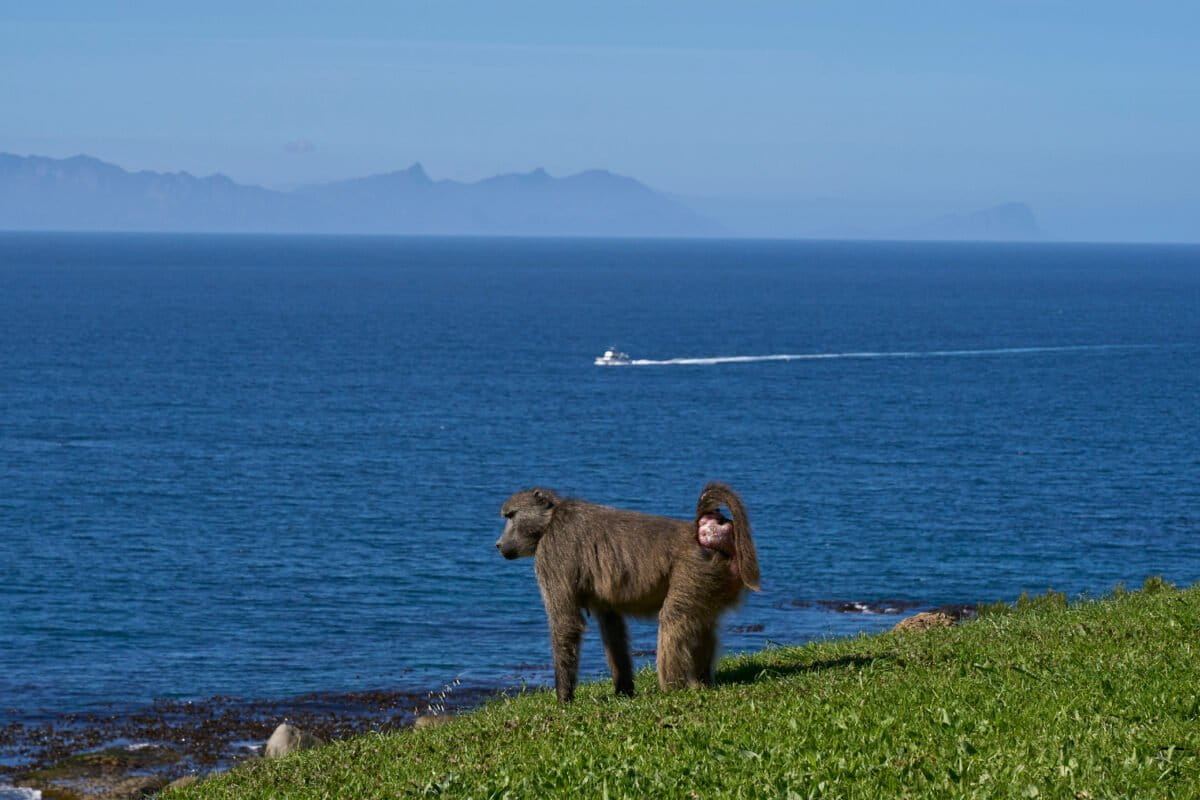
- Authorities in Cape Town are planning to capture and relocate two “highly habituated” troops of chacma baboons that range close to a city suburb.
- The baboons will be moved to enclosures where they will live out the remainder of their lives.
- The impending removal is part of a “hard reset” by authorities after decades of interventions and will be accompanied by a new fence in the northern Cape peninsula and 6,000 baboon-proof bins.
- Some experts say that while baboons should be kept out of urban areas, the plans to remove the troops are not convincing.
CAPE TOWN, South Africa — A steady stream of chacma baboons flows down the walking path in the beautiful wooded ravine that leads up to Admiral’s Kloof, on the slopes of Table Mountain National Park. The score of baboons (Papio ursinus) descending the ravine — half of the 44-strong Waterfall troop — are on their way to raid the naval barracks at the bottom, in the affluent suburb of Simon’s Town.
A baboon monitor with a paintball gun slung over his shoulder stands and watches as a car marked “Shark Spotters”, the name of the NGO responsible for the monitors, pulls up to transport three of his colleagues to try and head them off.
On this particular June morning, the effort is futile. The sound of the monitors’ paintball guns and the screeching of juvenile baboons fighting over choice morsels fills the air for 45 minutes, while the agile primates scale trees and buildings, and grab what looks like a bag of cereal from an unattended kitchen on the base. While the monitors manage to get some of the baboons out of the barracks, others move toward the surrounding suburb.
A WhatsApp group set up by the Cape Baboon Partnership to alert residents about the whereabouts of the troop, recorded 25 such raids between June 11 and July 11.
Cape Town city officials are ready to try something else.
The Cape Peninsula Baboon Management Joint Task Team has decided to capture the Waterfall troop, as well as the much smaller Seaforth troop which also ranges adjacent to Simon’s Town, and permanently remove them from the wild. The task team, which comprises the City of Cape Town, South African National Parks (SANparks) and the provincial parks authority, CapeNature, plans to relocate the troops to two separate enclosures where they will live out the remainder of their lives. Under the plan, no baboons will be allowed to move into spaces where the Waterfall and Seaforth troops now roam.
The impending removal is part of a “hard reset”, which the authorities say will allow them to redirect resources towards management efforts with better outcomes.

The case for a “hard reset”
The executive summary of the Cape Peninsula Baboon Management Action Plan, originally published in October 2025, says that the cost of managing the peninsula’s baboons has become unsustainable as the number of baboons has grown — from approximately 360 baboons across the whole of Table Mountain National Park in 2000 to approximately 600 baboons in 2025.
The authorities have now set population limits for the northern and southern baboon populations at 250 and 175 respectively — the limit for the south excludes around 100 baboons belonging to troops that live inside a section of the Cape Point Nature reserve.
The action plan calls for the removal of “highly habituated baboon troops” for whom existing management programs are ineffective. According to the task team, the Seaforth and Waterfall troops fit the profile.
The latest Cape Peninsula Baboon Annual Census says that in December 2025 the southern baboon population had 222 individuals, excluding the 100 baboons living in the Cape Point Nature Reserve, and that the Seaforth and Waterfall troops accounted for 16 and 44 individuals respectively.
Removing the two troops would bring the southern baboon population down to about 160. Going forward, baboon numbers will be assessed every six months and culled to keep the population at the newly prescribed size, according to the action plan.
“We need to remove those troops from that environment, because there isn’t adequate full range of resource rich habitat available to those troops,” says Gregg Oelofse, Cape Town’s coastal manager, who oversees the baboon program. He says the monitors are failing to keep the troops out of Simon’s Town’s urban areas, because there’s not enough low-lying habitat available to the troops to forage.
“We spend more with no real change in the outcomes,” he says.

In a phone interview, Oelofse tells Mongabay that the ranger program, which includes a hotline, support staff and vehicles, costs between 17 and 20 million South African rand ($1-1.2 million) per year. The City of Cape Town contributes about 85% of this, with CapeNature and SANParks making up the remainder, he adds.
Reducing the free roaming baboon population from roughly 600 to 525 will result in only slightly lower annual costs, as rangers freed from managing the Waterfall and Seaforth troops will be redeployed elsewhere in the program, he says.
Under the new plan, the city will also pay for a new fence in another part of the Cape peninsula, the roll out of 6,000 baboon-proof bins, and the enclosures, Oelofse says. These are being built on a parcel of city-owned land at Kogelfontein, roughly 2.5 kilometers (1.6 miles) east-southeast of Admiral’s Kloof. A 3.5-hectare (8.6-acre) enclosure will house the Waterfall troop and a 1.9-hectare (4.7-acre) enclosure will house the Seaforth troop. The site has a mix of Indigenous and alien vegetation, but Oelofse says the troops will be provisioned with food to stop them from stripping all the vegetation.
“If we do the sanctuary well, they can live a good life in the enclosures,” Oelofse says in a phone interview. “Not a perfect baboon life, but the welfare outcomes should be good. As a species, as long as they’re together with their troop, and they can continue with their troop dynamics and they are able to have enrichment within a large enclosure, forage for food, do all of those things, the evidence suggests that they’re generally quite happy from a health point of view.”
Relocating the troops to enclosures is not a desired outcome, he says, but for the joint task team, the only other option is worse: culling the troops.

Mitigation vs removal
Culling baboon populations was common practice in the not too distant past. Dave Gaynor, one of the people who developed the city’s first baboon management strategy, says that as recently as the 1950s, the Western Cape’s provincial authorities culled troops across the greater Cape Town area at the request of farmers, residents and just about anyone who complained about the primates.
“There were troops on the slopes of Table Mountain as well as on top of the mountain at the dams, and they were progressively removed,” Gaynor tells Mongabay over the phone. “Anywhere humans came up against baboons, baboons just lost.”
In 1990, city officials moved to get rid of a baboon troop in the Kommetjie area, on the other side of the peninsula, roughly 10 km (6 mi) northwest of the current Waterfall troop’s range. But some local residents sprang to the baboons’ defense.
In response, Wally Peterson and Jenni Trethowan launched the Kommetjie Environmental Awareness Group (KEAG). “We just wanted people to think about managing the [conflict] a bit better,” says Trethowan, adding that the organization’s scope soon widened to include the clearing of invasive vegetation, recycling and litter.
KEAG’s efforts prompted the city to explore alternatives, adopting a strategy that prioritized mitigating conflict between humans and baboons through nonlethal means.

In 1998, Gaynor and researcher Ruth Kansky, who had spent three years studying wild baboons in a nature reserve on the other side of the country in KwaZulu-Natal, began studying the baboons living near their new home in the west coast village of Scarborough. A year later, they had determined that the southern peninsula’s baboon population’s death rate was 13%. Troops that spent the most time in residential areas were suffering the highest mortality rates of mortality from being shot or poisoned by residents, hit by cars, mauled by dogs or electrocuted.
Their study found that the Da Gama Park and Slangkop troops were actually shrinking, as their human-induced mortality rates were higher than the maximum possible birth rate for a baboon troop.
Gaynor says that the researchers trained baboon monitors and assigned them to follow three troops as part of a trial study to test whether it was possible to chase the primates out of urban areas.
The results were encouraging: the two troops spent between 47% and 79% fewer days raiding the Da Gama Park suburb, Kommetjie and Scarborough.
As well as monitors, the strategy they developed called for popular education, signage, waste management and electric fencing. Baboon monitors were the only element of the strategy that was adopted by the city, Trethowan told Mongabay over the phone.
“We tried to break the cycle where the baboons always get removed and disappear from human habitats,” Gaynor says.

The long marginalized Waterfall troop
Between 1999 and about 2012, monitors provided a partial solution to keeping baboons out of residential areas of the south peninsula. Training and management of the monitors was passed from one group to another. Funding shortfalls led to a drop in working hours and their effectiveness waxed and waned.
With a growing population of intelligent primates seeking easy, high-calorie food on the one hand; and a growing population of equally intelligent primates leaving windows open and bins unsecured, baboon monitors could only ever be an inadequate strategy.
According to KEAG’s Trethowan, who went on to found Baboon Matters, an NGO that trained and managed the first cohort of baboon monitors, in 2005, a small number of baboons split off from the larger Smitswinkel troop that ranged south of Simon’s Town. At the time, there was no funding to add monitors to accompany the new troop and members were left to their own devices until about 2012: This was the birth of the Waterfall troop, now slated for capture and enclosure.
Justin O’Riain, a human-wildlife conflict expert who previously ran the Baboon Research Unit (BRU) at the University of Cape Town (UCT), first met the Waterfall troop in 2007. He says the baboons still largely lived on cliffs high above Simon’s Town but, every day, would descend on Happy Valley Home, a shelter for homeless people, whose occupants hand-fed them leftover food.
In 2012, the city asked BRU to come up with a management plan for each of the Cape peninsula’s troops.
O’Riain says the Waterfall troop had become adept at breaking into homes and buildings in Simon’s Town, but there also wasn’t enough productive vegetation for them on the mountain above the suburb. With their ongoing exposure to urban dangers, he saw no good future for the troop and advised the city that contraception was the best plan of action for this group.
“If they had done it then, the troop would have been extinct by now,” he tells Mongabay on the phone.

The city was also discussing the merits of a return to culling of baboons that were not kept away by monitoring. An alternative suggestion was to establish a sanctuary to house repeat offenders instead. At the time, O’Riain says he opposed the idea as he felt that other ways to keep baboons out of town had yet to be explored.
A workshop organized by South Africa’s National Council of Societies for the Prevention of Cruelty to Animals (NSPCA) in November 2012 marked a turning point, O’Riain says. A decision was taken to increase the level of deterrence from noise to pain, in the form of paintball guns that, proponents said, would deliver a startling smack to baboons without causing lasting harm. Another outcome was an agreement that if a baboon could not be stopped from raiding urban areas using aversive management, it would be humanely put down.
“All aversive management techniques were used at their maximum, and the opportunity to remove an individual that didn’t respond was acted on,” O’Riain says. He calls the years between 2012 and 2019 a golden period for baboons because mortality due to urban causes dropped from 58% to 14%.
Paintball guns no longer work as well on Cape Town’s urban troops as it did at the start, O’Riain says, because the baboons have found ways to avoid getting shot and are less fearful of the pain.


Problem troops or problematic tropes?
Like Oelofse and O’Riain, field biologist Gaynor says baboons should be kept out of urban areas, but he doesn’t find the arguments for removing the troops from the mountains above Simon’s Town convincing.
“The narrative goes: ‘They have no conservation value, they spend all their time, all their time in town, and they have twenty years of habituation. It’s so bad’,” he tells Mongabay.
“Every single other [southern peninsula] troop had 30 years of habituation. So if we apply the same rules, we might as well take out every troop.”
Gaynor says that the habituation argument doesn’t tell the complete story. When he and Kansky started their study in 1998, some troops spent 30 out of 31 days raiding urban areas. “They were opening doors, raiding, forcing sliding doors apart,” he says. “It was exactly the same.”
But he and Kansky found that when monitors chased raiding troops out of town and back into natural vegetation, the baboons went back to foraging and reverted to their normal social dynamics.
“They weren’t a separate class of abnormal baboons,” he says. “They were ordinary baboons exploiting a highly rewarding opportunity.”

Gaynor first proposed a baboon-proof fence, which would wrap around Simon’s Town, following the contours of the existing firebreak for roughly 10 km (6 mi), in 2022. The fence would keep the primates away from the risks and rewards of the suburbs, while allowing the troop to remain in its natural habitat in Table Mountain National Park. He brought the fence up again during the development of the current baboon management strategy, but says the suggestion was rejected.
Cape Town’s coastal manager Oelofse tells Mongabay that the fence was too risky for two main reasons: Firstly, nothing like it has been built before; and secondly, there is no guarantee that the Waterfall troop wouldn’t just move along to the next urban area.
“If you fence them all out of Simon’s Town at [great expense], they’re not going to suddenly learn to live on top of the mountain, they’re going to move to the next suburb,” Oelofse says.
“You’ll have a massive expenditure on a fence that the public don’t want to pay for, you’ll have monitors that you still have that you have to pay for, you have this extraordinarily most likely outcome that the baboons will just move to [the adjacent suburbs]. So what have you achieved?” he says.
After his fence proposal was rejected in 2025, Gaynor says he secured a private donor who was willing to donate double the cost of the materials for building it, but the authorities’ stance did not change.
Oelofse says the city sees the costs of a fence beyond simply erecting a barrier. Properties above the planned fence-line would need to be secured separately. An expensive environmental impact assessment and engagements with landowners would need to be carried out, and, if the fence fails, then enclosures would still need to be built, he says.
The city told Gaynor that his donor would have to agree to pay for all of these additional elements. “What happens if in three years’ time, there’s no political support for budget for a sanctuary?” Oelofse says. “Where will the money come from? Who’s going to drive that process?”

Gaynor wants the value of the Waterfall troop to be fully appreciated. “This isn’t just another population of baboons that’s of ‘least concern’,” he says. “This is a population of baboons that’s been isolated for over 140 years. Ultimately, what we should be trying to do is make sure that this population of the baboons continues into perpetuity and plays its role in the ecosystem. Everything should stem from that.
“Baboons are ecological architects. They’re seed dispersers. We probably don’t even know all the plants they impact.”
Chacma baboons are generalist omnivores, according to the South African National Biodiversity Institute. While their role in the fynbos landscape of Table Mountain — the shrubland vegetation that forms one of the world’s most diverse ecosystems — has not been studied, they are known to be important dispersers of seeds in Southern African savanna environments. “[I]t stands to reason that they might play important roles in the dispersion and propagation of diverse plant species,” the institute’s red-list assessors write.
But O’Riain discounts this in this case. “In my opinion, the Waterfall Troop has extremely low ecological value because they spend so little of their time foraging in the fynbos,” he says. “They used to come down and forage, but all the low-lying land is urbanized, so there is no natural vegetation or no connection to the coastline left to them.”
The vegetation higher up the mountain, above 230 meters (755 feet), is predominantly sandstone fynbos that grows in weak soils and is very diverse, but not very productive. “That’s all fantastic from a plant point of view, but it’s awful for a vertebrate to persist in,” he says. “People say, ‘Let’s fence them so they can live up there’, well then you’re just consigning them to starvation.”
In their 1998 study, Kansky found that the Kanonkop troop, which ranges freely inside the Cape Point Nature Reserve, showed no preference for fynbos below 230 m (755 ft). But in a later study by Matthew Lewis, a student of O’Riain’s at UCT, found that the troop transited across higher elevation areas and spent the most time foraging in the lower-lying areas on each coast.
“If the end goal is for better troop welfare as well as better quality of life for Simon’s Town residents, then sanctuaries are the clear answer,” O’Riain says.

Missing mitigation
The action plan states that the two enclosures would be built on private land adjacent to Cape Point. They would form part of a coastal tourism route and the landowner would make them self-sustaining by charging tourists to view the troops. If the planned enclosures failed to be economically sustainable — or if the baboons broke out — the animals would be culled.
However, pressure from residents in the area caused the landowner to pull out of the plan. A new location has been found and the enclosures will now be built on city-owned land at Kogelfontein. Plans to fund them by charging visitors have been dropped. The city expects the site will be ready for occupation before the end of 2026.
Oelofse says the city has budgeted 10 million South African rand ($610,000) for the enclosures over the first three years, during which time additional funding will be sought to keep the them going. The city has an added incentive to make the enclosures a success, he says, as it is fully responsible for the project: If the baboons do well during this time, donor funding will be sought to keep them running.
“Upending (or ending) the lives of these baboons cannot be treated as a simple answer to a complex problem,” Belinda Abraham, communications manager at the Cape of Good Hope SPCA tells Mongabay via email. “It must be regarded as the final option after all alternatives have been sincerely attempted and demonstrably failed. The SPCA remains opposed to proposals that suggest relocating baboons to sanctuaries as a primary solution.
“There is scope for stronger investment in waste management, baboon proof fencing, habitat restoration or expansion, fertility control, and sustained public education. These measures have been shown to reduce conflict without destroying lives. We urge the authorities to priorities these interventions with renewed urgency and to demonstrate clearly to the public that every avenue has been explored with honesty and commitment.”

Twenty years ago, Kansky warned that if a range of mitigation strategies weren’t implemented, problems would persist.
Baboon Matters’ Trethowan says a suite of mitigation strategies were identified again during expert consultations in 2009 and 2012, but never implemented. “They also spoke about strategic fences, engaging the people, waste management and by-laws. But because the monitor program was working well, that became the focus. If only they had been doing those things years ago then I don’t think we would have got to this position. But they didn’t, and the only ones paying the price really have been the baboons.”
As the sun set behind Admiral’s Kloof on a June evening, Gaynor walks along the path above the firebreak where his proposed fence would run.
The majority of the vegetation found on the top of the mountain is the sandstone fynbos that O’Riain says can’t sustain a baboon troop.
But lower down, nearer the firebreak, Admiral’s Kloof is densely wooded with patches of rich vegetation that would be available to the troop. O’Riain counters that the company that builds baboon-proof fences said routing the fence along that part of the ravine would be too risky to guarantee because of the terrain.
“[The authorities] mistake preference for need,” Gaynor says. “Baboons are the second biggest generalist mammals. You have the same species living in the Kuiseb Canyon in Namibia, where they dig for water.”
He also says that the landscape at higher elevations contains a diverse range of vegetation.
He stops next to a shrub, picks a berry and bites into it. “Olea europaea subspecies africana, wild olive,” he says. “Baboons would eat this, they would eat bitou [bush], this place is pretty much made for them.
“I know the argument [is] that the two troops are not conservation worthy, that they only are eating human food, and they aren’t filling any ecological function, but put up that Simon’s Town fence, and wow: suddenly they’re in their natural in habitat where they’ve always been interacting with the thing.”
Banner image: A female member of the Smitswinkel Troop above False Bay. Image by Barry Christianson for Mongabay.
Feedback: Use this form to send a message to the author of this post. If you want to post a public comment, you can do that at the bottom of the page.
Cite this article
Barry Christianson (2026). ‘A hard reset’: Cape Town to capture and relocate baboon troops. Mongabay Conservation news. DOI: https://doi.org/10.66709/news-332319

