


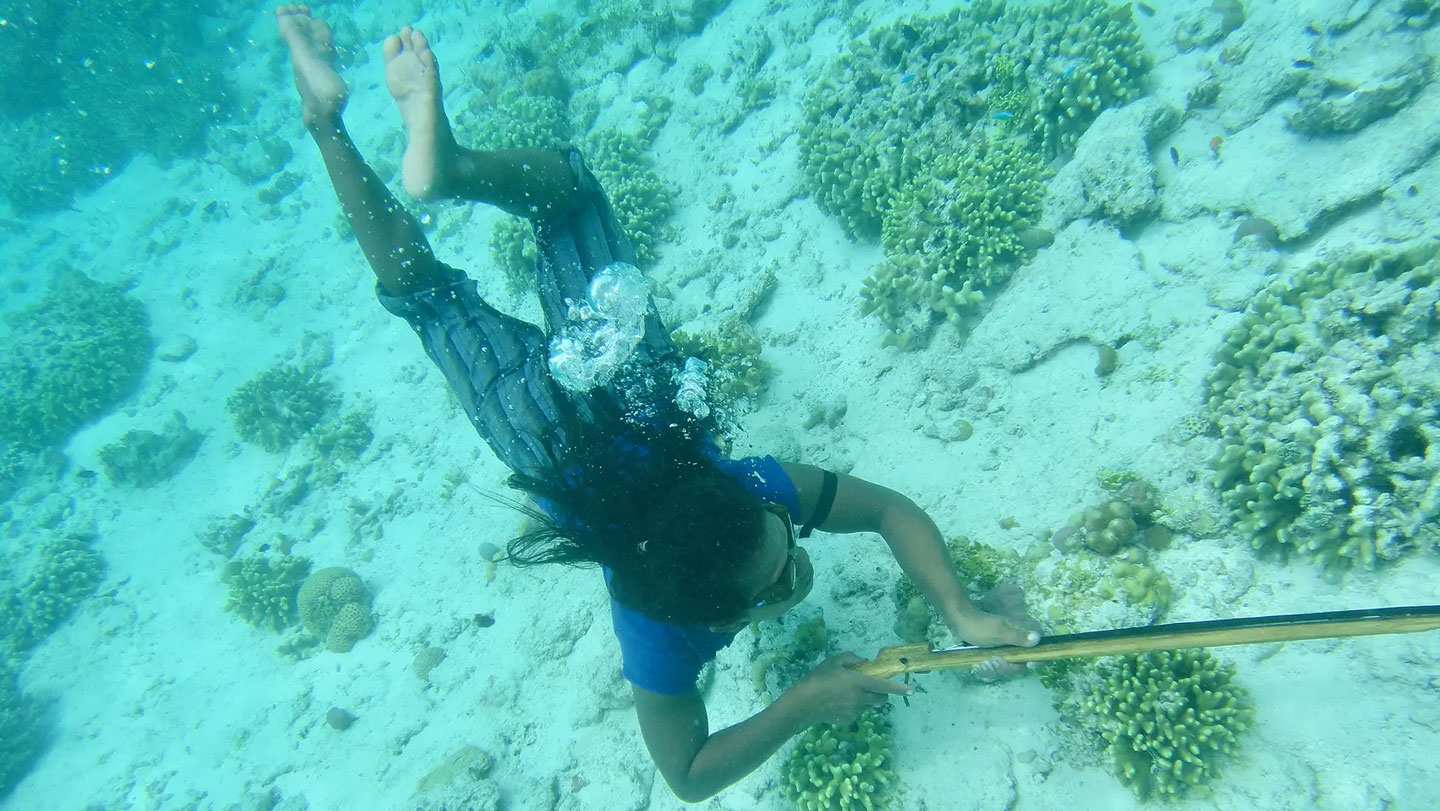
Two researchers may have opened floodgates on the debate over why humans can run marathons, swim the English Channel or dive a hundred meters and back on a single breath and their ape cousins can’t.
Humans evolved endurance for feats like these not just by running down prey on the African savanna, but also by diving for food in lakes or coastal waters, the duo propose September 17 in PaleoAnthropology. The hypothesis adds complexity to a decades-old theory that puts the drivers for evolution exclusively on land. But it coexists with a history of pushback for any water-related ideas.
The work is causing ripples among anthropologists. “I could not work out [at first] if this was groundbreaking or dumb,” says Christian Tryon, a paleoanthropologist at the University of Connecticut in Storrs.
In 1960, researchers came up with what’s been called the aquatic ape or waterside hypothesis, which suggested that our ancestors evolved longer legs and other adaptations from swimming for their suppers in watery habitats. Popularized in media accounts but not adequately vetted in peer-reviewed journals, the idea was shunned by the scientific community as additional fossils pointed away from a life in water. More recently, the dominant theory has been that it was landlocked human ancestors who gradually developed our remarkable endurance. “There’s been this reluctance to really think about anything sort of water-related as important in human evolution,” Tryon says.
Yet evolutionary anthropologist Josephine Joordens, a self-professed “water person” who trained as a marine biologist, had long wondered whether coastal life was vital to the evolutionary process, because it provides easy access to both water and land resources. Joordens combined forces with Erika Schagatay, a physiologist at Mid-Sweden University in Östersund, to formulate what they call the “dive first, run later” hypothesis.
Schagatay — herself a freediver — has spent decades observing and monitoring modern sea foraging people such as the Ama in Japan and the Sama-Bajau in Southeast Asia. Joordens studied fossil evidence and combed the literature about aquatic activities. Our evolution “was likely a very complex and very dynamic process,” says Joordens, of the Max Planck Institute for Evolutionary Anthropology in Leipzig, Germany.
They propose some Homo species wound up shallow-water diving repeatedly about 2 million to 3 million years ago, much the way the Sama-Bajau do today. These people spend four to six hours per day repeatedly diving several meters deep to catch fish and collect shellfish and other food. They evolved bigger spleens than their non-diving counterparts and, it seems, enhanced respiratory and cardiovascular capacity. They have the ability to “pace” breathing periods and breath-holding to avoid fatigue. In our ancestors, that could have paved the way for the cardiorespiratory stamina needed in modern endurance running, Schagatay says.
These Homo divers evolved heavy bones to help stay underwater and downward facing noses to keep water out, the two suggest. They eventually passed those endurance-boosting traits on to other populations with lighter bones and a more terrestrial lifestyle.
The study “shows there is a lot of evidence” for forage diving as an early evolutionary driver, says Leslea Hlusko, a paleobiologist at the Centro Nacional de Investigación sobre la Evolución Humana in Burgos, Spain.
This idea is not a retread of the aquatic ape theory, says Christopher Ruff, a biological anthropologist at Johns Hopkins School of Medicine. “Occasional aquatic foraging is quite a different proposal“ from the discredited theory’s primarily aquatic existence and should be taken seriously, Ruff says.
Not everyone thinks the dive first idea holds water.
Multiple factors work against the idea that diving could have helped humans become better endurance runners, says Daniel Lieberman, a paleoanthropologist at Harvard University. He argues that endurance diving does not require an enhanced aerobic capacity: It slows the heart rate, whereas running speeds it up. He disputes how and why heavy bones arose; they could have developed in people who used their bodies for heavy work and not because such bones helped divers with buoyancy issues. Nor is the downward pointed nose meaningful given that many diving mammals have forward facing noses. Other reasons, such as keeping the air in nostrils moist, were probably more important in selecting for this feature, he says.
What’s more, many people around the world have long relied on running down game for food, says archaeologist Eugène Morin of Trent University in Peterborough, Canada. “Diving is costly and the [caloric] returns are low,” so early humans would not choose to dive if other foraging opportunities existed, he argues.
Critiques aside, “the simple ‘ape walked out from forest to savanna’ story clearly does not cut it anymore,” says Pascal Gagneux, a biological anthropologist at the University of California, San Diego. Coastal routes around Africa, along Africa’s lakeshores and out of Africa “must have played a huge role” in human evolution, Gagneux says.
The pair knows they risk the ire of their peers in presenting this “dive first” hypothesis, but Joordens says, “we are both in our early 60s and we both have beautiful careers, so we thought ‘whatever happens, happens.’”
And Tryon ultimately found the paper worth the read. “If nothing else, it gets people thinking and it gets people looking.”
