


- “On Indigenous Peoples Day, let’s honor the leadership and contributions of Indigenous women in water,” a new op-ed says.
- Women bring people together, build partnerships, solve problems, and move important work forward every day, the author writes, and Indigenous women in particular exhibit the kinds of community knowledge and relationship-building skills that lead to greater health outcomes, like access to clean water.
- This article is a commentary. The views expressed are those of the author, not necessarily of Mongabay.
On Indigenous Peoples Day, let’s honor the leadership and contributions of Indigenous women in water. Women – and particularly Indigenous women – are underrepresented in the water workforce and make up less than one in three voices in water governance.
Yet, the water sector has much to learn from women’s leadership.
Women have always led, and women get things done. Across the water community, women bring people together, build partnerships, solve problems, and move important work forward every day. Their leadership takes many forms. Some lead through community engagement and relationship building. Others advance technical solutions, policy, research, infrastructure, public health, or education. Many do all of these things at once.
Different perspectives help turn vision into action. Women lead in complementary ways, and that collaboration often drives meaningful progress.
In working alongside Indigenous leaders such as Emma Robbins and Crystal Tulley-Cordova, I have seen how community knowledge, technical expertise, and relationship-building complement one another. Throughout this work, women continue to champion Indigenous knowledge, environmental stewardship, water justice, and community resilience. They advance conversations about water rights, water hauling, universal access to clean water, public health, policy, research, and infrastructure. They also recognize that solving water challenges requires more than technical expertise: Real progress happens when communities, researchers, educators, advocates, and decision-makers come together around shared goals.
Women play a leading role in creating and sustaining those connections. Through efforts like the Navajo Water Access Coordination Group, which I’ve helped coordinate toward improving water access for tribal homes plus organizations like Chapter House, Indigenous leaders, researchers, universities, tribal utilities, healthcare providers, nonprofit organizations, and government agencies all come together regularly to exchange ideas, share lessons learned, and work through water challenges.
Collaboration does not happen on its own. People build it, nurture it, and sustain it. Women lead this work every single day.
Art also plays an important role in that conversation. Creative expression helps people connect to water, to one another, and to the deeper meaning behind the work. It creates space for reflection, understanding, and community connection in ways that technical discussions alone cannot. This work is not only about the technical realities of water but also about relationships, creativity, lived experience, storytelling, mentorship, and learning across generations. It is about recognizing that water connects to identity, culture, memory, and community.
Joy matters too. Water work can be heavy. It touches on access, inequity, infrastructure, health, and history. Yet joy and laughter create room to breathe. In serious work, that kind of energy is necessary. It creates connection, builds resilience, and reminds us why this work matters in the first place.

There is something powerful about creating spaces for elders, emerging leaders, and younger voices to learn from one another and be in conversation. When we all learn from one another we strengthen both the present and the future of water stewardship. Leadership is not only about who holds responsibility today but about the knowledge we pass forward, the relationships we sustain, and the foundation we build for those who will follow.
That is what stands out most to me: Women continue to lead from different places and in different ways. They lead in chapter houses, classrooms, boardrooms, public office, community gatherings, and on-the-ground projects. They build relationships that sustain collaboration and mentorship that prepares the next generation.
I am grateful to learn from — and work alongside — women like these, whose leadership continues to strengthen communities and shape the future of water stewardship. Women have always led and always will. In water, that leadership continues to shape the future with intelligence, strength, humor, heart, and vision.
Justine Apodaca specializes in community-focused initiatives, including her current work for Weston Solutions supporting the Navajo Nation Water Access Mission, which increases access to safe drinking water.
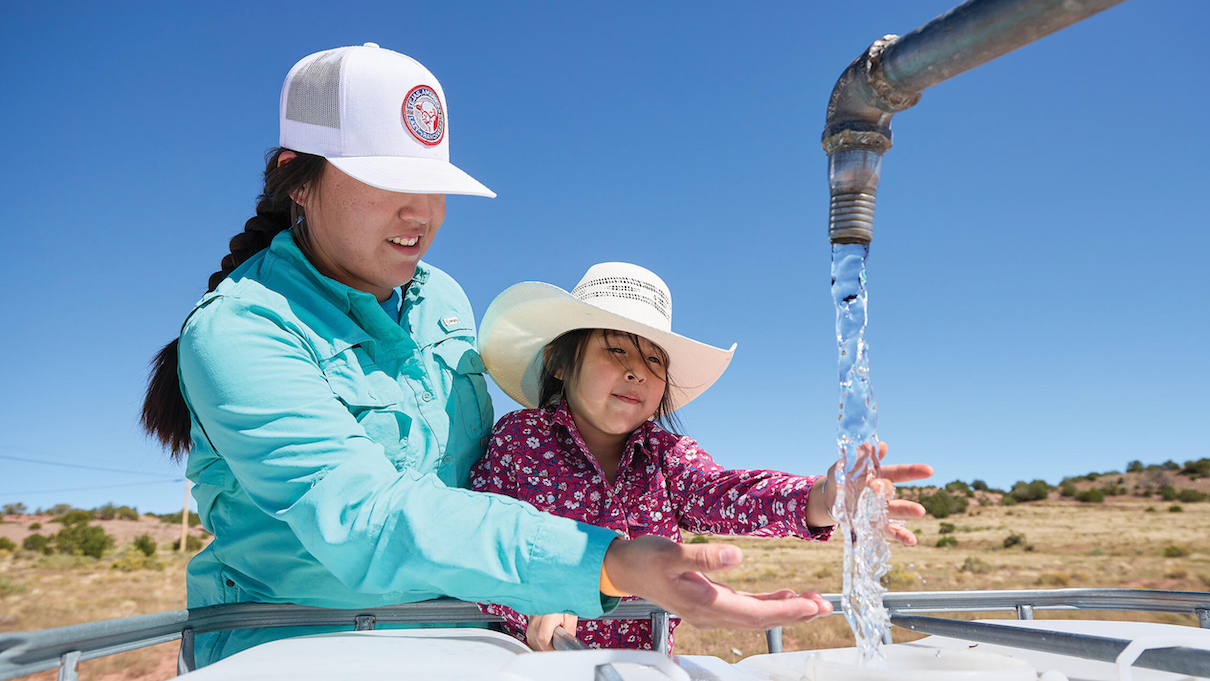
Banner image: A young Diné girl assists her aunt in collecting water for their livestock. Image courtesy of the Center for Indigenous Health.
See related coverage:
In Nepal, women seek ownership rights to the lands they tend
Meet the Indigenous women restoring Kenya’s Mau Forest — and reshaping gender roles
Sickles, sarees and smoke: Women on the frontlines of Uttarakhand forest fires
First Nation-led effort replants kelp forests in Clayoquot Sound

