


Welcome back to World Brief, where we’re looking at next year’s risks to the global economy, escalating student-led protests across France, and Russia denying rumors of the pneumonic plague.
‘Get Your House in Order’
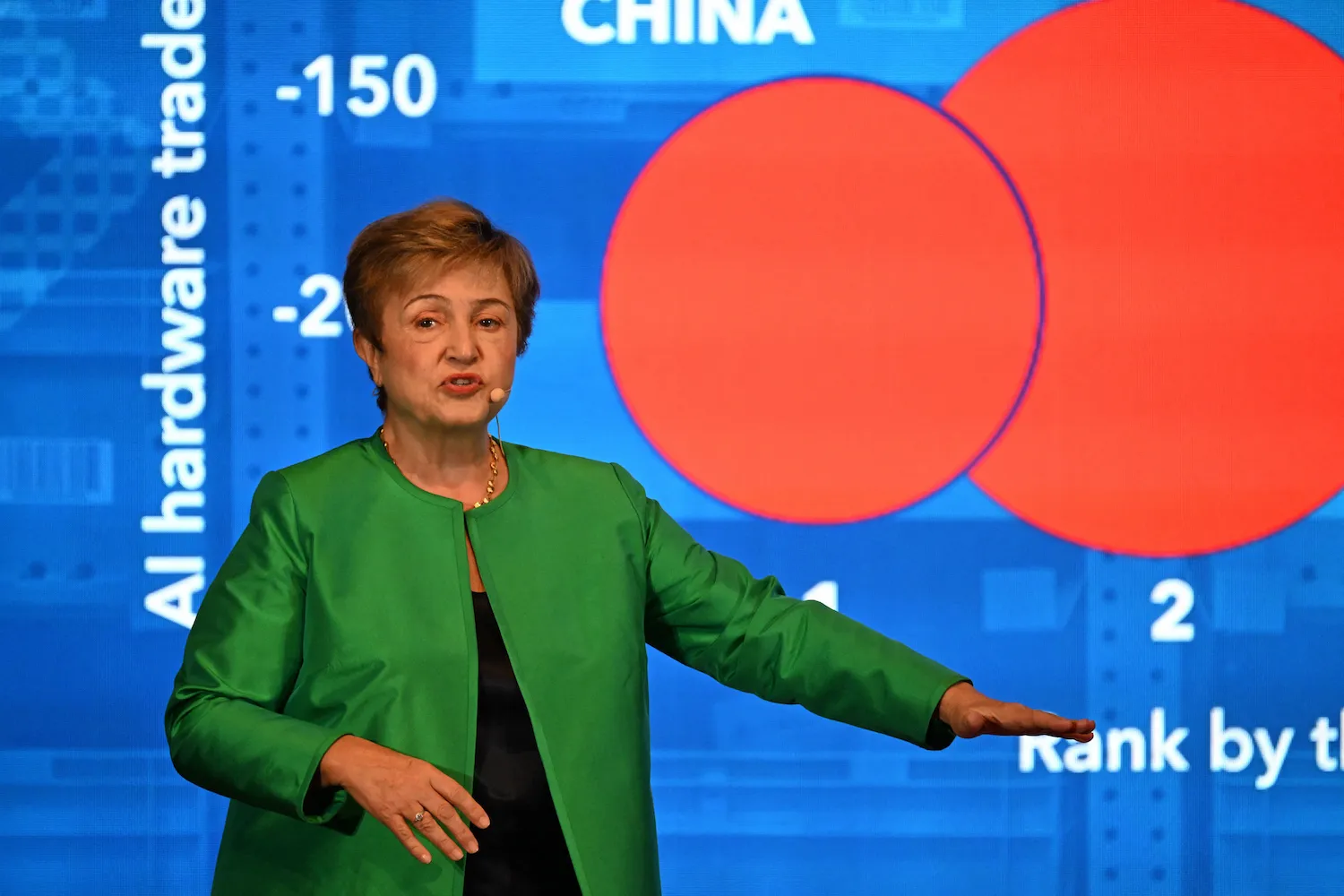
Skyrocketing energy costs from two devastating wars. Record-high public debt amid ballooning government bond yields. Debilitating inflation rates, sluggish fiscal growth, and new artificial intelligence investment risks. The global economy is in for a tough 2027, International Monetary Fund (IMF) chief Kristalina Georgieva warned on Wednesday.
Welcome back to World Brief, where we’re looking at next year’s risks to the global economy, escalating student-led protests across France, and Russia denying rumors of the pneumonic plague.
‘Get Your House in Order’
Skyrocketing energy costs from two devastating wars. Record-high public debt amid ballooning government bond yields. Debilitating inflation rates, sluggish fiscal growth, and new artificial intelligence investment risks. The global economy is in for a tough 2027, International Monetary Fund (IMF) chief Kristalina Georgieva warned on Wednesday.
In a speech previewing next week’s annual IMF/World Bank meetings in Bangkok, Georgieva outlined several of the risks threatening the world order and urged nations to implement protective measures to help keep the lights on.
“My message to the world’s economic policymakers will be this: We cannot keep delaying necessary policy action,” Georgieva said.
Instead of relying on rapid economic growth to lift debt burdens, governments should prepare to make “very tough political choices” in the near future. “Now may be a good time for a prudently hawkish bias in many countries’ monetary policy,” Georgieva suggested, applauding recent rate hikes by the Bank of Japan, the European Central Bank, and the U.S. Federal Reserve. She also urged leaders to tighten government spending, focus on price stability, and tackle the risks of AI.
The IMF chief highlighting AI investments was notable, as it comes while the world’s two largest economies—the United States and China—are competing in the advanced tech’s development. “I will never stifle the growth of a technology that will be bigger than the industrial revolution,” U.S. President Donald Trump said last week, even as leading AI firms have called for a slowdown or pause in the development of the most advanced models to allow for the creation of global safety guardrails. Many experts fear that AI’s expansion could spark mass job layoffs, worsen inflation rates, and stifle housing markets.
Investors also remain skeptical of global energy security, as the wars in Iran and Ukraine continue to hamper oil and gas supply chains. Last week, G-7 nations agreed to release 100 million barrels of diesel and crude from their reserves over the next four months to try to rein in high fuel prices. Yet Brent crude still exceeded $100 per barrel on Wednesday, and West Texas Intermediate rose to nearly $90 per barrel.
Further worrying economists is the global bond sell-off, whose resumption on Wednesday pushed long-term borrowing costs to some of their highest levels in decades. France’s 10-year yields hit 4.93 percent; Britain’s 30-year gilt reached a 28-year high of roughly 6 percent; and 30-year U.S. Treasurys climbed to 5.73 percent, their highest level since 2002.
However, when Georgieva was asked whether these sell-offs—specifically, in France—forecast a bigger eurozone debt crisis, the IMF chief was cautiously optimistic. “We need to remember that, [compared] to the previous time, we have a much more mature system in Europe,” Georgieva said, pointing to the strength of the European Central Bank and other instruments that protect against financial stability risks.
“Yet again,” she added, “my message is: get your house in order.”
Today’s Most Read
What We’re Following
Alleged police brutality. France on Wednesday suspended the use of stun grenades against student protesters amid allegations of police brutality. Interior Minister Laurent Nuñez stressed on Wednesday that the suspension is only for school-related protests. The ban will remain in effect until authorities investigate how a 15-year-old lost his hand when he came into contact with a police stun grenade on Monday. Police have also used batons, tear gas, and water cannons to disperse demonstrators.
Late last month, protests erupted across France over school staffing shortages, overcrowded classrooms, and dilapidated buildings. Coupled with the recent unveiling of a controversial 2027 budget proposal, the demonstrations have only grown in scale. Around 260,000 people, including members of several French labor unions, took to the streets across France on Tuesday in some of the biggest protests yet. More nationwide demonstrations are expected on Thursday.
Around 6,500 people—mostly minors—have been arrested, and more than 700 police officers have been injured since the unrest began. During an emergency meeting on Tuesday, Prime Minister Sébastien Lecornu ordered ministers to review some of the protesters’ main demands, including reviewing the length of the 8 a.m. to 6 p.m. school day, extending lunch breaks, and ensuring absent teachers are replaced.
Low risk of plague. Russian authorities have not reported any case of plague out of the Siberian region, the World Health Organization (WHO) confirmed on Wednesday. According to WHO chief Tedros Adhanom Ghebreyesus, Moscow believes a “typical” acute respiratory viral infection—not a case of the pneumonic plague—was the cause of a recent staffer’s death at the Irkutsk Anti-Plague Research Institute of Siberia and the Far East.
On Sept. 25, 28-year-old Daria Shipilova was working at the research institute when she reportedly broke a test tube containing samples of the pneumonic plague, a contagious respiratory pathogen that can be fatal if untreated. Within days, she was admitted to a hospital with symptoms of severe pneumonia and died soon after, prompting several medical facilities in the area to impose quarantine measures.
Despite initial fears of a possible contagion, WHO officials coordinating with the Kremlin reported that the risk of pneumonic plague is “moderate to low for Irkutsk, a low risk for the Russian Federation as a whole, and very low for the WHO European region.” Still, the U.S. State Department sent a démarche to Moscow on Tuesday urging Russia to disclose more details about Shipilova’s death; Trump also told reporters that he has a call scheduled with Russian President Vladimir Putin “soon.”
AfD victory. Lawmakers elected Alternative for Germany (AfD) member Tobias Rausch on Tuesday to be president of Saxony-Anhalt’s parliament, making him the first far-right politician to lead a German state legislature since the Nazi era. The appointment signals a major shift in power for the party, which has ties to neo-Nazis, as it will now have greater sway to advance its anti-immigrant, anti-establishment agenda.
For years, Germany’s mainstream parties have imposed a firewall on the AfD in an attempt to ostracize it, with Berlin’s domestic intelligence service labeling it an “extremist” organization in 2025. Yet that didn’t stop the far-right party from winning 39 out of 83 seats in Saxony-Anhalt’s legislative election last month. On Tuesday, that firewall was further damaged, when 48 Saxony-Anhalt lawmakers anonymously voted in favor of Rausch’s appointment, meaning that several politicians from mainstream parties broke ranks to back the far-right candidate.
Rausch’s election could forecast good news for the AfD’s Ulrich Siegmund, who is running for Saxony-Anhalt’s most powerful position, minister president, in December. Siegmund has campaigned on school segregation, vowing to separate the children of asylum-seekers from other students; championed more funding for patriotic arts; and vowed to replace all rainbow flags in schools with German flags.
Odds and Ends
The Nobel Prize in chemistry on Wednesday went to two researchers who solved a century-old mystery: How can some molecules exist as two variants that mirror each other while living organisms only use one of those forms? Discoveries by Henri Kagan and Kenso Soai over the past several decades revealed new ways to manipulate chemical reactions to produce just one of the mirror molecules, which the Royal Swedish Academy of Sciences argued will be “decisive for chemists who design reactions for the manufacture of pharmaceuticals.” Look, we don’t totally understand it, either, but we’re glad they do.
