


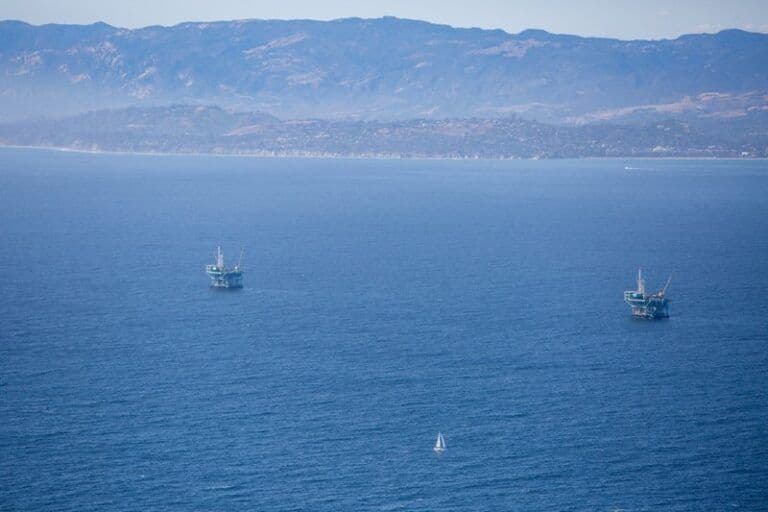
After President Trump enacted a ten-year moratorium on Florida’s entire coastline from new offshore drilling during his first term in 2020, the agency has proposed a draft five-year plan that would sell offshore drilling leases off the western coast of the state, as well as off California, Alaska, and throughout the central and western Gulf of Mexico. Senators Rick Scott (R-Florida) and Ashley Moody (R-Florida) have introduced legislation that would protect parts of the U.S. Gulf off Florida from offshore oil and gas drilling in response.
Oceana, which has welcomed the ‘Protecting Florida’s Offshore Military Readiness Act,’ outlines that the bill would prevent any interference that could impede the federal government’s ability to maintain military readiness through training and other activities within the Eglin Gulf Test and Training Range (EGTTR) in the Gulf of Mexico, including offshore drilling.
Joseph Gordon, Oceana’s Campaign Director, outlined: “Healthy oceans help provide the foundation of America’s security and prosperity. Expanded offshore drilling is simply incompatible with the many national interests that rely on clean, thriving coastlines and wildlife. Floridians across the state – from business owners to residents to lawmakers across the political spectrum – all agree that the state should be safeguarded from oil drilling and spilling.”
U.S. military officials and lawmakers have voiced concern over oil drilling moving forward in the Eglin Gulf Test and Training Range, which is critical for military training and national security, as this area is the largest testing and training range in the continental United States, with the Eglin Air Force Base supporting 20,000 personnel and providing roughly $9 billion in economic impacts to Florida.
Gordon added: “Oceana thanks Senators Scott and Moody for this important legislation that will protect oceans from expanded offshore oil and gas drilling. Congress must pass this bill and continue working to protect Florida’s coastline, and all our coastlines, from the Trump administration’s misguided offshore drilling proposal.”
From California, where newly minted laws block the infrastructure needed to service federal leases and conservation groups slap emergency permits with fresh lawsuits, to the U.S. Gulf, where military readiness zones threaten new drilling leases, the path to American energy independence is running through a maze of courtroom battles.
While the message from state capitals that are not fond of Big Oil is clear and underlines that reviving legacy offshore production will mean fighting for every single barrel of capacity, the oil and gas producers’ willingness to engage in these battles and the success of any counter-offensive moves remain to be seen.
These developments emphasize that America’s offshore energy sector is caught in a cross-country tug-of-war where federal fast-tracking attempts are colliding head-on with state-level resistance.
