


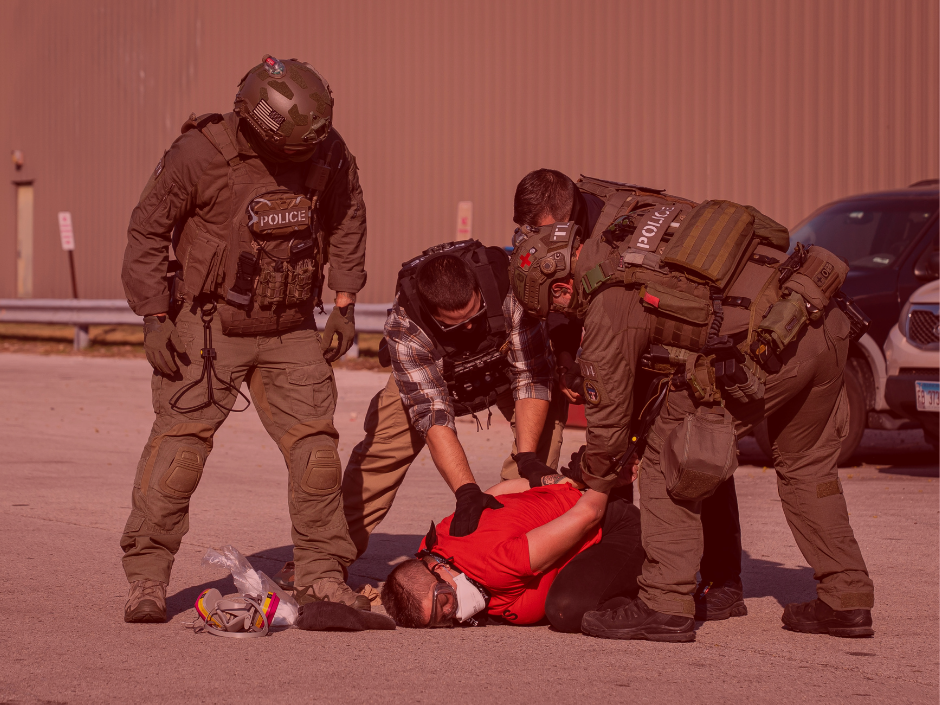
WASHINGTON, D.C. — Today, American Oversight released records obtained through Freedom of Information Act (FOIA) litigation against U.S. Immigration and Customs Enforcement (ICE) that include a military assessment of the electric shock gloves ICE plans to give its officers.
As reported by the Associated Press, the assessment shows the devices force compliance by inflicting pain, but it did not evaluate their health or safety effects. The assessment tested the gloves on Army soldiers role-playing guards and inmates in a mock prison cell. It says nothing about the risks to children, pregnant women, older adults, or people with disabilities, the groups against which the manufacturer’s own user manual warns against using the device .
ICE has awarded a contract of nearly $17 million to the manufacturer, Compliant Technologies, for 6,000 pairs of the gloves. The contract reportedly describes them as “a low-impact tool” for use when “an individual is resisting arrest or otherwise represents a clear threat to officers and agents.” The purchase follows records American Oversight obtained earlier this year showing a nearly 400 percent spike in ICE use-of-force incidents in the first months of the Trump administration. Last week, California Gov. Gavin Newsom signed a law banning local, state, and federal officers in the state from using the gloves.
“ICE officers have shot and killed at least five people since last year, including two U.S. citizens, and deaths in ICE custody have reached a record high. The agency has repeatedly misled the public about its conduct, denying any change in its use of force even as its own data showed a surge. Now it’s spending nearly $17 million on shock gloves it calls ‘de-escalation devices’ and expects the public to trust that it will use them responsibly,” said Chioma Chukwu, Executive Director of American Oversight. “Calling a shock glove a ‘de-escalation device’ does not make it safe. The manufacturer itself warns against using these gloves on children, pregnant women, older adults, and people with disabilities, and ICE’s record gives us little reason to believe it will listen. This administration is giving an agency with a record of escalating violence another way to inflict pain, while basic questions about the risks remain unanswered. The public deserves answers and accountability now, before these devices seriously injure or kill someone.”
The 38-page “Generated Low Output Voltage Emitter (GLOVE) and E-Band Restrictor Limited User Assessment Final Report,” dated Dec. 12, 2024, is marked for distribution only to U.S. government agencies and their contractors. The Naval Surface Warfare Center Indian Head’s Demonstration and Assessment Team conducted the assessment between Oct. 21-23, 2024, at Fort Leavenworth, Kansas. The Army’s Combat Capabilities Development Command sponsored it, and subject matter experts from Compliant Technologies took part. ICE produced the report in response to American Oversight’s request for the agency’s use-of-force policies and training materials.
After completing a four-hour course from the manufacturer, soldiers in the exercise role-played cell extractions, common-area disturbances, and escorts of inmates in body shackles. The report concluded the devices were “operationally effective and suitable” for military prison cell-extraction teams. But it also states that the assessment “did not produce statistically relevant data that might be used to make predictions on efficacy, nor was it a technical test of the GLOVE and E-Band,” and that “limited operator-level data was collected on the performance of the system and its non-lethal capability.” On safety, the report says only that “technical representatives” confirmed the devices had “the requisite technical manuals and safety certificates to be employed by military forces.”
The report describes how the devices work: “The body perceives the NPI [neuro-peripheral interference] as pain.” With the E-Band, a remote-controlled companion device that ICE has not yet procured, the report says the role player was in a restraint position before staff went hands-on “due to the intense pain applied to the inmate.” Being wet or oiled “amplified the effectiveness” of the glove and in one scenario, the oil “created residual discomfort for approximately 30 minutes.” Repeated exposure left the soldiers playing inmates with “fatigue, soreness, and excessive apprehensiveness to being shocked again,” according to the report.
“The military assessment in ICE’s own files shows that these gloves can cause ‘intense pain’ and force compliance. It does not establish that they are safe,” Chukwu continued. “The assessment did not evaluate health or safety effects, so its conclusion that the gloves were operationally effective leaves a fundamental question unanswered: At what cost to the person wearing them or being subjected to them? Everyone should be alarmed that ICE is preparing to deploy a tool designed to inflict, at best, intense pain, without showing that it is safe for the people who will be subjected to it.”
As ICE prepares to put thousands of shock gloves in the hands of its officers, the public deserves to know what the agency knew about the devices’ risks, and what, if anything, will stop them from being used on the people the manufacturer itself says are most vulnerable.
