


Welcome back to World Brief, where we’re looking at Spain’s failure to pass housing reforms, student-led protests across France, and widespread calls for the release of former Pakistani Prime Minister Imran Khan.
Madrid’s Moment of Reckoning
Spanish Prime Minister Pedro Sánchez called for snap elections on Monday, just days after his left-wing minority government failed to pass emergency measures to tackle the country’s worsening housing crisis. The election, to be held on Nov. 29, is likely to be risky, as Sánchez has never before led his Spanish Socialist Workers’ Party to an outright parliamentary majority.
Welcome back to World Brief, where we’re looking at Spain’s failure to pass housing reforms, student-led protests across France, and widespread calls for the release of former Pakistani Prime Minister Imran Khan.
Madrid’s Moment of Reckoning
Spanish Prime Minister Pedro Sánchez called for snap elections on Monday, just days after his left-wing minority government failed to pass emergency measures to tackle the country’s worsening housing crisis. The election, to be held on Nov. 29, is likely to be risky, as Sánchez has never before led his Spanish Socialist Workers’ Party to an outright parliamentary majority.
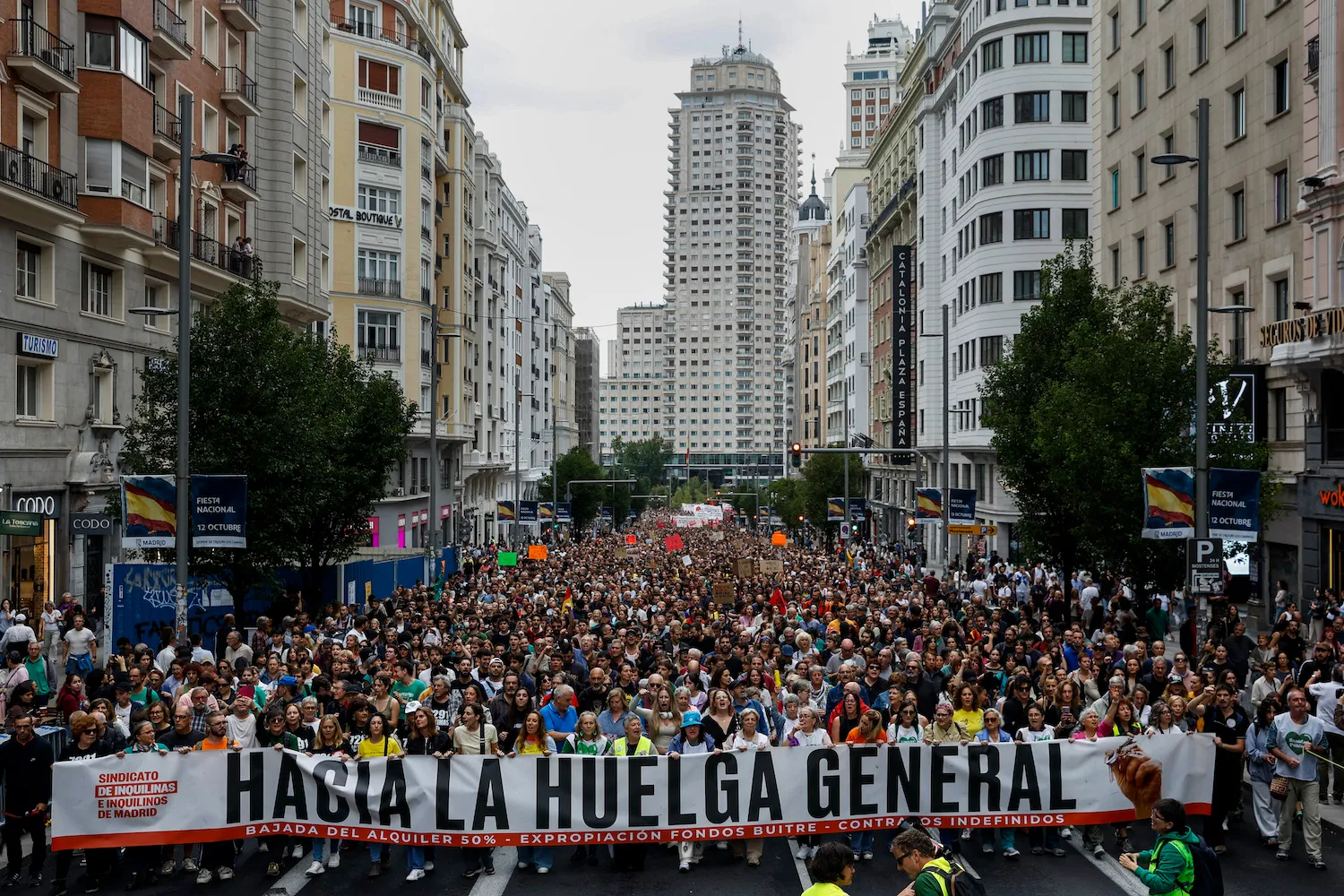
Last week, tens of thousands of Spaniards took to the streets to protest skyrocketing rent costs and a lack of affordable housing. Symbolizing the movement was 87-year-old María del Carmen Abascal, who was forcibly evicted from her home of seven decades after the investment firm that purchased her apartment increased her rent by 230 percent. Although Abascal’s legal team was able to successfully fight her eviction order, demonstrators have continued to demand stronger tenant protections.
On Friday, Sánchez tried to pass dual housing measures to quell public anger. The first would have frozen evictions for vulnerable tenants until 2030, while the second would have allowed automatic rent renewals without the possibility of rate increases or lease expirations. However, Spain’s conservative opposition voted down both proposals, arguing that federal intervention would lead to increased prices and fewer rental options.
This legislative defeat—coupled with corruption allegations against Sánchez’s inner circle and a recent immigration crisis in the Spanish exclave of Ceuta—has exposed the weakness of Spain’s governing coalition.
Snap elections may therefore be Sánchez’s last chance to hold on to power.
Sánchez has vowed to focus on housing affordability, inequality, and public services. Since he took office in 2018, Spain has become one of the fastest-growing major advanced economies in the world and has emerged as a leading voice in progressive politics, particularly in the face of rising far-right movements across Europe; next year, France, Italy, and Poland will also hold general elections that could see major right-wing wins.
“The time has come for the Spanish people to decide what future you want for yourselves and for your country,” Sánchez said on Monday. “Whether you wish to join that far-right wave, which rolls back progress wherever it governs, or whether you want Spain to remain a bastion of openness, social justice, and environmental responsibility.”
Experts suggest that the timing of the country’s snap election makes the vote a litmus test for Sánchez as well as progressive politics worldwide. If he wins, then Madrid will remain a symbol of Europe’s pushback against far-right populism. If he loses, then Spain’s far-right Vox party will likely form an alliance with conservative lawmakers, bringing an end to one of the continent’s most staunchly liberal administrations. Sánchez’s Spanish Socialist Workers’ Party is currently trailing in almost every local opinion poll.
Today’s Most Read
The World This Week
Tuesday, Oct. 6: United Nations chief António Guterres visits Pakistan.
Wednesday, Oct. 7: European Union foreign-policy chief Kaja Kallas begins two-day trip to Lebanon.
Croatia hosts a summit for leaders from southern Mediterranean countries.
Thursday, Oct. 8: German Chancellor Friedrich Merz hosts British Prime Minister Andy Burnham.
Iceland hosts the three-day Arctic Circle Assembly.
The British constituency of Holborn and St. Pancras holds a by-election.
Friday, Oct. 9: European Council President António Costa visits the Netherlands.
The Czech Republic begins two-day Senate and municipal elections.
Monday, Oct. 12: Ethiopia starts hosting the 65th session of the Intergovernmental Panel on Climate Change.
The International Monetary Fund and World Bank begin annual weeklong meetings in Thailand.
What We’re Following
Student-led unrest. Hundreds of French high schools remained closed on Monday, as student protesters continued to clash with police. “Our priority is to restore order,” French government spokesperson Maud Bregeon said.
Nationwide demonstrations erupted late last month over staffing shortages, overcrowded classrooms, and dilapidated buildings. Coupled with anger over Paris’s controversial 2027 budget proposal, which was unveiled on Thursday, the protests have turned violent.
Over the course of just one week, 24 schools have been burned or ransacked; 78 teaching staff have been injured; and around 5,000 people have been arrested, the majority of whom have been teenagers, according to Education Minister Édouard Geffray. Property damage is estimated to cost millions of dollars.
Demonstrators have also accused security forces of using heavy-handed methods, such as batons and tear gas; a 15-year-old protester’s hand was blown off on Monday after coming into contact with a police stun grenade, French newspaper La Voix du Nord reported.
A nationwide rally is set to be held on Tuesday, and several major French labor unions have already vowed to participate.
Marching for Khan. Thousands of people continued their lengthy march toward Islamabad on Monday to call for imprisoned former Pakistani Prime Minister Imran Khan to be released and given medical treatment amid reports of the 74-year-old’s ailing health. The rally began in the northwestern Khyber Pakhtunkhwa province on Sunday and aims to reach the capital by Thursday, with planned stops along the way.
Khan was removed from office in 2022 via a no-confidence vote and arrested the following year on several corruption charges, sparking widespread clashes between his supporters and the Pakistani military. He has since been convicted in multiple trials on charges from selling state gifts to leaking classified intelligence; however, all but one of these rulings have been suspended or overturned. Khan maintains his innocence, calling his arrest politically motivated.
Khan’s Pakistan Tehreek-e-Insaf (PTI) party was supposed to kick off the roughly 50-mile march on Sept. 27, but the PTI chose to delay it after the government of Prime Minister Shehbaz Sharif offered to negotiate. Those talks collapsed over the weekend, though, prompting the dayslong demonstration. Fearing massive disruptions to the city center, Sharif’s administration has deployed thousands of police and security personnel to Islamabad and barricaded key administrative buildings, vowing not to let the protesters enter the capital. “We will finish it once for all,” Interior Minister Mohsin Naqvi said on Monday.
Canada’s separatist push. Voters in Quebec cast ballots on Monday in a provincial election that could determine the future of Canada’s largest province. For the first time in more than a decade, the separatist Parti Québécois could win a majority in the 127-seat legislature, allowing party leader Paul St-Pierre Plamondon to hold a referendum on independence.
Support for independence across the predominantly French-speaking province remains low, and St-Pierre Plamondon’s fellow party members have previously favored ambiguity to avoid alienating mainstream voters. However, St-Pierre Plamondon’s defiant platform—which includes lowering taxes, cracking down on immigration, and improving government efficiency—could inject new life into Quebec’s separatist movement.
His rivals, however, have warned that St-Pierre Plamondon’s proposals could spark greater instability. With no apparent end in sight to the U.S.-Canada trade war, high costs of living remain a greater concern to residents than calls for independence. St-Pierre Plamondon has suggested that he will wait to hold a referendum until after U.S. President Donald Trump is out of office.
Odds and Ends
The Norwegian Nobel Committee awarded three scientists on Monday with the Nobel Prize in physiology or medicine for their discoveries in neuroscience. Karl Deisseroth, Peter Hegemann, and Georg Nagel helped establish the field of optogenetics by creating light-gated ion channels, which are used to isolate nerve cells and circuits in the brain to better learn how the organ functions. This breakthrough, which is now used in laboratories around the world, has helped experts research treatments for addiction, blindness, dementia, and depression, among other conditions.
