


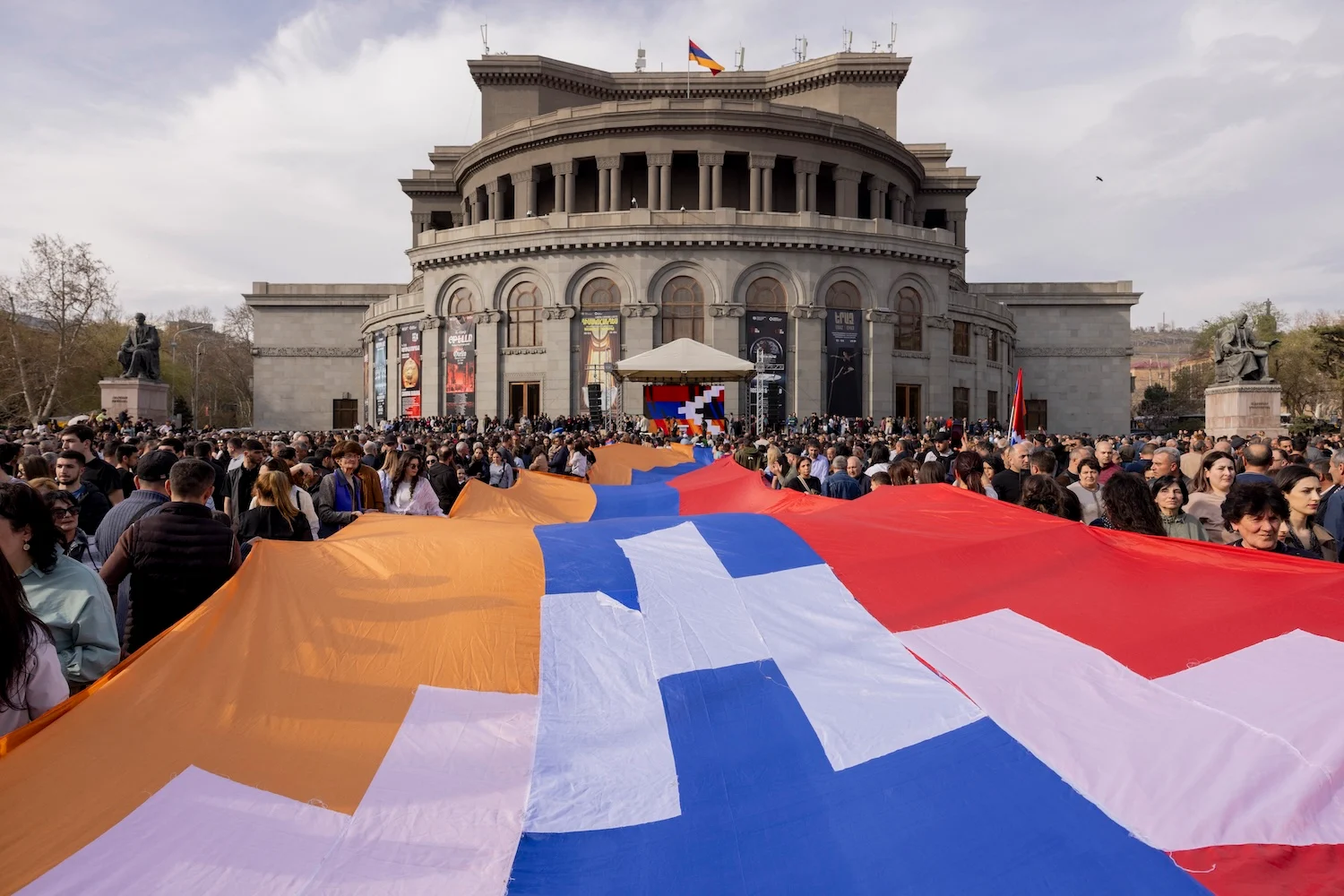
The Nagorno-Karabakh Republic’s official mission in Yerevan was part of a government presence that once employed 2,000 officials and administrators. Now, a plaque emblazoned with the vanished state’s emblem is overgrown with ivy. Next to it still hangs a large poster with the faces of Karabakh hostages captured by Azerbaijani forces in 2023. The office’s interior shows signs of a recent government raid, including a smashed safe—further evidence of the increasingly hostile relationship between the government of Armenian Prime Minister Nikol Pashinyan and supporters of the Karabakh cause.
The Nagorno-Karabakh Republic, known to Armenians as Artsakh, was a self-declared state that existed from 1991 to 2023 but was never internationally recognized. Nestled in the mountains between Armenia and Azerbaijan, Nagorno-Karabakh has been at the center of a brutal conflict between the two South Caucasus nations for decades. In 2023, Azerbaijan launched a lightning military operation, seizing control of the region and forcing thousands of ethnic Armenians to flee to Armenia.
The loss of Karabakh is still a painful and open wound for many in Armenia. But the Pashinyan government has taken steps to accept defeat and move toward a peace agreement with Baku. Supporters insist that this is a matter of pragmatism and that after 30 years of war with Baku over this land, and with tens of thousands of Armenian lives lost, it is time to move toward a more stable future. For others, though, including critics of the prime minster and many refugees, Yerevan’s abandonment of Nagorno-Karabakh—the cornerstone of the country’s national struggle for decades—is an act of treason.
In this fraught context, Karabakh refugees have become the victims of online hate speech and government harassment. Much of the hostility has played out online, stoked by pro-government activists, bloggers, and Armenian media outlets, but even senior government officials have publicly targeted Karabakhians. Researchers have found that stigmatizing narratives around the “ungrateful” and “deserter” Karabakhian have been systematically amplified by figures loyal to Pashinyan’s government.
This past summer, an Armenian court cleared the way for the government to seize and reclaim Nagorno-Karabakh’s diplomatic mission. According to Artak Beglaryan, Artsakh’s former state minister, Artsakh’s government funding, which was previously a $100-200 million annual budget, has dried up.
“In this wild world order, it is only possible to influence or change something with hard cards in your hands,” Beglaryan told Foreign Policy in an interview at the now-empty mission. “And Artsakh has nothing. No army, no money, no infrastructure. We have no levers with which to influence this peace process. The Armenian government has become the number one obstruction of our right to return.”
While out campaigning for reelection this summer, Pashinyan became embroiled in several heated confrontations over Karabakh.
In one viral incident, Pashinyan, who was reelected for a third term in June, tried to give a voter a campaign pin bearing a map of Armenia that excluded Nagorno-Karabakh. The woman, a refugee from Karabakh and the daughter of a commander killed in the first Karabakh war, flared up when Pashinyan referred to her as a “runaway.” “Don’t you dare say that I gave up Karabakh,” he shouted in response, wagging his finger.
In another now-infamous argument, Karabakh activist Artur Osipyan clashed with Pashinyan at a rally, criticizing the prime minister for his handling of the 2020 Karabakh war and the political decisions that followed. As Osipyan grew more emotional, Pashinyan exploded: “You should have gone and died in the place of our children … you thieving animals. Why are you still alive?” Osipyan was subsequently arrested and spent almost a month in pretrial detention.
This angry, combative version of Pashinyan is a world away from the Pashinyan who led Armenia’s pro-democratic Velvet Revolution in 2018 and who once said, “Artsakh in Armenia, full stop.”
Armenia’s defeat in the Karabakh war in 2020 unleashed a volatile period of protests and riots, including demands for Pashinyan’s resignation. In retrospect, it also proved to be a catalyst for Yerevan’s democratic backsliding. When his party unexpectedly won the 2021 elections with a landslide, Pashinyan began to prioritize loyalty and his political survival above all else.
This summer’s election campaign in particular was characterized by a string of arrests of Pashinyan’s critics, including Osipyan. At the same time, evidence of the government’s abuse of administrative resources has mounted.
Armenia’s Investigative Committee opened more than 120 criminal proceedings during the lead-up to the 2026 election, most of them targeting Strong Armenia, the main opposition party. Eighty-nine people were charged, and 13 were placed under house arrest. A separate Anti-Corruption Committee track initiated prosecutions against more than 200 people. A handful of those arrested included prominent Armenian tycoons and billionaires backed by Russia who now stand accused of corruption.
“The concentration of arrests and criminal prosecutions against opposition figures contributed to perceptions of selective justice,” concluded Farah Karimi, special coordinator and leader of the short-term OSCE observer mission.
Pashinyan himself has become increasingly prone to threatening and insulting his detractors—and Karabakh refugees are one such group that he has sought to scapegoat.
“It has gotten very ugly. The government’s hate speech against Karabakh refugees intensified exponentially during the elections—it was much worse than we expected,” said Tigran Grigoryan, a political analyst and the director of Yerevan’s Regional Center of Democracy and Security. “This government is sowing division to mobilize support for their policies, specifically the peace accord with Baku.”
Grigoryan, whose center tracks Armenia’s treatment of its displaced communities, concluded that the government’s scapegoating of Karabakhians has now become “systematic in nature.”
“They are using repeated, well-tested narratives against refugees that are being used each time there is a political crisis,” he said. “And they are using these narratives to promote their political interests without thinking how these refugees have lost everything.”
For Pashinyan, however, it is time for Karabakhians to accept their new reality and move on. Many Armenians are tired of war, and there is some support for Pashinyan’s efforts to make peace with Azerbaijan and secure rapprochement with Turkey.
In a televised address to the nation on Feb. 19, 2025, Pashinyan unveiled his “Real Armenia” doctrine. The doctrine’s core message was that Armenians should focus on the development and prosperity of the existing state within its current, internationally recognized borders, rather than the wider “historical” Armenia with claims over lands in Azerbaijan and Turkey—including Nagorno-Karabakh. Pashinyan argued that illusions over these claims had only resulted in tragedy. In August of that same year, Pashinyan and Azerbaijani President Ilham Aliyev signed a declaration on the cessation of hostilities at the White House in Washington, initialing a peace agreement.
On the night of Pashinyan’s victory in June, Yerevan Mayor Tigran Avinyan told me that the government had had to take “very, very difficult steps,” but Armenia “needed to establish its territorial integrity and security.”
“I was there during the whole war in Karabakh. I know the situation, I’ve seen practically everything there. But I am in complete agreement with [the government’s] line,” he said. “It was not an easy decision, not even for us, but it was a decision that we made for the good of our people and for the best of our country, for the future.”
Since the 1990s, thousands of Armenians have been killed fighting in wars waged between Yerevan and Baku for control of Nagorno-Karabakh. On the road leading from Yerevan’s airport to the city center, one is met with the somber sight of the Yerablur military cemetery shimmering with hundreds of flags marking the graves of young soldiers killed in the 2020 conflict.
“Overall, Armenian society is tired of war. We lost very badly in 2020, and after all these escalations, Armenia is just not in a position to defend itself currently. So, for a lot of people, this is no longer a realistic agenda,” Grigoryan said, referring to Karabakhians’ hope to one day reconquer and return to Karabakh.
Critics of the prime minister have cast Real Armenia as a one-sided concession to Baku, dictated by Azerbaijan’s demands that Armenia change its constitution to exclude territorial references to Karabakh as a precondition for negotiations. In the June elections, Pashinyan hoped to secure a parliamentary majority so that he could see these amendments through, but his Civil Contract party fell just short of that margin, resulting in a bottleneck.
The June elections, the first of Armenia’s post-Karabakh reality, were cast by political analysts as a referendum on the potential peace accord with Baku. But based on my conversations with voters and political scientists in June, many Armenians saw little political alternative to Pashinyan and were more motivated by opposition to pro-Russian parties than by the question of Nagorno-Karabakh.
As for the Karabakhians themselves, there is little hope now for their right to return. Many are trapped between precarity and fear. Most live in poverty, while 70 percent face unemployment, according to Artsakh officials. Due to their refugee status, most did not have the right to vote in the June elections.
Lucine Minasyan is now struggling to pay rent on an income of $400 a month. She fled Karabakh with her then-four-year-old son in 2023, with a single bag of clothes and her husband’s military medals. He was killed in a firefight on the first day of the 2020 war at the age of 30.
She sobbed when she described having to leave his grave and that of her father’s, also a soldier, behind in Artsakh. “I was five years old when my father was killed, but I grew up with pride,” she said. “Now I cannot explain to my son why his daddy died—there is no Artsakh.”
Minasyan is frustrated that she has no say about the fate of her homeland and said that she will leave Armenia if Pashinyan signs the peace deal, most likely to Russia.
“My son has revenge in his heart. There will never be peace,” she said.
Larisa and Gevorg Sargsyan, meanwhile, received their Armenian passports this spring and now live with their entire family of 10 in three rickety rooms on the outskirts of Yerevan. Ardent critics of Pashinyan, they voted for Robert Kocharyan, the former president of Armenia who was born in Nagorno-Karabakh and also led the breakaway republic in the 1990s. Throughout the campaign, Kocharyan repeated that his key election promise was Karabakhians’ right to return and eventually reclaim Artsakh, but he remained vague about how that could be achieved.
“People who have never been to Karabakh do not understand,” Gevorg said, describing how, like many Karabakh families forced to flee in 2023, they tried to dig up the coffin of Larisa’s brother and bring his body with them. “His grave, our memories, and our land was the most precious to us. Nothing compares to our homeland.”
