


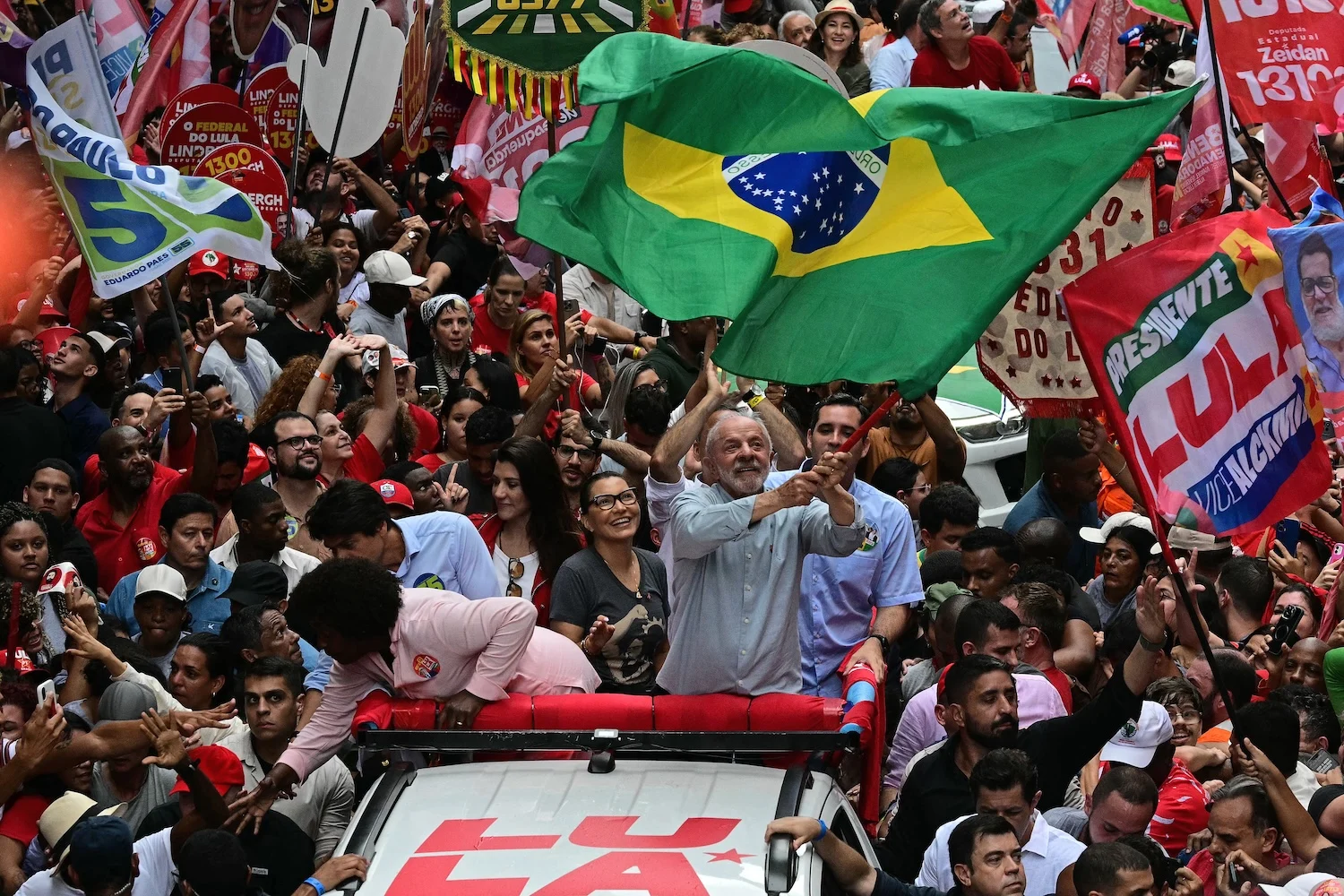
Brazilians go to the polls on Oct. 4 in what looks to be a very close presidential race between left-wing President Luiz Inácio Lula da Silva and right-wing Sen. Flávio Bolsonaro. Lula, as he is known, is vying for his fourth nonconsecutive term in office. Bolsonaro is the son of former President Jair Bolsonaro, now imprisoned for attempting a coup after losing to Lula in the 2022 election. Much is at stake in the contest—both domestically and in terms of Brazil’s foreign policy.
What has Lula accomplished in office? What are the stakes of the election for Brazil’s relationship with the United States? And for Brazil’s relationship with China?
Those are just a few of the questions that came up in my recent conversation with FP economics columnist Adam Tooze on the podcast we co-host, Ones and Tooze. What follows is an excerpt, edited for length and clarity. For the full conversation, look for Ones and Tooze wherever you get your podcasts. And check out Adam’s Substack newsletter.
Cameron Abadi: What has Lula accomplished in his most recent term in office as president?
Adam Tooze: Lula administrations in Brazil are very good for ordinary Brazilians and especially Brazilians at the bottom end of the extremely skewed income and wealth distribution. And the facts on this are just completely undeniable. There’s an element here of COVID recovery. Brazil had a very bad COVID under Bolsonaro senior, and it’s bounced back, but it goes way beyond that. So the current unemployment rate in Brazil is a historic record. Youth unemployment, which is an affliction of Brazilian society, is down to around 10 percent, which is unprecedentedly low. The incomes of working people are up by really dramatic numbers, about 20 percent since 2022. Poverty has fallen. Food insecurity has been reduced. Five million families have left the Bolsa Família basic welfare system as a result of increasing prosperity. That system itself has been reformed and improved. There has been substantial adjustment to debt relief [for poor people], mass public housing projects, the whole works, right? So Lula administrations are bona fide reformist administrations in a society afflicted by very large inequality and quite rank class differentiation that’s also then quite heavily racialized. And this is not the first time—this is true of all of his administrations. So they carry through, and they make a real difference.
They also make a very, very significant difference with regard to the global environmental issue—which of course is also a Brazilian issue—which is the Amazon and Amazonian deforestation. [Jair] Bolsonaro was deeply in cahoots with the rancher interest in the Amazon, which is the interest most directly responsible for the most egregious destruction of rainforest. And Lula administrations repeatedly since the early 2000s have, when they come into office, reversed this. So this is a story that’s really dramatically significant for not just Brazil but the whole world.
If you follow the financial press, however, if you follow commentary from Western media on Brazil, you’ll hear a different story. And this is to do with the fact that though unemployment is down and growth is not bad, the big anxiety is that this is essentially being driven by undisciplined fiscal policy. And because Brazil has a history, now decades back but nevertheless a history, of really rapid inflation—not to say hyperinflation—there was deep anxiety about fiscal imbalance. And Brazil being a class society, there is a huge conservative interest in control of fiscal policy, of tax policy, and of central bank policy. And so this is a hotly debated issue. And under Lula, the debt-to-GDP ratio has risen from 70 percent of GDP when he took office to over 80 percent of GDP, which by European and American standards, given what’s been achieved in the interim, would be a reasonable trade-off. But from the point of view of the comfort zone of Brazilian financial elites, it’s anything but. And the efforts by the Lula administration to struggle within the fiscal framework that had been set in place since the 2010s to constrain any adventurous progressive policy is well intentioned and smart and yet has run into really major, major obstacles, in terms of politics and Congress, where Lula never had a solid majority to say the least.
And so the odd thing is the current election is actually about a bunch of issues that are not natural Lula territory at all, including security and crime, which is a huge issue of state violence and of race and of class in Brazil, with Rio de Janeiro of course and its favelas being the crosshairs of this. And national security of all things. I mean, Lula is a leftist organizer who risked his life in struggles against the military dictatorship in Brazil. Bolsonaro père, on the other hand, celebrated the military dictatorships, which went hand in hand with torture and disappearances. And yet, nevertheless, under the sign of [U.S. President Donald] Trump, Lula has found himself courting military interests, in part also because it’s seen as a way of pursuing industrial policy, which is at the heart of the way in which the Lula administration has tried to think about economic policy. Because when they think about the problems of mass unemployment, one of the questions they have is, how do we rebuild a nation-centered industrial structure like the one that grew up in Brazil in the ’60s and ’70s and ’80s? And military industrial construction in Brazil as elsewhere has appeared as a kind of weird deus ex machina for that problem.
So it’s a checkered record not when you look at the socioeconomic data, where it’s just quite clear that if you actually have the interests of average Brazilians in mind, you vote for Lula administrations. But when you get into the weeds of how this problem is constructed, whether it’s “sustainable,” how the financial markets will react, you can see how things are getting sticky. And then there’s questions of governance and now itself is embroiled in different types of corruption allegations. All of this is eating away at the nimbus, the charisma of the Lula government.
CA: Foreign-policy questions have also been at the center of the campaign, including Brazil’s relationship with the United States. [Flávio] Bolsonaro has been promising a closer partnership with the United States in general and the Trump administration specifically, right?
AT: That’s an understatement, right? What’s at stake here, or at least on the face of it, is absolutely dramatic. What we are seeing is a level of massively aggressive and intrusive intervention by the Trump administration in Brazil’s democratic processes. Questioning the legitimacy of the electoral system; threatening and in fact implementing sanctions against the Brazilian judiciary for carrying through on the judgment against Bolsonaro senior; engaging in very overt support for his son as a rival to Lula; clandestine conversations, which apparently involve also side deals by which if Bolsonaro junior is elected, then there will be deals done that allow the United States to gain access to Brazilian raw materials—geopolitical power plays at that level.
So, on the one hand, when you read Marco Rubio, it’s this astonishingly aggressive assertion of the Monroe Doctrine against players the size of Brazil, which literally asserts that American dominance in the Western Hemisphere, in so many words, will not be challenged. Whereas, of course, Brazil’s own aspirations to sovereignty imply that it has sovereignty and autonomy and will not accept the dominance of the United States in the Western Hemisphere. And then from the Trump camp, something much more personalistic, which is literally Trump’s view that electoral campaigns in South America are extensions of the war that MAGA is waging against liberal North America, Canada, Mexico. And he literally talks up the victories of right-wing candidates and chalks them up to his own personal account. He’ll say things like, “We’re doing really well in Latin America right now.” By which he doesn’t mean U.S. national policy, that more conventional Marco Rubio kind of vision, but a much more partisan and much more personalistic vision of his camp, his ideology, his vision. So, as much, of course, as America has a century-old tradition of intervention in the Southern Cone and in Latin America and in Central America, this has a new edge because it really is a matter of personalities and personal commitments and personal loyalty, which runs against the standard logics of American statecraft.
And were Bolsonaro to prevail, therefore, I think it would be a shock. Not just in Brazil, though it would be massive in Brazil. It would be a shock in the wider region, and it should be a shock in the United States as well. Because there already are protests from Congress. In the last couple of days, there’ve been protests, letters from Congress to the White House saying, “We have no business interfering in Brazilian electoral democracy in this way.” And if Trump were to pull it off, thanks to the Brazilian electorate and his threats, it would, at this point, constitute a flouting, at least, of the will of a significant minority of members of Congress. Because this isn’t the way that American foreign policy has been conventionally handled, as intrusive and aggressive as it has often been toward South America.
CA: China is also a big topic in the campaign. In contrast to Bolsonaro’s promises of partnership with Trump, Lula has been proposing deeper cooperation with China. Does he have a sustainable strategy that he’s developed for Brazil with respect to China?
AT: Yes, the China-U.S.-Brazil triangle is fascinating. It’s new. This was never previously an issue. And the rise of China since the 2000s accompanied the first pink tide in Latin America and continues as a major factor in enabling a greater degree of sovereignty and autonomy. And it’s quite clear that it’s reflected within the Brazilian political system itself. And though overall public opinion appears to be balanced on preferring China or the United States, it’s actually highly partisan. So right-wing Brazilians strongly favor closer relations with the United States, and left-wing Brazilians even more strongly oppose those. Because Brazilian nationalist leftism is based on opposition to the Yankees, obviously. And then conversely, conservative Brazilians are much more skeptical toward China, and more left-wing Brazilians are more interested in balancing. And Lula has articulated that and has refused on several occasions to align himself with sort of Western coalitions against other fellow members of the BRICS, for instance.
The problem for both the right and the left in Brazil on this issue are the realities of the economic connection to China, which is that 79 percent of Brazil’s soybean exports—one of the great agro-industrial miracles of the 21st century—go to China; 67 percent of its iron ore exports and 45 percent of Brazil’s booming petroleum exports go to China. And this creates a conflict. You might say, well, this is all in favor of the left Brazilian strategy of balancing. Except the interests inside Brazil that favor trade with China are all die-in-the-wall conservative business class, anti-Lula Brazilians. So they’re your actual anchor to China. And conversely, [Jair] Bolsonaro, as much as he was a xenophobic racist, in the end couldn’t really break with China to a substantial degree because his core constituency in the business community is totally bought in on the relationship. So it’s a truly conflicted position that Brazil is in.
CA: What are the stakes of the election for Brazil’s relationship with the rest of the region, including Argentina and Cuba?
AT: The really striking thing about these questions of cross-cutting relationships in South America is that by comparison with the deep economic integration of North America—you know, in defiance of MAGA ideology, Mexico, the United States, and Canada are actually deeply economically integrated—let alone by comparison with the deep economic, political, and cultural integration of Western Europe, for instance, the relations between the major South American societies and states are much, much more tenuous. I mean, trade relationships are trivial. Given proximity and everything else, you’d expect this to be a single kind of massively complex, unified block. And it truly, truly isn’t. And that means that relations between the states are much more tenuous.
So the answer to your questions is much less substantial than one would imagine it to be, right? You’d think these things would all be very tightly knitted together, but they’re really, really not. One way of trying to think of this integration would be by way of big political currents, however. And it’s quite clear that one of the key things about this election is that it’s another test of the increasingly dominant trend toward right-wing politics across much of South America and Central America. The big standout exceptions are [Claudia] Sheinbaum in Mexico and Lula in Brazil. But overall, across Bolivia, Chile, Colombia, Peru, the intervention in Venezuela, and [Javier] Milei, of course, in Argentina setting the trend, there has been a really decisive right-wing shift. This has produced some pretty serious ruptures.
The first Bolsonaro government, to come to your Cuba question, actually broke relations with Cuba. There was a long-standing medical assistance program from Cuba to Brazil. So poorer parts of Brazil were provided with medical services for a fee by Cuba. And Bolsonaro used accusations of exploitation of the Cuban medical staff as an excuse to break those relations off.
The relations between Argentina and the Lula administration have been rock bottom because of essentially abusive Trump-style comments made about Lula by Milei, which resulted in the Brazilians reducing their representation in Argentina to chargé d’affaires level—so essentially, withdrawing their ambassador. The Argentines left theirs in Brasília, but nevertheless, this is a remarkable development. I think the upshot of this answer is that this isn’t the sort of earthquake that a [Marine] Le Pen presidency in France would be for the rest of the European Union because the interconnections are not as tight.
