


During this past summer of climate extremes, more than half of Europe experienced dangerous levels of heat stress, the combined effect of temperature, humidity, wind and sunshine on the body’s ability to cool itself. In some places, that amounted to a “feels like” temperature of 100 degrees Fahrenheit or higher.
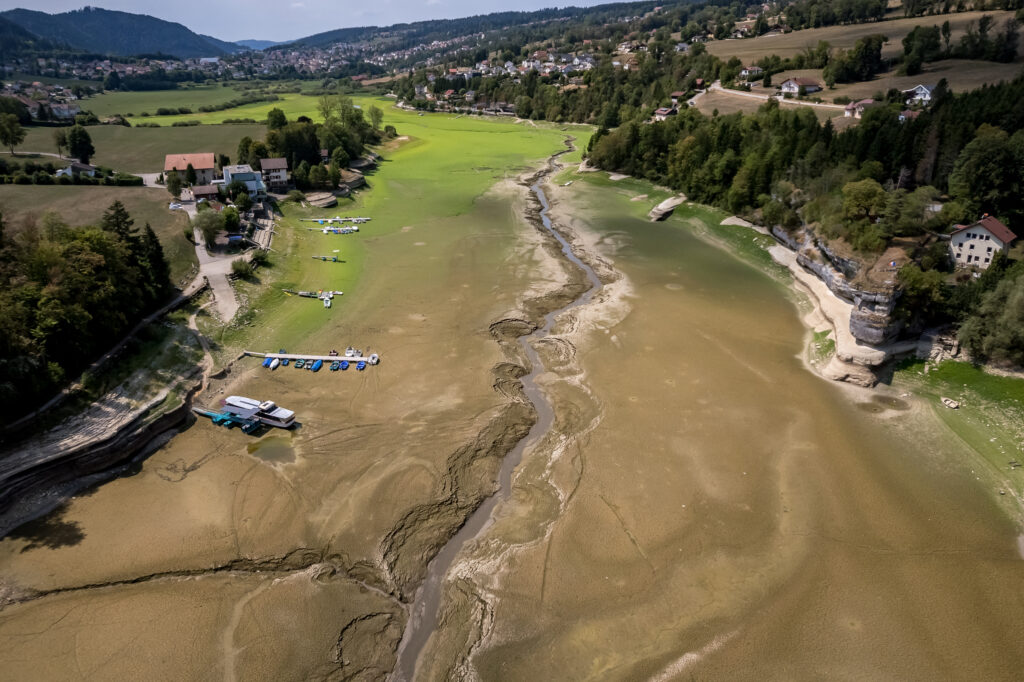
The heat stress spread across a record extent of 52 percent of the continent, the European Union’s Copernicus Climate Change Service announced in a Friday news bulletin. The May-to-August period also brought record-low flows in many major European rivers and widespread losses of important food crops, including grain.
The higher the heat stress index, the harder it becomes for the human body to regulate its temperature, said Peter Hoffmann, a senior scientist and meteorologist with the Potsdam Institute for Climate Impact Research. The measurement captures the magnitude and spatial extent of heatwave impacts in detail, he said.
But temperatures remain a key factor, he added, and last summer, 37 percent of European land areas experienced all-time daily, monthly or seasonal temperature records, extending across nearly all of England and Wales, and from France and Spain across Italy, Switzerland and Austria.
The summer was so extreme that four of Western Europe’s 10 most severe heatwaves since 1950 occurred between late May and mid-August 2026. All four were more intense than Europe’s landmark 2003 heatwave, although they differed in duration and spatial extent.
Samantha Burgess, a climate expert with the European Centre for Medium-Range Weather Forecasts, said the summer brought compounding extremes to Europe, affecting water supplies, energy systems, transport, ecosystems and agriculture, along with human health.
The report also concluded that the heat season is expanding into the spring and fall. In May and September, more than 40 percent of Europe experienced temperatures of 86 degrees Fahrenheit (30 degrees Celsius), a benchmark for heat on a continent historically known for a temperate climate.
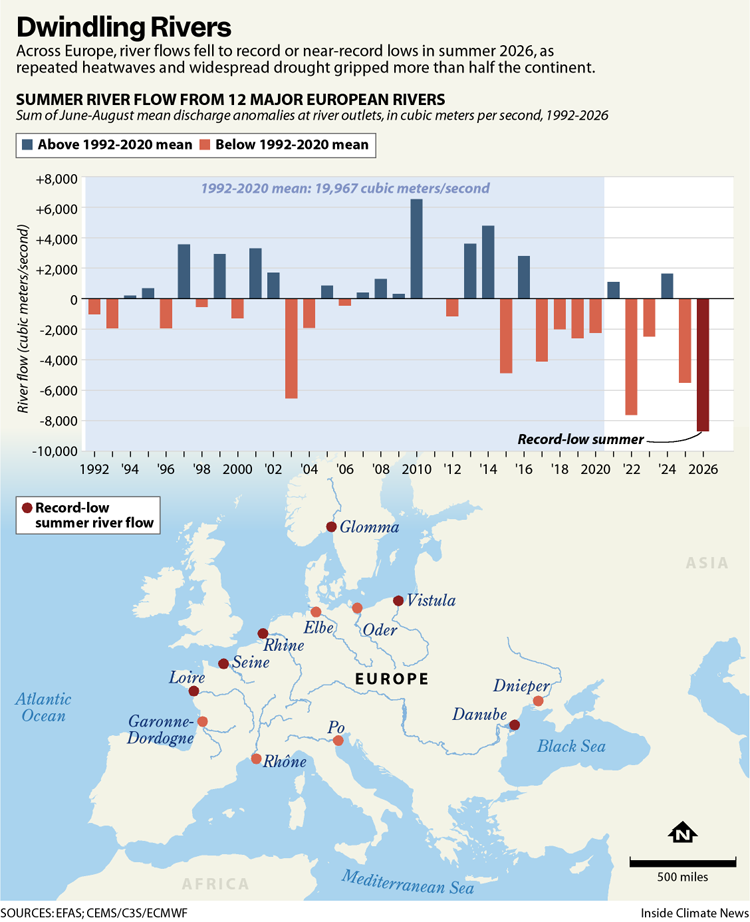
Across 12 major river systems, the total discharge volume was about 69 cubic kilometers below the long-term mean, equivalent to roughly two years of public water supplies across the European Union. The Loire, Seine, Rhine, Glomma, Vistula and Danube rivers recorded their lowest summer-average flows on record at their outlets. Long stretches of the Rhône, Po, Dniester, Elbe and Dnieper rivers also experienced record-low flows.
By the end of August, around 46 percent of European land was experiencing drought conditions, and around 40 percent of the affected area was classified as being under extreme drought.
Several rapid climate attribution assessments this summer found that human-caused warming intensified all the extremes, making the heatwaves hotter and more likely than in the past.
An analysis of the June heatwave led by World Weather Attribution scientists found that human-caused warming raised the daytime highs by nearly 4 degrees Fahrenheit. Other climate research suggests that global warming is shifting large-scale wind patterns into directions that spawn more heatwaves over Europe.
“The summer of 2026 shows that we are lagging behind in adapting to climate change in many areas,” said Fred Hattermann, a hydroclimatic risk expert with the Potsdam Institute for Climate Impact Research. The adaptation gap is evident in the disruption to transportation from low river flows, and in the wildfires that raged out of control in France, he said.
“It’s not that there’s no investment in adaptation, but it’s often fragmented and not coordinated on a larger regional scale,” he added. “With climate change advancing rapidly, we’re having great difficulty implementing these measures quickly enough.”
About This Story
Perhaps you noticed: This story, like all the news we publish, is free to read. That’s because Inside Climate News is a 501c3 nonprofit organization. We do not charge a subscription fee, lock our news behind a paywall, or clutter our website with ads. We make our news on climate and the environment freely available to you and anyone who wants it.
That’s not all. We also share our news for free with scores of other media organizations around the country. Many of them can’t afford to do environmental journalism of their own. We’ve built bureaus from coast to coast to report local stories, collaborate with local newsrooms and co-publish articles so that this vital work is shared as widely as possible.
Two of us launched ICN in 2007. Six years later we earned a Pulitzer Prize for National Reporting, and now we run the oldest and largest dedicated climate newsroom in the nation. We tell the story in all its complexity. We hold polluters accountable. We expose environmental injustice. We debunk misinformation. We scrutinize solutions and inspire action.
Donations from readers like you fund every aspect of what we do. If you don’t already, will you support our ongoing work, our reporting on the biggest crisis facing our planet, and help us reach even more readers in more places?
Please take a moment to make a tax-deductible donation. Every one of them makes a difference.
Thank you,

Reporter, Austria
Bob Berwyn is an Austria-based reporter who has covered climate science and international climate policy for more than a decade. Previously, he reported on the environment, endangered species and public lands for several Colorado newspapers, and also worked as editor and assistant editor at community newspapers in the Colorado Rockies.
