


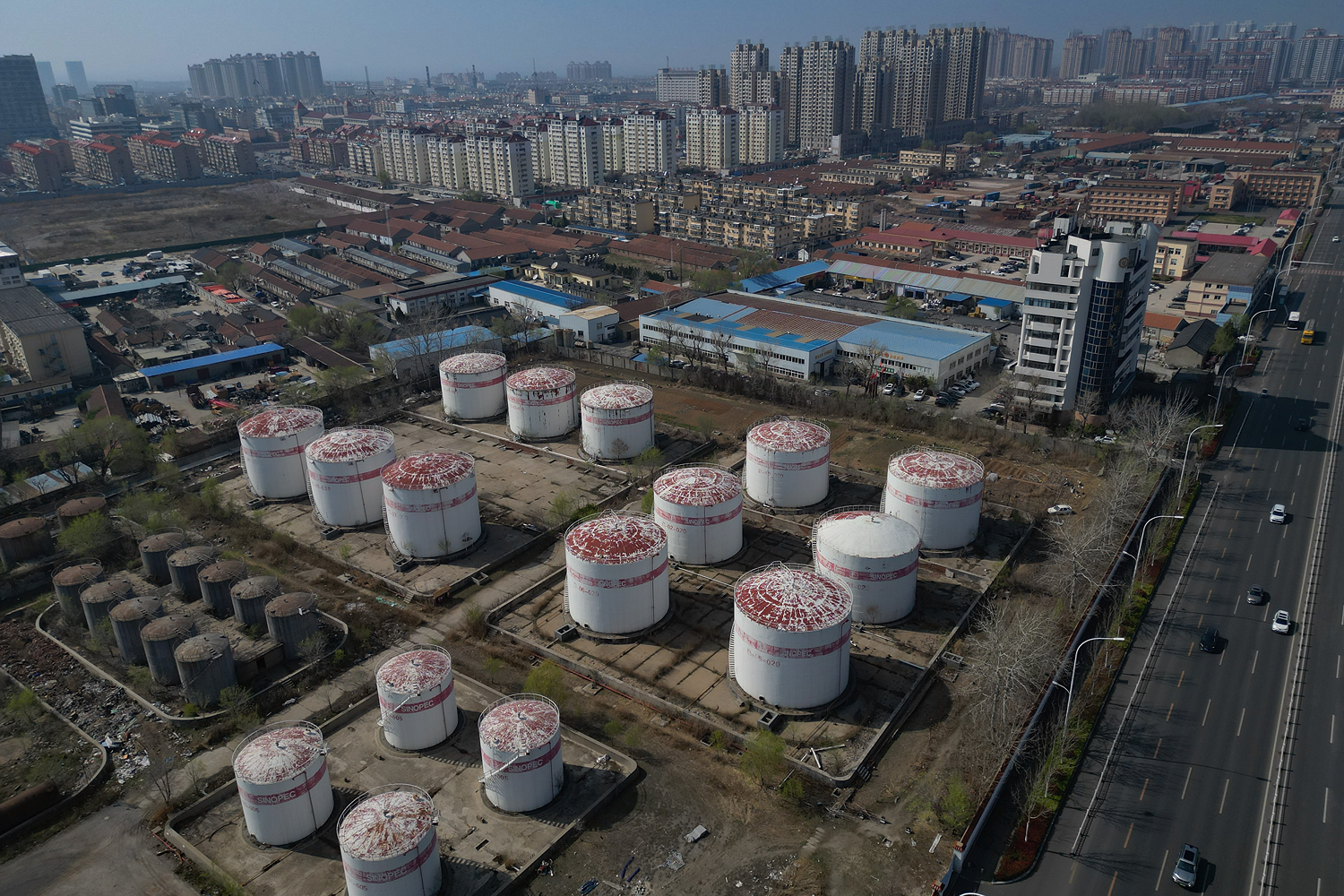
Since what the International Energy Agency called “the largest supply disruption in the history of the global oil market” arrived in February, China—the world’s largest crude oil importer, with more than 90 percent of these imports arriving by sea—has not scrambled to bid for every replacement barrel. By June, four months into the supply disruption, China had cut crude imports to the lowest level in nearly a decade. China began cautiously restoring crude imports in July, but its purchase rebound remained weak through August and September and far below precrisis levels.
China’s ability to endure the Strait of Hormuz stress test for so long shows that its decade-long efforts to build buffers and reduce dependence on oil for fuel have changed the socioeconomic pressure points of a supply disruption. The scale of China’s reduction in crude imports is striking, but the government did not directly order the cut.
Chinese leaders view the Hormuz supply shock not just as an energy security problem but also as a macroeconomic stability challenge. Their priority is to prevent rising oil prices from cascading into imported stagflation: China’s industrial system could withstand lower crude imports, but its demand-constrained economy cannot withstand the wrong kind of imported inflation, where prices rise due to higher oil costs rather than rising wages.
The Chinese political system and its policymakers can manage an industrial adjustment problem diffused among a concentrated number of state-owned and independent refiners. A broad and visible increase in higher costs of living would be much more difficult to handle, especially at a time when social stability is under mounting pressure because of weak employment opportunities and stagnating wages.
As the crisis hit, Beijing instead used its well-honed supply-side approach to prioritize domestic supply and compress rising costs largely within its refining system. As crude prices started to increase rapidly in early March, the Chinese government first restricted refined products exports to ensure domestic needs. Within a week, it raised regulated retail fuel price ceilings in the sharpest increase since 2022.
Existing electrification helped ensure reduced needs. In the first six months of 2026, China’s existing electric vehicle fleet is estimated to have displaced about 1.35 million barrels of oil per day, or 6 percent of China’s total annual crude imports. But electrification does not eliminate crude oil demand. Rather, it has shifted demand growth away from fuel to petrochemical feedstocks.
This change has transformed the nature of China’s vulnerability to high dependence on oil imports. An oil supply shock was thus increasingly not a fuel shortage problem but an industrial adjustment problem, which Beijing could manage through supply-side policies that diversified the raw materials used by the petrochemical industry, in addition to oil stockpiling and refinery output management.
When prices surged above $100 per barrel in late March, the Chinese government increased regulated price ceilings again, but it avoided the full pass-through of the oil price increase to domestic consumers. China has a long-standing administered pricing system stipulated in the Petroleum Price Management Measures, which limit how much and how quickly rising costs could be passed on.
Beijing’s approach meant that refiners were expected to maintain refining production, forgo profitable export markets, and sell products at home where demand was weak and price increases were capped, which would squeeze their profit margins.
Refiners seek to maximize profits. When market conditions and government policies turned against them, they adjusted to minimize losses by reducing crude imports and cutting production. They took the counterintuitive measure of not rushing to replace missing barrels amid a supply shock thanks to inventory buildup, crude secured before the Hormuz disruption, and deliberate import diversification.
Inventory availability provided the initial buffer for refiners to absorb the shock. China entered the disruption holding an estimated 1.4 billion barrels of commercial and strategic crude, equal to roughly 120 days of imports at its prewar pace. At the macro level, these inventories allow Beijing to sustain at least a three-month import cut on its own terms without a sharp domestic economic contraction.
At the refiner level, these stocks meant that refiners did not have to rush to replace disrupted Persian Gulf barrels with expensive spot purchases from other supplies. Customs data on crude imports and National Bureau of Statistics (NBS) data on domestic crude production and refinery throughputs suggest that inventory buildup slowed from January to April, and refiners did not have to draw down inventories until May and June.
As refiners retreated from the spot crude market, China’s oil imports declined sharply even though the government did not order the cut. During the second quarter, crude imports decreased from prewar levels by about one-third, from an average of 12 million barrels per day during the second half of 2025 through February to an average of 8.1 million barrels per day. Imports bottomed out at 7.12 million barrels a day in June.
During those three months, China bought roughly 355 million fewer barrels than if it had maintained its prewar pace, equivalent to almost one month of its usual crude imports, or roughly 180 fully loaded supertankers.
But refiners did more than cut imports. They also adjusted their refining operations in response to rising crude prices, higher freight and insurance costs, falling inventories, and government restrictions on refined product exports and price increases.
Even though crude secured before the Hormuz disruption continued to arrive in March, refiners had already begun cutting throughputs to preserve existing inventories. March refinery throughput fell to 61.76 million metric tons, or around 14.6 million barrels a day, down 2.2 percent from a year earlier and well below the roughly 16.3 million barrels per day available from imports and domestic production combined.
As cheaper oil secured before the Hormuz disruption ran low, refining margins were further eroded, making it harder to maintain production. For independent refineries whose margins depend on discounted crude, especially so-called teapots—small, privately owned refineries—in Shandong province, the more crude they refined, the more money they lost.
At the worst point in April and May, Shandong teapots were estimated to be losing more than 1,200 yuan (around $175-$180) for every metric ton of crude that they processed, equivalent to a negative refining margin of roughly $24-$25 per barrel.
NBS data shows that refinery throughput contracted sharply through the second quarter, despite the National Development and Reform Council instructing independent refiners at the beginning of April not to cut throughput, otherwise risking their crude import quotas being slashed. Some private refiners also sought Beijing’s approval to cut production.
By June, Chinese authorities allowed some loss-making Shandong teapots to moderately cut output to no less than 80 percent of the 2025 levels. By late June, the country’s refinery throughput slumped to its lowest level since the COVID-19 pandemic. All types of refineries had cut production to lower than prewar levels, though at different speeds and magnitudes. Local independent refineries slashed production to the lowest level since March 2020. State-owned refiners cut production lower than their own bottom during the pandemic.
Thus, by concentrating the Hormuz shock downstream at the refiners, the Chinese government initially induced a sharp crude imports contraction without commanding it. China’s reduced crude imports have spared the rest of the world from an even more severe price squeeze. The U.S. Energy Information Administration concluded that China’s lower imports reduced global demand and softened the upward pressure on oil prices.
China’s refiners are at the center of this transition, increasingly operating as integrated refining and petrochemical complexes. In addition to processing crude oil into gasoline, diesel, and jet fuel, they produce petrochemical feedstocks such as naphtha, a light liquid used to make basic chemicals. Since 2018, Chinese refiners have begun adjusting their operations in anticipation of declining fuel demand growth and petrochemical demand driving crude demand.
The Chinese government has encouraged this transition. In 2022, Chinese authorities formally incorporated “reducing fuels and increasing chemicals” into the country’s industrial policy for the 14th five-year plan period.
Petrochemicals are intermediate industrial inputs used to make auto parts, electronics, consumer goods, and other high value-added goods. A prolonged shortage of petrochemical feedstock could spill over to downstream industries, raise production costs, erode manufacturing margins, and even force production halts and layoffs.
Coal chemicals give refiners another source of flexibility during a crude supply shock by providing an alternative route to some of the same basic chemicals, although they cannot fully replace petrochemicals. Coal can be converted into synthesis gas and methanol, and then into olefins such as ethylene and propylene, the building blocks for many industrial inputs otherwise made from naphtha.
China has deliberately developed this coal-to-chemicals pathway. In 2017, the National Development and Reform Commission (NDRC) formalized a plan explicitly calling for expanding, not replacing, the sources of petrochemical raw materials to reduce the industry’s high dependence on oil and gas imports. The country’s industrial policies have continued to promote refinery integration and the orderly development of modern coal chemical industries.
Before the oil supply disruption, China already had meaningful coal chemicals production capacity that could provide some relief when crude- and naphtha-based petrochemical plants faced feedstock supply disruptions. In 2025, China produced 15.45 million metric tons of coal-derived olefins, accounting for 15 percent of total national olefin production, and its production of coal-derived ethylene glycol reached 7.62 million metric tons, or around one-third of total national ethylene glycol production.
These volumes cannot eliminate Chinese industrial demand for petroleum-based basic chemicals, but they mean that a reduction in refinery throughput does not translate proportionately into a shortage of basic industrial inputs. During a crude supply shock, coal chemicals relieve some pressure for refiners to maintain high crude runs simply to meet downstream demand. They can cut naphtha and concentrate on products with fewer substitutes. Meanwhile, coal chemicals compete with the petrochemical output of integrated refiners.
High crude prices weaken the economics of increasing refining throughput to produce additional feedstocks. When crude prices rise, high naphtha feedstock costs can make naphtha crackers—facilities that break down naphtha into basic chemicals used to make plastics and other industrial products—less competitive relative to coal-based olefin producers. The average coal-derived olefin production costs were estimated to be around 6,800 yuan per ton (around $993) in late March and April, compared with roughly 10,700 yuan per ton (around $1,562) for oil-based production, giving coal chemicals a cost advantage of more than one-third.
This trend is directionally consistent with NDRC estimates published in 2022. When oil prices surged in early 2022, average coal-to-olefin production costs were 7,596 yuan per ton (or around $1,150, at the 2022 average exchange rate), compared with 9,600 yuan per ton (around $1,430) for oil-based production.
The NDRC attributed this gap partly to the different cost structure. It estimated that naphtha accounted for roughly 75 percent of the production cost of oil-based olefins, whereas coal accounted for only around 22 percent of the cost of coal-derived olefins. This means that the economics of naphtha-based petrochemicals are much more sensitive to crude prices than those of coal-to-olefins producers.
Thus, recovery in refinery runs is likely to depend more on fuel margins, inventory needs, and government supply requirements than on crude availability alone. As long as petrochemical economics do not improve, Chinese integrated refiners have little incentive to increase throughput, reducing the urgency for them to return to spot purchases even as more oil becomes available.
Electrification and the refining-to-chemicals transition are changing how an oil supply shock is transmitted through the Chinese economy. They give the government more room to use its preferred supply-side tools to respond to a supply disruption. They also allow Chinese demand for crude as fuel and chemical feedstocks to be cushioned by domestic coal.
Future oil shocks may be less likely to trigger an immediate energy crisis in China and more likely to unfold as a managed industrial contraction, with the government attempting to compress the costs among refiners and industrial producers before the shock produces the wrong type of inflation.
An import dependence ratio alone is therefore an incomplete measure to evaluate an economy’s vulnerability to an oil shock. What is at least equally important is how deeply a country can cut imports, and for how long, before an oil supply disruption spills over into industrial damage or the resulting costs become intolerable.
