


While I’ve done a decent job of predicting the overall arc of U.S. President Donald Trump’s foreign policy, I’ve also gotten some things profoundly wrong. For example, I—like many in Washington—thought we were headed into a new period of tension and competition with China. Worse, I told a journalist last year that I didn’t think Trump wanted a war with Iran, a mistake that has prompted me to reconsider not just Trump’s approach to Iran, but my understanding of his decision-making process writ large.
Mea culpa.
While I’ve done a decent job of predicting the overall arc of U.S. President Donald Trump’s foreign policy, I’ve also gotten some things profoundly wrong. For example, I—like many in Washington—thought we were headed into a new period of tension and competition with China. Worse, I told a journalist last year that I didn’t think Trump wanted a war with Iran, a mistake that has prompted me to reconsider not just Trump’s approach to Iran, but my understanding of his decision-making process writ large.
Mea culpa.
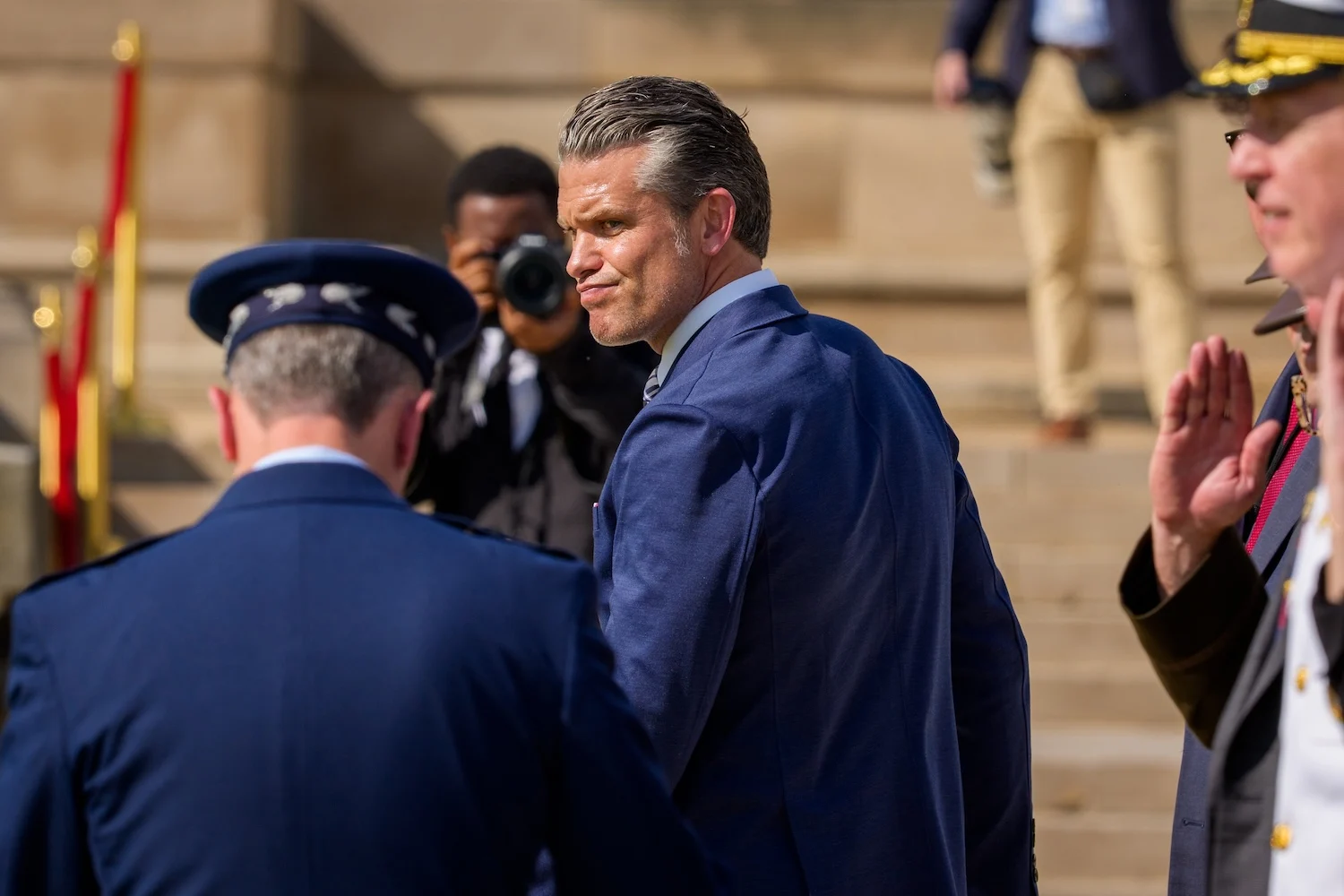
But in thinking through predictions about the second Trump administration, I’m struck that practically everybody got Pete Hegseth wrong. Is there a single person who predicted that the secretary of defense would become one of the most influential—potentially even the most effective—senior officials within the Trump administration? I can’t find one, and that’s astounding. In May, the Washington Post described Hegseth as an “emboldened, ascendant figure” within the Trump administration, while more recently the Bloomberg editorial board penned a piece on his “generational damage” to the U.S. military. And today, Hegseth’s State of the Force speech will offer him another opportunity to highlight the drastic changes he has made in how the American military approaches recruiting, training, and even combat.
Back when Trump first proposed Hegseth as his defense secretary, it prompted a wave of incredulity in the press and in Washington. Sure, Hegseth had a military background—but only as a junior officer. He’d never worked at the Pentagon. Indeed, it was very clear that his primary qualification for the job, at least in Trump’s eyes, was his extended stint as a host of Fox and Friends. His chiseled good looks and snappy suits, straight out of “central casting,” probably didn’t hurt, either.
His confirmation hearings did little to dispel the notion that Hegseth was at best incompetent. It emerged he had been fired from two different veterans’ advocacy organizations over financial mismanagement, drunkenness, and womanizing; there were allegations of worse behavior. Even his foreign-policy views were concerning, to say the least. Hegseth may have portrayed himself as a “recovering neocon” whose war-on-terror experiences purportedly left him wiser, but he also railed against “defeatist” Democrats as well as spent years campaigning for Eddie Gallagher, a veteran who was accused of multiple offenses by his members of his own platoon and acquitted of the most serious charges at his 2019 court martial.
Despite all of this, Hegseth was narrowly confirmed by Congress; many assumed he’d simply be an empty suit. And the early months of his tenure did little to disabuse people of this notion. Among his early priorities were installing a makeup studio near the press briefing room in the Pentagon, posting social media videos about new drone acquisitions, and forcing senior officers to fly halfway around the world to listen to him lecture them about physical fitness standards.
He also seemed to struggle with management. Hegseth fired several senior defense officials, accusing them of leaking sensitive information; those officials were later exonerated by an investigation. He lashed out at journalists who reported embarrassing facts about his leadership, leading one publication to describe the Pentagon, memorably, as the “Department of Defensiveness.” And perhaps most infamously, the secretary was a core participant in the Signalgate scandal, where he shared classified information about an ongoing military campaign via the messaging app.
But over time, the blunders and bureaucratic infighting at the Pentagon have faded, and Hegseth has increasingly been able to impose his will on the institution. Most notable has been his stunning success in waging an internal culture war on the military’s diversity initiatives. Not content merely to undermine existing pro-diversity programs, Hegseth has also intervened directly to block military leaders that he felt were the beneficiaries of such programs. The result is that today’s promotion lists are largely limited only to white men.
Hegseth has also tightened his control on the Pentagon by removing those he feels disagree with him on policy or raise inconvenient questions. The overall numbers are staggering: He has either fired or blocked the promotions of around 10 percent of the military’s top officers. The most recent casualty of these purges was Army Secretary Dan Driscoll, a friend of Vice President J.D. Vance and a man long perceived as a possible competitor and successor to Hegseth for the top defense job.
What, then, is driving Hegseth? His policy preferences and ideology remain remarkably opaque even at this point. Profiles of the secretary have focused primarily on his religion, suggesting he may be a form of Christian nationalist. Yet despite bringing extreme preachers to the Pentagon, and monthly prayer sessions, he hasn’t pushed much of an explicitly religious agenda.
Nor does he appear to have an explicit geopolitical or strategic set of principles. On foreign-policy questions, he has made only two significant contributions to the Trump administration’s approach to the world. The first of these is loosening the rules of engagement for the U.S. military, freeing soldiers from concerns about collateral damage and humanitarian issues. This is a cause Hegseth has been openly supportive of since he was a Fox News correspondent. As he memorably put it to journalists, there should be “no stupid rules of engagement” and “no politically correct wars.”
The second has been the war in Iran. As the war has continued, reporting has suggested widespread opposition, or at least neutrality, from other senior members of the Trump administration. Hegseth’s voice, in contrast, seems to have been instrumental in persuading the president that this war would be quick, sharp, and decisive. Thus far, the president appears more impressed by the military’s tactical successes than upset about Hegseth’s poor advice.
Rather than implement policy, Hegseth has spent his time reshaping the military through the lens of the culture war issues that have animated him since he was a student at Princeton. He has attempted to bar transgender troops from serving and openly questioned whether female soldiers should be permitted in combat. His State of the Force speech will be given in front of an audience of soldiers who must meet physical fitness and grooming standards, part of his ongoing effort to promote a fitter, leaner—and if we are honest, a more homogenous—military.
It is astounding how a man initially dismissed as a drunken buffoon—or a television talking head—has nonetheless so profoundly shaped the direction of the Trump administration’s defense policy. It is likewise notable that he remains so influential. Hegseth would appear to be the obvious sacrificial lamb for a president looking to off-load blame for the war in Iran, yet he remains ascendant. Clearly, in the eyes of the White House, he is doing something right.
Here, the explanation may be simple: Trump sees himself in Hegseth. From angry culture war posturing to his willingness to challenge the media and an obsession with image over substance, Hegseth’s qualities are fundamentally Trumpian, suited to a television personality and not a public servant. Indeed, more than anyone else in the Trump administration, the self-styled “secretary of war” is uniquely well-positioned to mimic Trump himself in this way.
Yet for the rest of us, the costs inflicted by Hegseth will not be limited only to this presidency. His disastrous war against Iran has already left the U.S. poorer and our defense posture in Asia and elsewhere weaker. The hollowing out of the military promotion chain, the destruction of civilian instruction at the war colleges, and his fixation on lethality over strategy will undermine the U.S. military over the long term. Hegseth may have taken us all by surprise as the most impactful official of the second Trump administration; the results will not be pleasant.
